Best 10 Security Awareness Content and Development Solutions For Business (2026)
We reviewed the leading security awareness content platforms on module quality, the range of delivery formats, and how well organizations can tailor content to specific roles and risk levels.
 Written by
Mirren McDade
Written by
Mirren McDade
 Technical Review by
Laura Iannini
Technical Review by
Laura Iannini
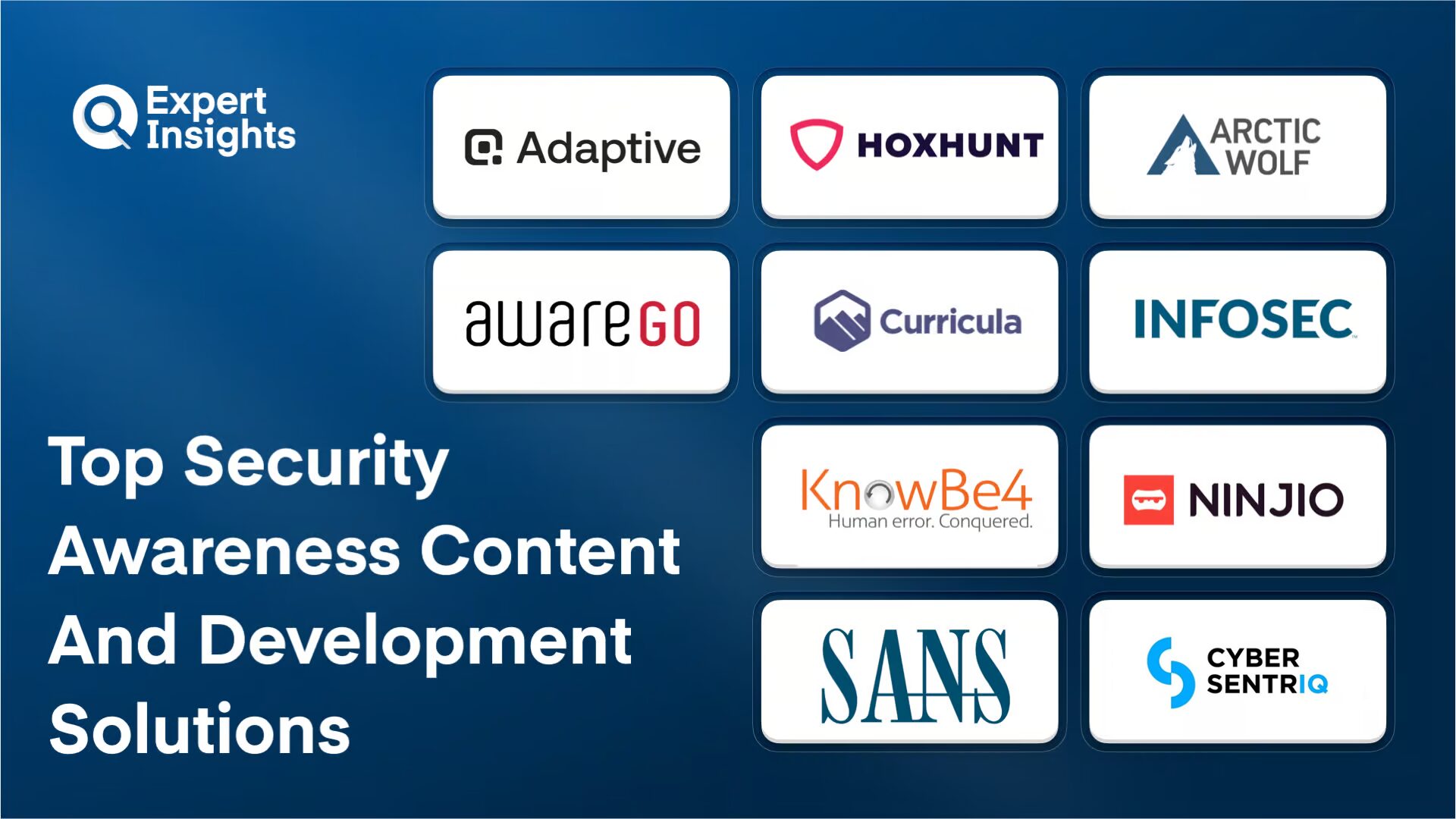
Security awareness content and development platforms provide the training modules, video content, and customization tools needed to build and maintain ongoing security awareness programs, distinct from simulation-only platforms. The quality and relevance of awareness content determines whether employees engage with training or treat it as a compliance checkbox. We reviewed the top platforms and found Adaptive Security, Hoxhunt, and Arctic Wolf Managed Security Awareness to be the strongest on content library quality and role-based customization.
Security awareness training is one of those programs where everyone agrees it matters, nobody wants to run it, and the wrong platform guarantees failure. Most teams end up with annual checkbox exercises where employees sit through mandatory modules they ignore, alongside retain nothing and forget before the video ends.
Finding awareness content is the easy part. Finding content that actually changes behavior without consuming the security team’s life. You need training that employees don’t resent, simulations that create teachable moments instead of gotcha scenarios, and platforms that surface metrics that matter to leadership, not just completion percentages.
We evaluated 10 security awareness training and simulated phishing platforms, testing each for content quality, employee engagement, customization flexibility, integration depth, and the actual usability of the admin experience. We also reviewed customer feedback to understand where platforms deliver value and where the overhead becomes a barrier to adoption. What we found: the gap between ‘engage your workforce’ marketing and the friction teams actually experience is significant.
What is Security Awareness Content and Development?
Security awareness content and development platforms provide the training materials, videos, interactive modules, and customization tools that organizations use to educate employees about cyber threats. These platforms go beyond phishing simulation by offering structured content libraries covering topics like social engineering, password security, ransomware, and compliance requirements. The goal is to deliver training that employees actually engage with and remember, not just complete.
Security awareness content platforms operate across four core capabilities: content libraries, delivery engines, customization frameworks, and engagement analytics. Content libraries range from static video modules to AI-generated scenarios reflecting current attack patterns. Delivery engines support multiple formats including micro-learning, gamified modules, narrative-driven episodes, and compliance-mapped coursework. Customization frameworks allow organizations to tailor content to specific roles, departments, risk levels, and regulatory requirements, with options ranging from template-based adjustments to full SCORM integration for uploading proprietary materials. Engagement analytics track completion rates, quiz scores, behavioral change metrics, and content effectiveness at the individual and departmental level. Advanced platforms use machine learning to personalize content delivery based on each user's performance history, adapting both difficulty and topic focus over time. Multi-language support with localized content is a key differentiator for global deployments.
Security Awareness Content and Development Solutions Compared
This table compares the key capabilities across all 10 security awareness content and development platforms we reviewed.
| Product | Best For | Type | AI Content Generation | Role-Based Delivery | SCORM Support | Multi-Language |
|---|---|---|---|---|---|---|
|
Adaptive Security
|
AI-driven simulations
|
AI-Native
|
Yes
|
Yes
|
No
|
No
|
|
Hoxhunt
|
Personalized adaptive training
|
Standalone
|
Yes
|
Yes
|
Yes
|
Yes
|
|
Arctic Wolf Managed Security Awareness
|
Managed training programs
|
Managed
|
No
|
No
|
No
|
No
|
|
AwareGo
|
European language coverage
|
Standalone
|
No
|
No
|
Yes
|
Yes
|
|
Curricula
|
Behavioral science training
|
Standalone
|
No
|
No
|
No
|
No
|
|
Infosec IQ
|
Compliance-focused customization
|
Standalone
|
No
|
Yes
|
No
|
Yes
|
|
KnowBe4
|
Content library depth
|
Standalone
|
Yes
|
Yes
|
Yes
|
Yes
|
|
NINJIO
|
Engagement-focused micro-learning
|
Standalone
|
No
|
No
|
No
|
Yes
|
|
SANS Institute
|
Industry credibility and depth
|
Standalone
|
No
|
Yes
|
Yes
|
Yes
|
|
CyberSentriq Security Awareness Training
|
MSP multi-tenant automation
|
Standalone
|
No
|
No
|
Yes
|
No
|
How We Tested
We evaluated 10 security awareness training platforms, assessing content quality and variety, enrollment workflows, admin console usability, reporting depth, and phishing simulation integration. This article was researched and written by Mirren McDade and technically reviewed by Laura Iannini, Cybersecurity Analyst at Expert Insights. Our editorial and commercial teams operate independently; no vendor can pay to influence our reviews. Read our full methodology
Adaptive Security
Best for AI-driven content and simulations
Adaptive Security is an AI-native security awareness platform built around the social engineering threats that traditional content libraries overlook: deepfake audio, video, voice, and text-based phishing. Backed by $136 million in total funding from the OpenAI Startup Fund, Andreessen Horowitz, and Bain Capital Ventures, it’s one of the fastest-moving vendors in the awareness content space. We think it’s the right call if your training content needs to reflect AI-powered attack patterns.
- Generative AI content engine builds custom simulations and training content from scratch, including deepfake audio and video scenarios.
- Content draws from real-world attack patterns rather than recycled examples, keeping material current.
- Modular campaign system supports fully custom content creation with a real-time analytics dashboard tracking user responses across every simulation type.
- Automated Slack and email notifications keep participation rates high without manual follow-up.
- Fast M365 deployment with responsive support and frequent content updates.
Customers praise the realistic, AI-driven content for keeping training current as threats evolve. The customization options let admins tailor campaigns to specific roles and access levels, and the M365 integration deploys quickly. Support is responsive and hands-on during onboarding, with most teams reporting operational deployment within days. Something to be aware of is that some customer reviews mention the interactive training module library could offer more variety beyond the simulation content.
We were impressed by how the generative AI engine keeps content aligned with real attack patterns rather than relying on aging template libraries. If your threat model includes AI-powered social engineering and your awareness content needs to reflect those risks, Adaptive addresses them more directly than any other platform we reviewed. Smaller teams focused on basic compliance training may find the AI-first approach more than they need.
Strengths
Cautions

Hoxhunt is a security awareness platform that uses AI-driven personalization and gamification to deliver training content tailored to each employee’s skill level. We think it’s a strong fit for organizations that want content to adapt to individual users rather than pushing identical modules to everyone. The platform supports over 30 languages and lets organizations build custom awareness content alongside the automated program.
- AI assesses each user’s skill level based on response history, then delivers bite-sized, interactive content focused on their weakest areas.
- Progressive difficulty model keeps experienced users challenged rather than coasting through exercises they’ve already mastered.
- Gamification with stars, badges, and company-wide leaderboards drives genuine engagement rather than checkbox completion.
- Phishing simulations deploy across email and MS Teams, with each scenario customized by role, skill level, and language.
- Supports 30+ languages for consistent global training programs.
We were impressed by the personalization depth. Content that adapts to individual skill levels is more effective than one-size-fits-all modules, and the multi-language support suits distributed workforces well. Teams that need heavy content customization or prefer a fully managed service model may want to weigh the self-service administration requirements.
Strengths
Cautions
Arctic Wolf Managed Security Awareness

Arctic Wolf
Best for managed training programs with minimal overhead
Arctic Wolf Managed Security Awareness delivers microlearning-based training for organizations that want engaging content without the management overhead. The platform combines Hollywood-style video content from their 2021 Habitu8 acquisition with a managed service model backed by the Arctic Wolf Concierge Security Team. We think it works best for teams that lack dedicated SAT resources or are replacing stale annual training.
- Short-form videos and interactive lessons with production quality reflecting the Hollywood talent behind Habitu8, delivering live-action and animated content to streaming-platform standards.
- Monthly touchpoints reinforce concepts over time rather than dumping everything into one annual session.
- Phishing simulations include integrated follow-ups with educational content, creating teachable moments rather than gotcha scenarios.
- Managed service model where Arctic Wolf handles scheduling and content rotation automatically via the Concierge Security Team.
- Compliance modules for HIPAA, FERPA, and PCI ship alongside core security content.
Customers report the training sparks actual conversations about security topics, which is a strong signal of content quality. Admins appreciate the hands-off option where Arctic Wolf handles scheduling and content rotation automatically. The Concierge Security Team works alongside customers to reduce management overhead. Something to be aware of is that some customer reviews mention limited portal access prevents managers from self-service viewing of team completion rates, and the standardized content approach requires separate tools for site-specific training.
We were impressed by the managed service model combined with genuinely high production-value content. If your team lacks bandwidth to manage an awareness program and you want content employees will actually watch, Arctic Wolf is well worth considering. Teams needing heavy customization or granular self-service reporting will find the standardized approach limiting.
Strengths
Cautions
AwareGo

AwareGo
Best for European language coverage and storytelling
AwareGo delivers security awareness training through short, story-driven video content designed using advertising industry techniques. The platform serves both SMB and enterprise customers with industry-specific modules for finance, healthcare, and insurance. We think it works well for organizations that need engaging video content with strong multilingual coverage.
- Content philosophy borrows from advertising: short videos, humor, and storytelling that make dry security topics easier to absorb.
- Library includes over 80 training lessons in 18 languages with new content released monthly.
- Human Risk Assessment tool captures employee risk data that phishing simulations alone miss.
- Drag-and-drop editor lets admins customize learning paths without technical overhead; content available through proprietary LMS or as SCORM for existing systems.
- Integrates with Slack, Teams, Active Directory, and Google Workspace.
Customers praise the Human Risk Assessment for surfacing risk data that goes beyond standard phishing tests. Setup is quick and the interface surfaces key metrics at a glance. The advertising-style content resonates with employees who tune out traditional training. Something to be aware of is that some customer reviews mention customization options feel restrictive for organizations needing tailored workflows, and phishing simulation templates lack the variety needed for repeated testing cycles.
We were impressed by the advertising-industry content approach, which keeps training short and memorable. The 18-language support with voiceovers makes localization straightforward for multinational deployments. If your employees are tuning out traditional security awareness content, AwareGo’s storytelling approach is worth evaluating.
Strengths
Cautions
Curricula

Huntress
Best for behavioral science-driven training
Curricula, acquired by Huntress for $22 million in 2022, applies behavioral science to security awareness training through story-driven content. The platform uses heroes, villains, and narrative arcs to make security concepts stick. We think it fits organizations tired of checkbox compliance training where traditional modules get ignored.
- Content library builds each module around memorable stories rather than slide decks, aligning with how people actually retain information.
- Topics span phishing, passwords, ransomware, removable media, and social engineering.
- AI hacker villain DeeDee ties phishing simulations directly into the storytelling; employees earn rewards for spotting and reporting DeeDee’s phishing attempts.
- Positive reinforcement rather than punishment-based learning creates engagement.
- Auto-syncs employee data; compliance tool integrations eliminate manual tracking of training completions.
Customers consistently praise the animations and storytelling approach for keeping employees engaged. The compliance tool integrations that auto-sync training completions draw positive feedback for reducing admin overhead. Something to be aware of is that some customer reviews mention new user enrollment requires navigating multiple screens for manual additions, and the onboarding workflow for new hires needs further simplification.
We were impressed by the behavioral science foundation and how the DeeDee villain character ties simulations directly into the learning narrative. The story-driven content genuinely makes security concepts more memorable than traditional modules. Now part of the Huntress ecosystem, the platform benefits from Huntress’s broader threat intelligence and managed service capabilities.
Strengths
Cautions
Infosec IQ

Infosec (Cengage Group)
Best for deep content customization and compliance
Infosec IQ provides security awareness content with over 3,000 training resources across 34-plus languages. Now part of the Cengage Group, the platform emphasizes customization, letting organizations tailor nearly every training element to their security policies, employee roles, and compliance requirements. We think it’s a strong choice for organizations needing deep content customization and multi-language support.
- Content flexibility lets you choose between gamified learning or traditional computer-based training depending on your culture.
- Training modules, infographics, posters, and email templates layer communications across multiple formats.
- Role-based delivery automatically routes tailored content to employees based on position and security aptitude.
- 34+ language support with localized dashboards makes this practical for global deployments.
- 70% of the Fortune 500 partner with Infosec, demonstrating proven scale.
Customers praise the content quality, noting videos avoid the AI-generated feel that makes employees tune out. The reporting capabilities get high marks for depth and personalization, and customer service is consistently flagged as responsive and open to feedback. Something to be aware of is that some customer reviews mention the web UI lacks polish, with missing basics like persistent filter settings, and content can feel repetitive over extended use.
We were impressed by the volume of customizable content and the role-based delivery system. Over 3,000 resources gives you options most platforms can’t match, and the ability to upload organization-specific content supports mature programs well. If your awareness program needs deep customization across a global workforce, Infosec IQ is well worth considering.
Strengths
Cautions
KnowBe4

KnowBe4
Best for content library depth at scale
KnowBe4 is the largest security awareness training platform on the market, with a content library of over 1,300 items across 35 languages. We think it’s the scale leader for mid-market and enterprise organizations needing proven content depth with the variety to sustain long-term engagement. The tiered access model lets you match investment to need without artificial license caps.
- Content library includes interactive modules, games, videos, and the original series The Inside Man, keeping content varied across multiple learning styles.
- Breadth of formats means teams can rotate between content types without running out of material, addressing where long-running awareness programs usually lose engagement.
- AIDA (Artificial Intelligence Defense Agents) system within the Diamond tier automates training assignments and generates custom content based on individual user risk scores.
- Science-based assessments measure security culture posture and track employee development over time.
- Active Directory integration simplifies user management for larger deployments.
Customers highlight the constantly updated content library and dedicated success managers who stay engaged beyond onboarding. The platform handles both training content delivery and phishing simulation requirements with minimal admin overhead. Recent additions including deepfake defense training show the platform keeps pace with emerging threats. Something to be aware of is that some customer reviews note KnowBe4 trails competitors on advanced gamification and customization options.
We were impressed by the content library depth and the CSM support model that reduces internal program management overhead. If you want a proven platform with content variety that won’t run dry over multiple training cycles, KnowBe4 earns its market position. Teams looking for more modern AI-driven content generation or heavy customization may find other platforms better suited.
Strengths
Cautions
NINJIO

NINJIO
Best for engagement-focused micro-learning
NINJIO delivers security awareness content through Hollywood-style animated episodes built around real breaches. The 3-4 minute micro-learning format targets behavior change through emotional storytelling rather than compliance checkbox exercises. We think it works well if employee engagement is your primary content challenge.
- Each monthly episode centers on an actual company breach, grounding abstract threats in concrete consequences.
- Animation quality reflects Hollywood talent, with both corporate and anime-style character sets available.
- NINJIO NANO condenses content to 90 seconds for time-pressed executives, adding deployment flexibility.
- Content streams or downloads to any device; gamification through leaderboards rewards employees who complete episodes quickly and pass quizzes on first attempt.
- Content is also licensed by other SAT providers, which speaks to its quality in the market.
Customers consistently highlight the storytelling approach as memorable and engaging. The real breach examples make threats tangible in ways that generic training content misses. Employees actually watch these rather than clicking through to completion. Something to be aware of is that the short episode format limits depth of coverage on complex topics, and interactivity is limited beyond video watching and post-episode quizzes.
We were impressed by the production quality and how real breach examples ground each lesson in actual consequences. If your employees are tuning out traditional awareness content, NINJIO’s storytelling approach cuts through the noise. Teams needing hands-on interactive elements or deep topic coverage will want to supplement with additional training tools.
Strengths
Cautions
SANS Institute

SANS Institute
Best for industry credibility and depth
SANS Institute brings its reputation for professional security training to the awareness content space. The platform offers over 50 training modules across 34-plus languages with tiered campaigns targeting different groups within your organization. We think it fits organizations that value the credibility and depth that SANS’ security expertise brings to awareness content.
- Content reflects SANS’ deep security background, a meaningful differentiator from vendors with a marketing or HR background.
- Phishing library is extensive and continuously updated to match evolving threats; customizable simulation campaigns let you tailor scenarios to your environment.
- Tiered campaign structure helps target specific roles without pushing generic content to everyone; industry-specific modules address sector requirements.
- Delivery options include live, on-demand, and in-person training.
- Supports deployment through the SANS-hosted LMS or your own SCORM-compliant system.
Customers praise the hands-on approach over pure theory, and instructors get consistently high marks for experience and expertise. The variety of delivery options gives flexibility for different learning preferences. Something to be aware of is that some customer reviews mention poor onboarding support with unanswered requests for SCORM files and missed implementation timelines. Pricing sits at the premium end, which may require organizational sponsorship for budget approval.
We were impressed by the credibility that SANS’ security expertise brings to awareness content. The 34-plus language support and customizable campaigns work well for global, complex environments. If instructor quality and industry credibility matter to your program, SANS delivers on both. Teams needing responsive onboarding support should factor in the inconsistency flagged in customer feedback.
Strengths
Cautions
CyberSentriq Security Awareness Training

CyberSentriq
Best for MSP multi-tenant automation
CyberSentriq Security Awareness Training combines security awareness training content with real-time phishing simulation in a platform built for MSPs and mid-market organizations. Launched after TitanHQ acquired Cyber Risk Aware in early 2022, the platform offers automatic campaigns, SCORM compliance, and unlimited access to training materials at an affordable price point. We think it works well for MSPs managing multiple clients or teams wanting set-and-forget automation.
- Automatic campaign scheduling reduces ongoing management overhead; once configured, training runs without constant attention.
- Unlimited access to training materials removes consumption concerns; content library updated weekly with new courses and modules.
- Its phishing simulation engine handles simulation and analysis; compromised email reports identify exposed accounts.
- PhishHuk Alert Button integrates directly into inboxes for reporting suspicious emails.
- GDPR and international data protection training ships alongside core security content.
MSPs highlight the automatic campaign features and reasonable pricing as key differentiators. Customers praise the low-maintenance model and content quality. Rolling out training across client environments is straightforward. Something to be aware of is that some customer reviews note support consistency varies, with some tickets and feature requests sitting untouched for extended periods. M365 tenant setup also takes longer than some competing platforms.
We were impressed by the unlimited content access at an affordable price point, which makes budgeting predictable for MSPs managing multiple client environments. The weekly content updates keep the library current without requiring admin effort. Teams needing responsive support should factor in the inconsistency flagged in customer reviews.
Strengths
Cautions
Security Awareness Training Pricing
Pricing for security awareness content platforms varies by vendor, organization size, and contract terms. Many platforms are quote-based, particularly at enterprise scale. The table below reflects publicly available starting prices where we could verify them; contact vendors directly for tailored quotes.
| Product | Starting Price | Billing | Link |
|---|---|---|---|
|
Adaptive Security
|
Contact for quote
|
Annual
|
|
|
Hoxhunt
|
Contact for quote
|
Annual
|
|
|
Arctic Wolf Managed Security Awareness
|
Contact for quote
|
Annual
|
|
|
AwareGo
|
From $1.40/user/month (Premium)
|
Annual
|
|
|
Curricula
|
Contact for quote
|
Annual
|
|
|
Infosec IQ
|
From $15/user/year (100-499 learners)
|
Annual
|
|
|
KnowBe4
|
From $1.30/user/month (Silver tier)
|
Annual
|
|
|
NINJIO
|
From $2/user/month
|
Annual
|
|
|
SANS Institute
|
Contact for quote
|
Annual
|
|
|
CyberSentriq Security Awareness Training
|
Contact for quote
|
Annual
|
|
Security Awareness Training Checklist
These are the configuration and operational steps we recommend when selecting and deploying security awareness content.
Production quality and engagement style vary dramatically between vendors; a demo or trial is the only way to know if employees will watch or click through.
Generic modules pushed to everyone create disengagement; content tailored to job function and risk level is more relevant and more effective.
Subtitles are not the same as localized content; voiceovers and culturally adapted examples drive better engagement for non-English speakers.
Stale content that references outdated threats loses credibility with employees and reduces training effectiveness over time.
Platforms that auto-enroll users who fail simulations into targeted training close the loop between testing and education.
Organizations with internal policies, sector-specific regulations, or proprietary training materials need the ability to integrate them alongside vendor content.
Some platforms require significant manual effort for enrollment, scheduling, and reporting; managed services eliminate this but limit customization.
Platforms that generate reports mapped to HIPAA, PCI DSS, GDPR, or SOC 2 save significant time during compliance audits.
Short, focused modules improve completion rates and retention; employees are more likely to engage with content that respects their time.
Quiz scores, reporting rates, and behavioral change data show whether content is driving real awareness, not just checkbox compliance.
The Bottom Line
The best awareness platform depends on your team size, budget, language requirements, and how much administrative overhead you can absorb. There’s no universal solution. For organizations facing AI-powered social engineering threats, Adaptive Security builds custom deepfake and voice phishing simulations that go well beyond standard email templates. If personalized, behavior-driven training is the priority, Hoxhunt adapts difficulty to each employee and uses gamification to sustain engagement across distributed teams. For managed service with minimal overhead, Arctic Wolf Managed Security Awareness delivers quality content and automated scheduling. KnowBe4 offers the largest content library (1,000+ items) and remains the scale leader for mid-market and enterprise organizations. If behavioral science and storytelling matter, Curricula makes security concepts stick. Infosec IQ delivers if customization across 34 languages and 2,000+ resources is your priority. For engagement-focused approaches, NINJIO and AwareGo use storytelling and humor to cut through training fatigue. SANS Institute brings unmatched credibility for organizations valuing industry expertise and hands-on training. For MSPs managing multiple clients, CyberSentriq Security Awareness Training automates campaigns and simplifies multi-tenant operations. All these platforms integrate phishing simulations. Read the individual reviews above to dig into content variety, customization depth, and the implementation overhead that matters for your team.
Security Awareness Content And Development: Everything You Need To Know (FAQs)
Security Awareness Content And Development solutions are training programs deployed by IT admins for their company’s users to train them on potential cybersecurity risks and dangers, and what actions they can take to mitigate and prevent those risks. It’s important to have your employees properly trained on potential cybersecurity risks, as often the only thing that ends up standing in the way of a security breach and your company is your users.
There are a huge number of Security Awareness solutions on the market today, coming in a variety of shapes and sizes. In the majority of cases, training is delivered via a series of short, online course with multiple modules that cover areas of potential risk within a company and what users can do to prevent serious breaches and data leaks from happening.
Important topics will cover things like email phishing scams (malicious emails sent by attackers that carry malware or links to harmful websites), educating employees on what they are, how to spot one, and to respond accordingly when they get one in their inbox. Many may include simulation, involving sending realistic-looking phishing emails to users, designed to test people’s ability to spot the real thing.
While email-borne threats are often the focus of these training sessions, programs also cover a range of other topics which can prove useful, which we’ll look at a bit later.
These solutions work to promote more security conscious behaviors in users by delivering engaging, digestible, and effective training designed to improve awareness of cyber security risks and make second-guessing and evaluating all communications they receive a standard practice. Cyber attacks are ever changing and unavoidable; your workforce will undoubtedly be approached by threat actors looking to exploit them for assets or information, and since you can’t prevent this communication from happening you owe it to your workforce to put them in the very best position to deal with it. A solution designed to educate them on potential security threats and what they should do if a mistake is made, or a breach is carried out, is essential to supporting organization-wide security.
Phishing
Clicks or downloads from phishing emails are how most malware gains entry to company networks, with 32% of all successful breaches involving the use of phishing techniques and 91% of all attacks starting out with a phishing email. The increasing cost required to successfully penetrate software means it is becoming more and more common for attackers to focus on methods like phishing to trick users, capitalizing on the prevalence of human error.
It is important for employees to recognize the signs of a phishing attack and to have a process in place to report such attacks when they spot them. Many SAT programs offer phishing simulation exercises that make use of a library of phishing email templates to give employees the know-how to spot the common signs of a phishing attempt.
The best security awareness training solutions offer hundreds of phishing templates so you can simulate a variety of different types of malicious emails (including ones with attachments, embedded links and requests for personal data). They will also provide reporting which shows how effective each individual user is at avoiding the pitfalls. This allows you to identify those in your organization most in need of SAT and provide them with additional support.
Social Engineering
Social engineering techniques are non-technical methods of accessing your networks and systems using tricks and manipulation. Email phishing is the most prevalent example of social engineering, but there are other lesser-known examples (spear phishing, baiting, malware, pretexting, tailgating, vishing, water-holing) that employees should be able to recognize.
Attacks involving phishing or social engineering account for 32-33% of all cyber security attacks, so ensuring that your employees are aware of the potential pitfalls is valuable. To best protect against social engineering, we recommend looking for an SAT solution designed specifically to train the parts of the brain associated with threat detection and response, using humor and repetition to train employees to resist manipulative exploitative techniques. You can read our guide to the top phishing awareness training solutions here.
Working Remotely Safely
Countless organizations worldwide made the decision to have their employees work from home after the outbreak of COVID-19 and many of them will continue allowing remote working going forward. Due to this, SAT for remote workers has become a priority for many organizations who understand how vital it is to maintain their cyber-hygiene.
Cyber attackers tend to look for easy vulnerabilities to exploit in their attempts, so its unsurprising that some 91% of businesses saw a spike in the volume of cyber-attacks being directed their way after the pandemic hit. Employees moving their workspace from the office to their homes led to an adjustment period, as businesses and workers struggled to make the necessary changes quickly and safely. This created the perfect opportunity for cybercriminals to take advantage.
For companies concerned about how the move from office-life to remote working has impacted their security, training for their remote employees is a worthwhile investment. Many security awareness training providers offer remote working training as a part of their content library, allowing you to ensure your workers are securely adjusted and able to stay vigilant against attacks and risky behaviors in their new working environment.
Safe Internet and Social Media Habits
As our world becomes more and more digitally connected, secure browsing know-how has become essential knowledge. Learning the importance of using varied passwords, not sharing personal information like our dates of birth or our first pets’ names on social media, and not connecting to public Wi-Fi may seem obvious, but for plenty of less technically inclined workers, an SAT solution which covers these topics can be very helpful. Employing safe internet habits – in all contexts, but particularly at work – is an excellent way to boost overall business security.
This need for a savvy, well-informed approach extends also to social media. Employees typically know the policies in place covering their use of social media at work, but it is important that they also take steps in their personal lives to remains safe and secure. A strong security mindset at home will help users to have a better approach to security issues in the workplace.
Insider Threats
When it comes to a malicious employee who has infiltrated your business for nefarious purposes, there is no amount of training that can prevent this outright. However, by providing employees with training that teaches them about the common indicators and behaviors that may signal a potential insider threat, you will encourage them to feel comfortable coming forward to share their concerns.
Insider threats are a less common issue facing businesses; they are not nearly as prevalent as, say, email phishing attacks. But still, with 68% of organizations considering themselves moderately to extremely vulnerable to insider attacks, it is clearly a risk worth considering. There are awareness training providers available which include insider threat training, but these are typically included in more enterprise-focused solutions.
Incident Reporting
If a security incident does occur – whether it be deliberate or accidental – employees have the potential to make a massive difference to the outcome through their reactions. When employees feel empowered to come to you with their concerns and understand what steps they should take when they suspect they may have made a mistake, this could save you precious time and allow you to take action sooner to mitigate the damage.
There are security awareness training solutions available that put a lot of emphasis on the goal of fostering a culture of reporting. Strong solutions will cover the common ways sensitive information may be compromised, which information is considered ‘protected’, examples of incidents that may occur (both in physical workspaces and digitally) as well as the appropriate actions to take after an incident has been reported.
Business Laws and Regulations
There are a number of private industry guidelines and regulations that exist to keep valuable and sensitive information secure. Not every organization will follow the same laws and regulations, but certain industries (finance, legal, healthcare) will need particular support as there are a number of important legal regulations to cover.
Your employees likely will not need to be experts on these rules, but they may need to be kept up to date on how the rules apply to your organization directly.
Data Privacy Practices
Data privacy and good cybersecurity should always go together. While many users will have no issues recognizing which pieces of information count as personal or sensitive and will understand how to handle, store and dispose is this information, this may not be the case for every employee. Part of your security awareness initiative and training should certainly cover these basics.
On average the cost of a data breach in 2021 was $4.24 million, a 10% increase from 2020. Researchers found that around 88% of all data breaches could be traced back to human error. Worrying statisitcs like these are usually all that is needed to illustrate to people the importance of SAT, but it is true that not everyone is convinced.
For some, the expenditure of time and money it takes to put employees through SAT is enough to put them off the idea, especially since no amount of training can eliminate the possibility for error altogether. However, there are several studies available indicating that using SAT (including ongoing training to keep up with the constantly evolving methods used by cybercriminals) can result in an up to 70% reduction in the risk of socially engineered cyber threats. Considering the potential massive cost and other serious repercussions to a successful cyber-attack, any action an organization can take to significantly reduce their window for error is a worthwhile investment.
There are more benefits to utilizing SAT beyond the prevention of breaches. Some of these include:
Creating A Culture Of Security
What we mean by creating a culture of security, is that the values you want to instill in your employees (such as the importance of security) become woven into the fabric of your business. Using interactive training and making an ongoing investment in the education of your workforce on matters of security is an excellent way to nurture their sense of personal investment in the wellbeing of the company and to promote the notion that they are the first line of defense against cyberthreats.
Supporting Your Technological Defenses
We strongly recommend that alongside security awareness training you have a strong layer of technological protection in place, including a secure email gateway, and endpoint protection. These defenses are highly valuable in your efforts to prevent breaches; however, knowledgeable people are required to keep these defenses running to their full potential.
Also, attackers today are not targeting only through technological means. Today’s cyber attackers understand that people are easier to hack than technology. So, the best thing you can do is make sure both your technology and your people are up to date security-wise and able to work in conjuncture with each other to keep your organization safe.
Customer Confidence
The very real threat of cyber-attack is not news to most customers these days. People are aware of the persistence of these attackers and understand what consequences there may be if a business they are a customer of is successfully breached. A survey found that 43% of the companies taking part in the study had suffered reputation loss and negative customer experiences as a result of a successful cyber-attack.
Customers do in fact take notice of a business’s security credentials, so taking proactive steps towards improving cyber security is likely to inspire a greater level of trust and loyalty.
Compliance
Implementing SAT may be, for some industries, a regulatory requirement. But organizations should be wary of considering SAT a necessary compliance rather than a beneficial security measure and risk doing the bare minimum. You will get the most out of your SAT if you view it not as a checking boxes exercise, but as a worthy investment into your security and your people.
Awareness And Shared Responsibility – Not Blame Shifting
There are some problems with security awareness training to be aware of. Some businesses rely too heavily on SAT; placing the bulk of the pressure onto employees not to fall for scams, thereby abdicating their responsibility to protect the business and its employees. Security against digital risks is a responsibility that all employees within the organization can play a part in maintaining, but there is a risk that reliance on SAT may lead to users disproportionately receiving blame if a data breach does occur.
Creating a culture of fear and blame when it comes to security may undermine your efforts to form a trusting relationship with your employees and strengthen your security culture. Too much fear of punishment for mistakes could lead to users feeling resentful, perhaps even too intimidated to come forward quickly if they suspect a mistake has been made.
Security Awareness Training Resources
Further reading on security awareness training from Expert Insights — buyers' guides, comparison articles, and platform-specific shortlists.


 Written By
Mirren McDade is a senior writer and journalist at Expert Insights, spending each day researching, writing, editing and publishing content, covering a variety of topics and solutions, and interviewing industry experts.
She is an experienced copywriter with a background in a range of industries, including cloud business technologies, cloud security, information security and cyber security, and has conducted interviews with several industry experts.
Mirren holds a First Class Honors degree in English from Edinburgh Napier University.
 Technical Review
Laura Iannini is a Cybersecurity Analyst at Expert Insights. With deep cybersecurity knowledge and strong research skills, she leads Expert Insights’ product testing team, conducting thorough tests of product features and in-depth industry analysis to ensure that Expert Insights’ product reviews are definitive and insightful.
Laura also carries out wider analysis of vendor landscapes and industry trends to inform Expert Insights’ enterprise cybersecurity buyers’ guides, covering topics such as security awareness training, cloud backup and recovery, email security, and network monitoring. Prior to working at Expert Insights, Laura worked as a Senior Information Security Engineer at Constant Edge, where she tested cybersecurity solutions, carried out product demos, and provided high-quality ongoing technical support.
Laura holds a Bachelor’s degree in Cybersecurity from the University of West Florida.