Best 12 Cyber Threat Intelligence Solutions For Enterprise (2026)
We reviewed 12 cyber threat intelligence platforms on the relevance and freshness of intelligence, how well each integrates with SIEM and SOAR tools, and whether the output drives faster response or just adds to the analyst reading list.
 Written by
Alex Zawalnyski
Written by
Alex Zawalnyski
 Technical Review by
Laura Iannini
Technical Review by
Laura Iannini
Cyber threat intelligence (CTI) solutions are designed to provide businesses like yours with timely, actionable, and relevant intelligence on potential cybersecurity threats, allowing them to take action before an attack occurs.
Automation is a key feature for many of these solutions. While most vendors provide a combination of automation and specialist analysis services, these solutions can actively scan, analyze, and feed back intelligence at a much faster rate than a human analyst can.
But each cyber threat intelligence solution works slightly differently. Some might shine for their advanced automation capabilities, and others might be better suited to organizations that are looking for more of a human-led approach.
Throughout our guide, we’ve included a range of the most dynamic, innovative, and powerful cyber threat intelligence solutions on the market.
What is Cyber Threat Intelligence?
Cyber threat intelligence is information about current and emerging threats to your organization, collected and analyzed so your security team can act on it. This includes data on threat actors, their tools and techniques, malware campaigns, leaked credentials, and indicators of compromise. CTI platforms gather this information from sources across the open web, dark web, and deep web, then deliver it in a format your security tools can use to improve detection and speed up response.
CTI platforms operate across tactical, operational, and strategic intelligence tiers. Tactical intelligence delivers machine-readable indicators of compromise, including malicious IPs, domains, hashes, and URLs, in standardized formats like STIX/TAXII for automated ingestion into SIEMs, EDR, and SOAR platforms. Operational intelligence covers active campaigns, adversary infrastructure, and malware families with enough context to inform detection rule authoring and threat hunting. Strategic intelligence provides curated assessments of adversary motivations, geopolitical factors, and targeting patterns that shape executive decision-making and resource allocation. Platforms differentiate on source coverage, which ranges from structured feeds and open-source intelligence to dark web forum monitoring and human intelligence networks; enrichment depth, which determines how much context each indicator carries; and automation maturity, which determines whether intelligence drives automated response or simply populates dashboards. The strongest platforms close the loop between intelligence and action by integrating directly with detection and response tools.
Cyber Threat Intelligence Solutions Compared
The table below compares the 12 cyber threat intelligence platforms we reviewed across key capability areas.
| Product | Best For | Type | Dark Web Intel | APT Tracking | Automated Enrichment | Managed Service |
|---|---|---|---|---|---|---|
|
ESET Threat Intelligence
|
Structured APT intelligence at accessible pricing
|
CTI Service
|
No
|
Yes
|
Yes
|
No
|
|
Flare
|
Dark web monitoring with active remediation
|
TEM Platform
|
Yes
|
No
|
Yes
|
No
|
|
Cyble Vision
|
AI-native threat intel with deep dark web and APT coverage
|
CTI Platform
|
Yes
|
Yes
|
Yes
|
No
|
|
CrowdStrike Adversary Intelligence
|
Organizations running CrowdStrike products
|
CTI Platform
|
Yes
|
Yes
|
Yes
|
Yes
|
|
ManageEngine Log360
|
Hybrid environments needing unified SIEM and compliance
|
SIEM + CTI
|
No
|
No
|
Yes
|
No
|
|
Cyware TIP
|
Enterprise SOCs managing multiple threat feeds
|
TIP
|
No
|
No
|
Yes
|
No
|
|
IBM Security X-Force
|
Managed intelligence paired with incident response
|
Managed CTI
|
Yes
|
Yes
|
Yes
|
Yes
|
|
Google Cloud's Mandiant
|
Expert-backed intelligence with managed detection
|
Managed CTI
|
Yes
|
Yes
|
Yes
|
Yes
|
|
NordStellar
|
Consolidated dark web monitoring and ASM
|
TEM Platform
|
Yes
|
No
|
Yes
|
No
|
|
Palo Alto Cortex XSOAR
|
Organizations running Palo Alto products
|
SOAR + TIM
|
No
|
No
|
Yes
|
No
|
|
Recorded Future
|
Broad, multilingual intelligence with dark web coverage
|
CTI Platform
|
Yes
|
Yes
|
Yes
|
No
|
|
ZeroFox
|
Brand impersonation and dark web exposure risks
|
DRP
|
Yes
|
No
|
Yes
|
Yes
|
How We Tested
We assessed each platform across threat detection coverage, intelligence sources, automation capabilities, integration options, and managed services availability. We reviewed customer feedback and conducted vendor briefings to understand coverage strategies and limitations. This article was researched and written by Alex Zawalnyski, with technical review by Laura Iannini. Read our full methodology


ESET
Best for structured APT intelligence at an accessible price point
ESET Threat Intelligence is a threat intelligence service focused on APT group tracking and curated threat feeds. We think it is a strong fit for security teams that need structured nation-state intelligence without enterprise-scale pricing.
- Persistent monitoring of APT groups operating out of Russia, China, North Korea, and Iran
- Curated feeds provide structured intelligence beyond raw IOCs, giving your team context on adversary behavior and tactics
- Automated threat investigation keeps intelligence flowing without manual triggers
- Premium tier includes direct analyst access for hands-on threat discussions; entry-level pricing starts at $211 per five users per year
Customers describe the platform as mature and well thought out, with easy integration into existing environments. Long-term loyalty gets mentioned repeatedly, with some customers citing over a decade of use. Something to be aware of is that the UI feels cluttered and harder to navigate than competitors, and the platform is focused on APT intelligence rather than broader threat exposure management.
If your team needs structured APT intelligence at an accessible price point, ESET is well worth considering. Entry-level pricing starts low enough that smaller teams can justify the investment, and the premium tier opens direct analyst access for deeper collaboration.
Strengths
Cautions
Flare


Flare
Best for dark web monitoring with active remediation capabilities
Flare is a threat intelligence and dark web monitoring platform built for tracking cybercrime exposure across thousands of sources. We think the combination of deep source coverage and autonomous remediation sets it apart from platforms that stop at alerting.
- Monitors cybercrime forums, dark web marketplaces, and over 58,000 Telegram channels while archiving content for investigation even after takedowns
- Autonomous remediation moves beyond passive monitoring into active threat response
- Enrichment layer adds context to alerts, helping analysts triage faster without switching tools
Long-term users praise the alerting system and the actionable guidance that comes with each alert. Support gets consistently high marks, with customers noting the team actively incorporates feedback. Something to be aware of is that the interface has a learning curve, especially for GUI-focused workflows, and documentation lacks practical examples around search query syntax.
If your organization needs dark web monitoring that goes beyond passive intelligence into active remediation, Flare fits that need. The archived content capability is particularly useful for investigations where source material disappears quickly.
Strengths
Cautions
Cyble Vision

Cyble Vision
Detailed, reliable threat intelligence for organizations of all sizes
Cyble Vision is a leading threat intelligence platform that combines AI-driven analysis and continuous threat monitoring to provide real-time protection against threat actor activity and brand impersonation.
Cyble Vision uses proprietary technology to collect data signals across the dark web, deep web, and surface web at a petabyte scale, in real time. It processes and enriches that data to provide insights into potential and existing threats to your organization. This solution stands out for the depth of information it provides on relevant threat vectors, threat actor engagement, and threat actors’ tactics, techniques, and procedures (TTPs).
- Tracks third-party threats and security risks via an easy-to-understand scoring mechanism
- Automatically filters and prioritizes alerts by identifying sentiment, malicious language, and the exposure of sensitive data
- Protects against brand impersonation by identifying your branding in images across digital platforms, and using facial recognition to prevent C-suite impersonation on social media
- Automatically generates threat landscape and advisory reports, and delivers them via a clear, intuitive dashboard
- Helps you remediate threats with malware analysis and reverse engineering, forensic investigation support, and takedown services
- Blaze AI, Cyble’s agentic AI engine, automates threat hunting, correlation, and investigation
Cyble Vision is an advanced solution that enables organizations to mitigate cyber risks before they develop into threats. It provides in-depth visibility into potential threats and attack vectors, all whilst being easy to manage and straightforward to integrate with your domain and existing vulnerability management tools.
This solution stands out for the depth of information it provides on relevant threat vectors, threat actor engagement, and threat actors’ tactics, techniques, and procedures (TTPs).
We also like how tightly Vision integrates with Cyble’s wider services: when it surfaces a phishing domain or brand impersonation, the takedown, forensics, and investigation support to act on it sits in the same ecosystem. Cyble was named a Challenger in the 2026 Gartner Magic Quadrant for Cyberthreat Intelligence Technologies. We recommend Cyble Vision for organizations of all sizes looking for detailed, reliable threat intelligence.
Strengths
Cautions
CrowdStrike Adversary Intelligence


CrowdStrike
Best for organizations already running CrowdStrike products
Founded in 2011, CrowdStrike is a global provider of cloud-native security solutions and is particularly well known for its endpoint protection platform. CrowdStrike Adversary Intelligence, formerly Falcon X, is a threat intelligence platform that combines dark web monitoring, adversary profiling, and automated threat analysis. What sets CrowdStrike apart is its detailed and contextualized integrated threat intelligence, which provides not only details of an attack but also the wider motivation and expertise of the threat actor behind it, helping admins strengthen their defense. We think Adversary Intelligence slots in naturally for organizations already running CrowdStrike products.
- Pre-built incident response playbooks accelerate SOC workflows without custom development
- Tracks 281+ adversaries across open, deep, and dark web layers
- Advanced malware sandbox with AI-powered analysis and classification
- Threat intelligence feeds deliver structured IOCs that map to MITRE ATT&CK
Customer feedback here draws from the broader CrowdStrike platform rather than Adversary Intelligence specifically, which makes isolating module-specific strengths harder. The fast, thorough, and accurate intelligence gets positive marks, as does the option for a dedicated intelligence team in the premium tier. Something to be aware of is that full value often requires investment in additional CrowdStrike products, and module-specific assessment is harder given the platform-wide feedback.
If your organization already runs CrowdStrike products, Adversary Intelligence slots in naturally and extends your existing investment. The pre-built playbooks and adversary profiling reduce the time to operationalize intelligence. Standalone buyers should weigh the value against the platform dependency.
Strengths
Cautions
ManageEngine
Best for hybrid environments needing unified SIEM, DLP, and compliance reporting
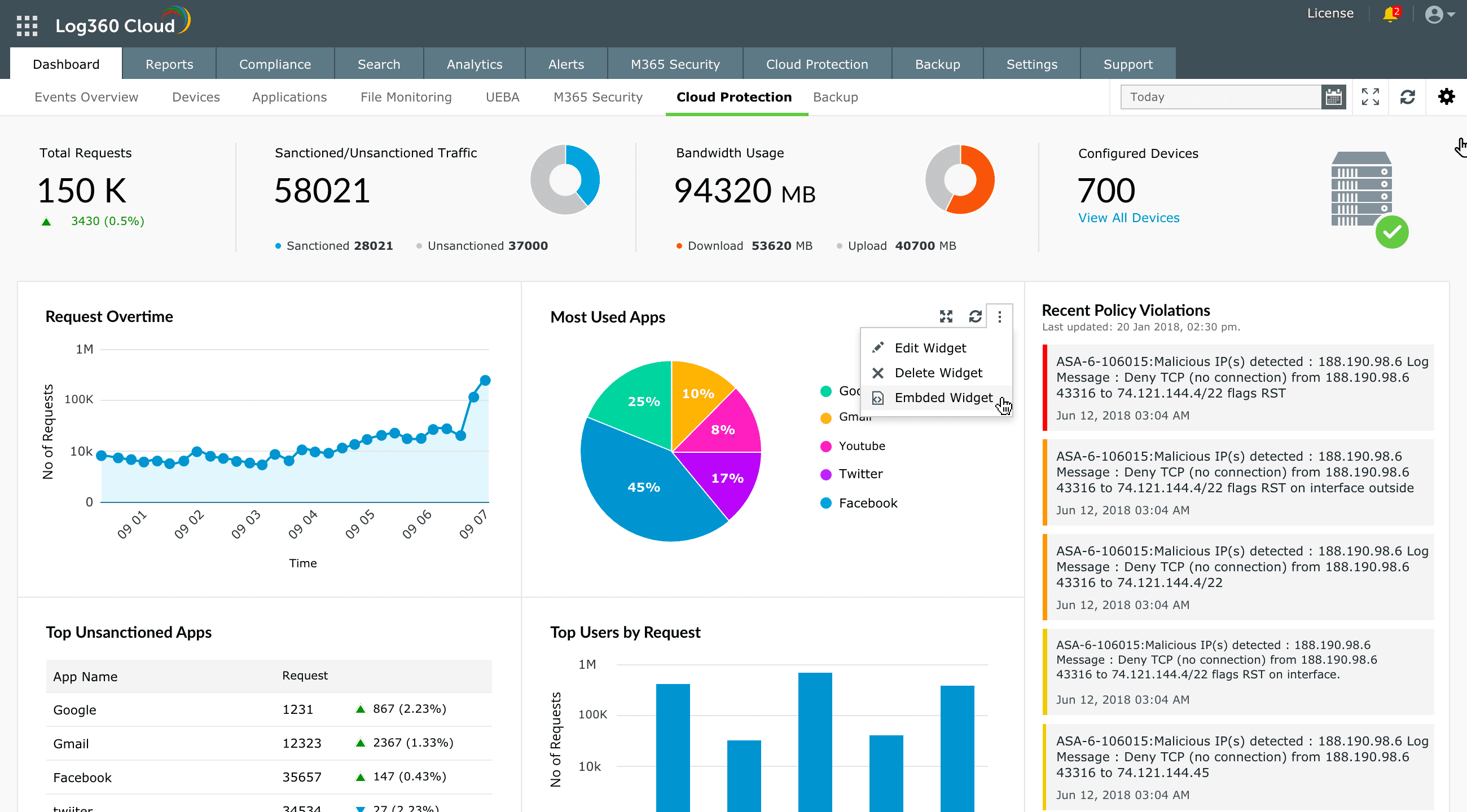
ManageEngine, the IT management division of Zoho Corporation, offers Log360: a unified SIEM, DLP, and CASB solution focused on detecting, prioritizing, investigating, and responding to security threats. The platform deploys machine learning-based anomaly detection, threat intelligence feeds, and rule-based attack detection to identify advanced threats across on-premises, cloud, and hybrid networks.
- Collects and analyzes logs from end-user devices, servers, firewalls, and IPS systems, presenting findings through intuitive dashboards and graphical reports
- Vigil IQ engine handles Threat Detection, Investigation, and Response using real-time correlation, UEBA, and MITRE ATT&CK framework mapping
- SOAR capabilities compile security data into a single console and automate threat resolution workflows
- Real-time auditing of critical Active Directory changes and visibility into cloud infrastructures across AWS, Azure, Salesforce, and Google Cloud Platform
- Audit-ready report templates and violation alerts aligned to HIPAA, PCI DSS, GLBA, FISMA, ISO 27001, and SOX
We recommend Log360 for organizations that need comprehensive security analytics and threat intelligence with strong compliance reporting. The combination of SIEM, UEBA, and SOAR in one platform reduces the tool sprawl that comes with managing separate point solutions. The MITRE ATT&CK mapping and Vigil IQ engine give SOC teams a structured approach to threat detection and investigation. If you operate across hybrid environments and need centralized visibility with compliance coverage, Log360 is worth evaluating.
Strengths
Cautions
Cyware Threat Intelligence Platform
Cyware
Best for enterprise SOC teams managing multiple threat intelligence feeds
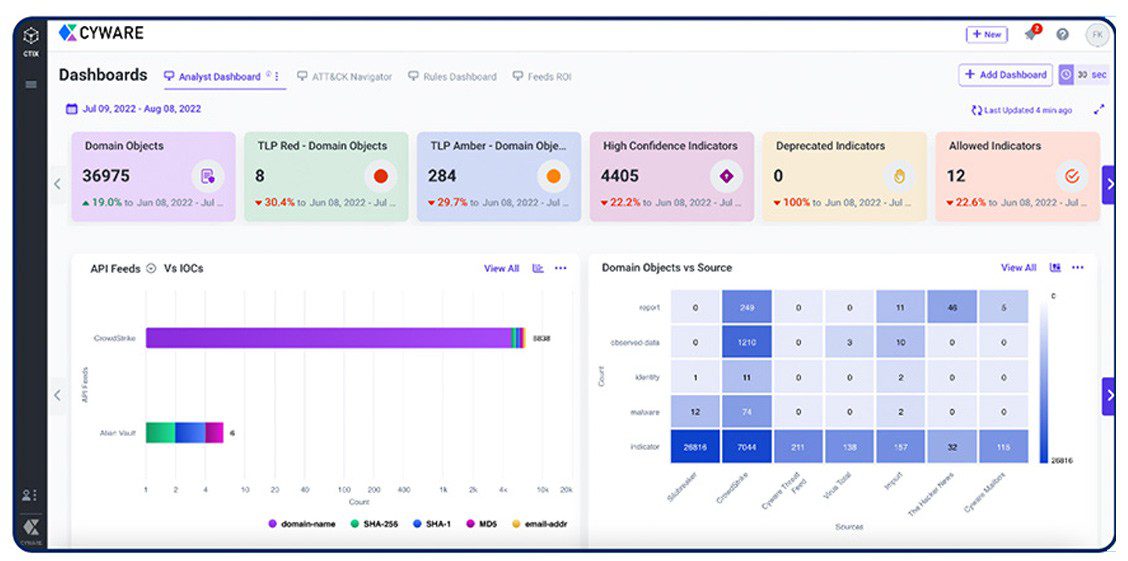
Cyware TIP, now branded as Cyware Intel Exchange, automates the threat intelligence lifecycle from ingestion through actioning, with a focus on enterprise SOC teams managing multiple intelligence feeds. We think this fits best in enterprise environments with established SOC operations.
- Multi-source intelligence ingestion and automatic enrichment pipeline pulls in threat data from commercial, open-source, and community feeds, deduplicates and enriches it, and pushes actionable intelligence to connected tools
- Bidirectional sharing with trusted communities uses STIX/TAXII standards
- ROI dashboard provides measurable visibility into threat feed effectiveness
- Direct integration with SIEM, EDR, MDR, and vulnerability management tools closes the loop between intelligence and action
Customers at large enterprises in banking, travel, and services highlight the deduplication and enrichment capabilities as key strengths. Something to be aware of is that bugs and integration issues, particularly with CTIX tooling, are noted, and platform complexity requires onboarding investment for teams new to TIP workflows.
We think this fits best in enterprise environments with established SOC operations. If your team manages multiple threat intelligence feeds and needs to automate ingestion, enrichment, and actioning, Cyware TIP delivers that workflow in a single platform.
Strengths
Cautions
IBM Security X-Force

IBM
Best for managed intelligence paired with incident response
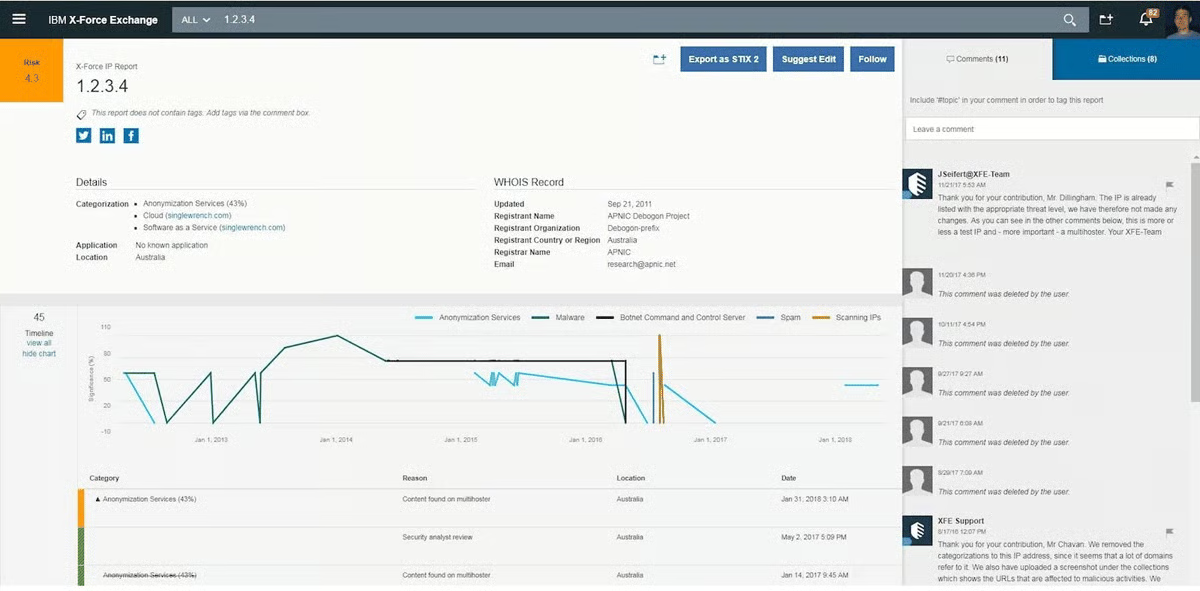
IBM is one of the world’s largest technology providers, making it a strong option for organizations looking for an enterprise-grade, end-to-end threat management solution. IBM Security X-Force is a managed cybersecurity services suite that combines threat intelligence, incident response, adversary simulation, and offensive security capabilities. The platform includes the X-Force Threat Intelligence Index and personalized threat scoring to help organizations prioritize their security investments. We think X-Force delivers the most value for enterprises that need managed threat intelligence paired with incident response capabilities.
- X-Force Exchange and Threat Intelligence Insights combine real-time threat feeds, curated research, and structured IOCs
- Threat forecasting surfaces emerging vulnerabilities before widespread exploitation
- Covers the full threat lifecycle from intelligence through response and recovery
- Offensive security services including adversary simulation and cyber range training
Customers in enterprise environments, particularly banking and semiconductors, highlight the platform’s ability to surface emerging threats with actionable context. The breadth of services across intelligence, response, and offensive security gets positive marks. Something to be aware of is that the managed service model requires sharing organizational data with a third-party provider, and customer feedback is broadly positive but lacks detailed critical insight on specific limitations.
If your enterprise needs managed threat intelligence paired with incident response and offensive security capabilities, X-Force delivers depth that few competitors match. The full lifecycle coverage from intelligence through simulation and response is a genuine differentiator at enterprise scale.
Strengths
Cautions
Google Cloud's Mandiant


Google Cloud
Best for expert-backed intelligence with managed detection
Founded in 2004, Mandiant is an established cybersecurity company that specializes in threat intelligence and visibility into cyber attacks. Acquired by Google in September 2022, Mandiant Threat Intelligence is now an enterprise-grade intelligence platform backed by one of the most recognized incident response and threat research teams in the industry. The platform manages the collection, analysis, curation, and dissemination of threat intelligence across structured and unstructured sources. Mandiant Threat Intelligence is available via three subscription tiers: Free, Security Operations, and Fusion. We think Mandiant fits enterprises that need expert-backed threat intelligence with managed detection capabilities.
- Intelligence curated by over 500 analysts across 30+ countries
- Indicator confidence scoring helps prioritize high-fidelity signals over noise
- Industry-targeted threat briefings and scheduled hunts tailor intelligence to your sector
- Free subscription enables database searching; Security Operations and Fusion tiers unlock managed detection, scheduled threat hunts, and full intelligence access
Customers in finance, healthcare, and enterprise environments describe Mandiant as a reliable managed detection and response partner. The depth of the research team and the quality of threat briefings get consistently positive marks. Mandiant Threat Intelligence is particularly popular with enterprise-sized organizations, including law enforcement agencies and government entities. Something to be aware of is that full value is realized through managed services rather than self-service, and limited critical customer feedback is available, making long-term pain points harder to assess.
If your organization needs expert-backed threat intelligence with managed detection capabilities and you operate at enterprise scale, Mandiant is worth evaluating. The three-tier subscription model lets you start with free access before committing to premium services.
Strengths
Cautions
NordStellar

Nord Security
Best for consolidated dark web monitoring and attack surface management
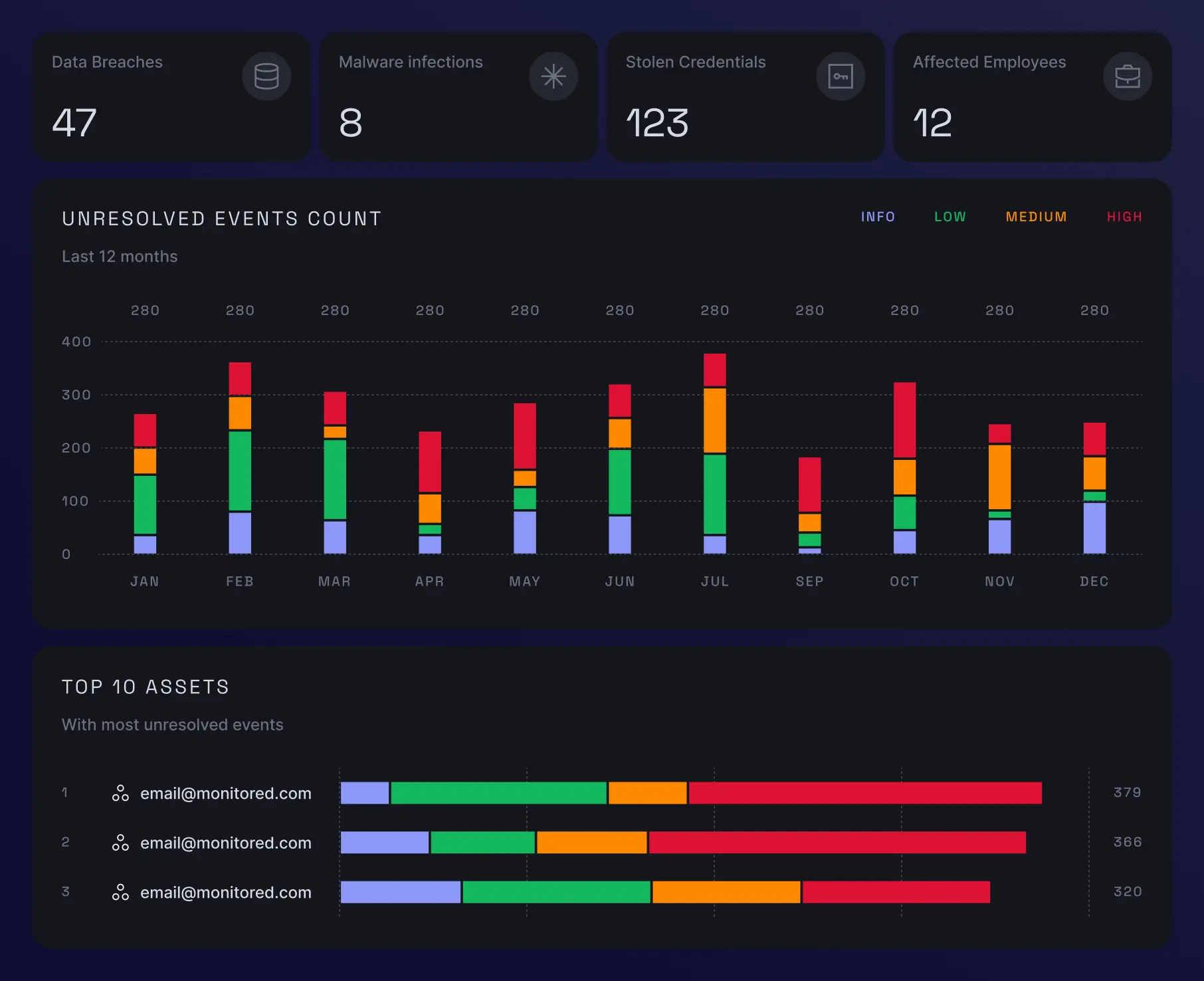
NordStellar is a threat exposure management platform that combines dark web intelligence, attack surface management, and cybersquatting detection in one console. We were impressed by how the platform consolidates multiple intelligence streams that organizations typically buy as separate tools.
- Alert prioritization ranks exposures by impact, exploitability, and breach probability, so your team spends less time triaging and more time remediating
- Dark web monitoring covers over 25,000 cybercriminal communities, tracking leaked credentials, data breaches, and brand mentions
- Attack surface management maps your external footprint and flags misconfigured assets
- Integrates with existing SOC/SIEM and incident response workflows
Setup is low friction. Customers highlight that you provide your company domain and the platform starts working. The team behind NordStellar is accessible and responsive, which matters for a newer platform. Something to be aware of is that the platform is still maturing, with deeper capabilities being requested over time, and limited long-term customer feedback is available given its relative newness.
We were impressed by the consolidated approach here. If your team needs dark web monitoring, attack surface management, and brand protection without managing three separate tools, NordStellar delivers that in a single platform.
Strengths
Cautions
Palo Alto Cortex XSOAR

Palo Alto Networks
Best for organizations already running Palo Alto products
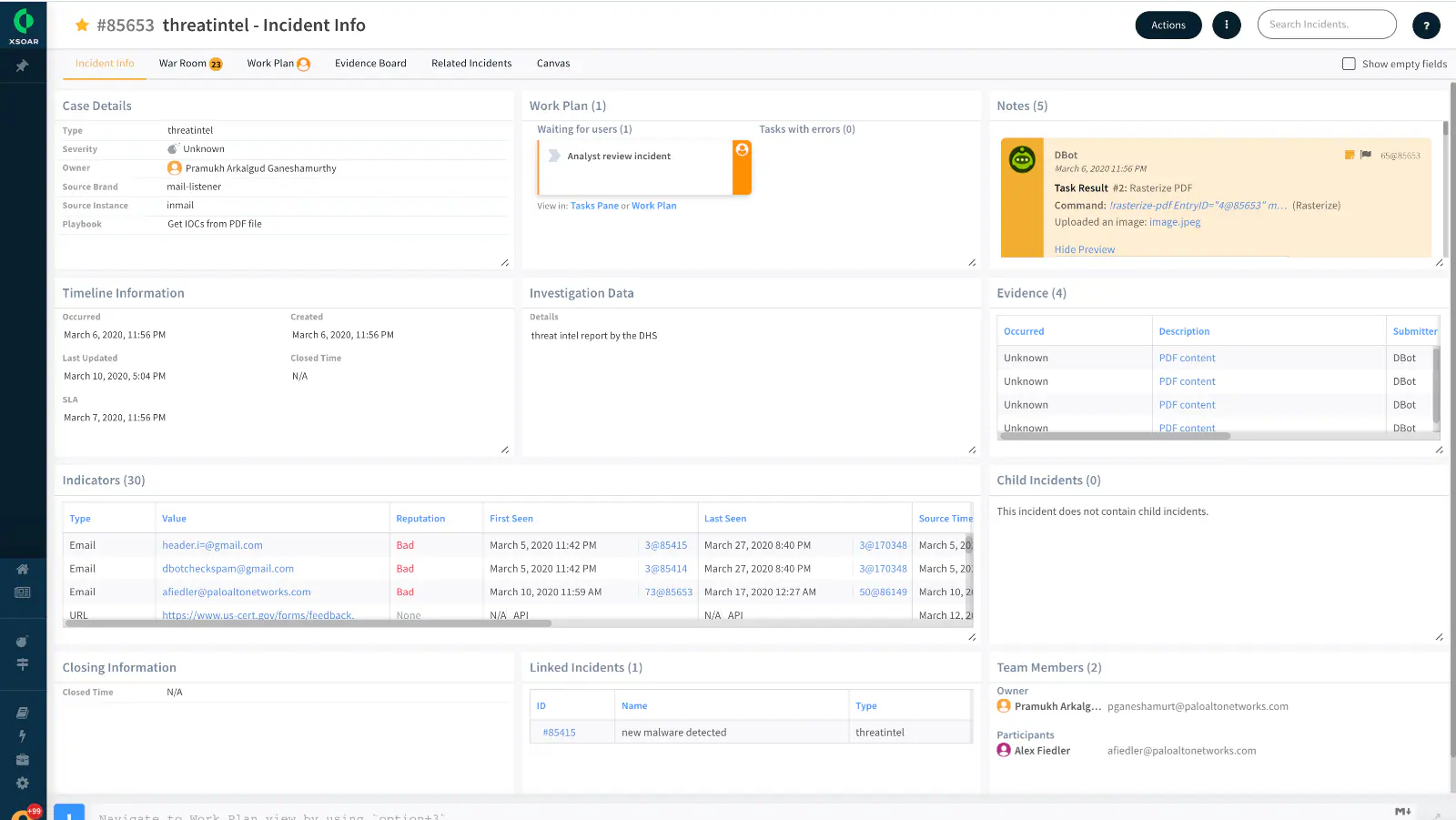
Palo Alto Networks is a global provider of enterprise cybersecurity solutions. Cortex XSOAR is a security orchestration, automation, and response platform that includes integrated threat intelligence management capabilities. Threat data is enriched by Palo Alto Networks’ Unit 42 research team, which is a leading resource in threat hunting and analysis and publishes regular threat assessments and reports. Palo Alto Networks offers more than 850 partner integrations via its XSOAR marketplace, making it a strong option for organizations that need to consolidate and act on intelligence from multiple sources. We think Cortex XSOAR integrates naturally for organizations already running Palo Alto products.
- TIM aggregates, scores, and distributes threat indicators through automated playbooks
- Unit 42 tagging helps analysts quickly separate high-impact threats from routine alerts
- Custom feed builder tailors intelligence to your organization’s specific threat profile
- Proven performance at scale with environments running 65,000+ endpoint agents; open API enables integration with SIEM, SOAR, and third-party security tools
Customers in manufacturing, telecom, and retail praise the customization and automation capabilities. Teams using XSOAR highlight the efficiency gains from automated playbooks handling repetitive enrichment and triage tasks. Something to be aware of is that there is a steep learning curve with complex configuration, and reporting customization options are limited.
If your organization already runs Palo Alto products, Cortex XSOAR integrates naturally and extends your investment. The sensor-driven detection combined with Unit 42 intelligence gives your team both automated and expert-backed threat analysis.
Strengths
Cautions
Recorded Future

Recorded Future
Best for broad, multilingual threat intelligence with dark web coverage
Founded in 2009, Recorded Future is a global threat intelligence provider that specializes in combining automated, AI-powered data collection with expert human analysis. Acquired by Mastercard in early 2025, Recorded Future uses machine learning and natural language processing to surface emerging threats across open, deep, and dark web sources. Intelligence insights are curated by a combination of Recorded Future’s proprietary Intelligence Graph and expert analysts from the Insikt research team. The platform is built on several modules, including brand, SecOps, threat, vulnerability, third-party, geopolitical, and identity intelligence. We think Recorded Future fits teams that need broad, multilingual threat intelligence with strong dark web coverage.
- Machine learning engine processes data in 12 languages, surfacing threats from non-English sources that many competitors miss
- Insikt research team provides exclusive threat actor intelligence beyond public data
- Multi-tenant architecture supports MSSP operations with efficient client management
- Straightforward integration with SIEMs, EDRs, and third-party security tools
Daily users praise the Insikt research team for delivering exclusive threat actor intelligence. The portal is described as simple to navigate with efficient search and filtering. Something to be aware of is that support quality varies, with some IOC verdict accuracy issues after escalation, and identity module breach alerts show occasional latency.
If your team needs broad, multilingual threat intelligence with strong dark web coverage and flexible integration options, Recorded Future is well worth evaluating. The modular approach means you can start with one intelligence stream and expand as your program matures.
Strengths
Cautions
ZeroFox


ZeroFox
Best for brand impersonation and dark web exposure risks
ZeroFox specializes in providing fully managed protection, threat intelligence, and adversary disruption across the public attack surface, including social media and the dark web. The platform combines brand protection, dark web monitoring, and automated takedown services. ZeroFox collects data relating to dark web, brand, fraud, malware, vulnerability, geopolitical, physical, and strategic threats, and is popular with organizations looking for brand protection and takedown capabilities. We think ZeroFox fits organizations facing brand impersonation, phishing, or dark web exposure risks that need managed takedown capabilities.
- End-to-end takedown workflow handles everything from phishing site detection through takedown execution across 80+ partners, disrupting over 1 million threats annually
- AI tagging learns alert behavior over time, reducing false positives
- Monitors 180+ platforms including social media, forums, and the dark web
- Real-time impersonation alerts and a dedicated takedown service backed by qualified analysts
Customers praise the dashboard clarity and the onboarding experience. The support team gets strong marks for recurring check-ins and strategic guidance. Analysts are noted for being highly qualified and providing excellent customer service. Something to be aware of is that takedown timelines can exceed 48 hours depending on registrar cooperation, and initial deployment generates high false positive volume requiring months of tuning.
If your organization faces brand impersonation, phishing, or dark web exposure risks and needs managed takedown capabilities, ZeroFox fits that need. The AI-driven alert tuning improves over time, but expect an initial tuning period before false positive volume stabilizes.
Strengths
Cautions
Other Cyber Threat Intelligence Services
We researched lots of threat intelligence solutions while we were making this guide. Here are a few other tools that are worth your consideration.
Provides detailed insights into fraud, ransomware, account takeover, brand risk, vulnerabilities, and physical threats.
Threat analytics, outbreak alerts, research, publications, and presentations to help you identify threats.
An intelligence hub fed by Fortra's telemetry and insights from the dark web, social media, and law enforcement.
Deep and dark web monitoring, alerts, and intelligence to help you prioritize mitigation efforts and shorten investigations.
Contextualizes threat research and IoCs from a variety of threat feeds to give you an accurate view of threats.
Cyber Threat Intelligence Pricing
CTI platform pricing varies significantly by intelligence tier, module selection, and whether managed services are included. Some platforms offer free tiers or entry-level pricing for smaller teams.
| Product | Starting Price | Billing | Link |
|---|---|---|---|
|
ESET Threat Intelligence
|
From $211/5 users/year
|
Annual
|
|
|
Flare
|
Free trial available; contact for quote
|
Annual
|
|
|
Cyble Vision
|
Contact for quote
|
Annual
|
|
|
CrowdStrike Adversary Intelligence
|
Contact for quote (add-on to Falcon platform)
|
Annual
|
|
|
Cyware TIP
|
Contact for quote
|
Annual
|
|
|
ManageEngine Log360
|
Contact for quote
|
Annual
|
|
|
IBM Security X-Force
|
Free tier available; managed services quoted separately
|
Annual
|
|
|
Google Cloud's Mandiant
|
Free tier available; Security Operations and Fusion tiers quoted
|
Annual
|
|
|
NordStellar
|
Contact for quote
|
Annual
|
|
|
Palo Alto Cortex XSOAR
|
Contact for quote
|
Annual
|
|
|
Recorded Future
|
Contact for quote
|
Annual
|
|
|
ZeroFox
|
Contact for quote
|
Annual
|
|
Cyber Threat Intelligence Checklist
These are the evaluation steps we recommend when selecting a cyber threat intelligence platform.
Different platforms specialize in different intelligence tiers; matching your primary need narrows the field quickly.
Intelligence that requires manual import loses most of its operational value; look for platforms that push enriched data directly into your detection tools.
A platform specializing in dark web forums delivers limited value if your primary threats are nation-state APTs, and vice versa.
Full lifecycle automation from feed ingestion through indicator distribution reduces the analyst time needed to operationalize intelligence.
Direct access to human analysts adds significant value for emerging threat questions, but it's often limited to premium tiers or billed separately.
Platforms that don't deduplicate and score indicators create noise that adds to analyst workload rather than reducing it.
STIX/TAXII-based sharing with ISACs and peer organizations improves collective defense and enriches your own intelligence with external context.
CTI platforms that can demonstrate measurable value through feed effectiveness metrics and threat reduction dashboards are easier to justify at budget time.
Self-service platforms give your team direct control; managed services add expert analysis but require sharing organizational data with the provider.
Complex TIP platforms require meaningful onboarding investment; evaluate vendor support, documentation quality, and training resources before committing.
The Bottom Line
The CTI market spans from focused dark web monitoring tools to full-lifecycle managed intelligence services. The right choice depends on your organization’s maturity, existing security stack, and the specific threats you face. Organizations already invested in CrowdStrike or Palo Alto platforms will find the most value in their native intelligence modules. Enterprise teams with established SOC operations should evaluate platforms that automate the full intelligence lifecycle. Smaller teams or those new to CTI should consider platforms with accessible pricing and strong onboarding support. For organizations facing brand impersonation or digital risk exposure, dedicated digital risk protection platforms offer capabilities that general-purpose CTI tools do not match.
Cyber Threat Intelligence Solutions: Everything You Need To Know (FAQs)
Cyber Threat Intelligence (CTI) describes any data that is gathered and analyzed to answer questions relating to your digital and cyber infrastructure or events. This can be a very broad subject area. Some CTI solutions will focus on your organization, your capabilities, and the active threats that you face. However, CTI also encompass broader trends that may affect entire industries or technologies.
CTI may be used to carry out threat hunting and investigation time into specific types of malware, as well as highlighting suspicious activity. Information can be gathered regarding the malware’s origin, attack method, and Indicators of Compromise (IoCs). This assessment will be based on detection rules and other cybersecurity experts, if the platform offers a Managed service with a skilled Security Operations Center (SOC) team.
This intelligence can be used to identify the malware more quickly in future cases. This, by extension, improves remediation times, keeping your organization more secure.
At the other end of the scale, organizations might use CTI to identify market trends and plan future cybersecurity strategy. In this case, organizations will be looking at the “big picture” – such as new cybersecurity technology to implement – rather than the specific details of an individual threat. The big questions in today’s CTI landscape include AI and its uses in carrying out or defending against attacks, as well as how the metaverse might change the way we work.
Cyber Threat Intelligence can be split into three main intelligence groups, defining the type of intelligence they gather and who it is designed for.
Tactical Intelligence is the most granular and specific form of intelligence that focuses on individual threats.
- Attack behavior
- Indicators of Compromise (IoC)
- Best remediation actions
Operational Intelligence relates to the implementation of policies and effectiveness of security tools overall.
- Configuration policies
- Malware detection rates
- Network dwell time
Strategic Intelligence looks at the big picture, long term trends to plan a multi-year cyber security strategy.
- Emerging threats and vulnerabilities
- Competitor and peer experience
- Cost effectiveness and ROI of cybersecurity tools
Depending on which type of intelligence you need, there will be different solutions on the market, with different preset (and configurable) detection rules. Some platforms may offer intelligence across multiple areas, or package information differently depending on destination. This information has a range of applications and uses, depending on the questions that you ask of it.
Cyber Threat Intelligence is a very broad topic that can have a broad range of applications. Because of this, it can seem overwhelming when trying to identify which features are important for your use-case. In this section, we’ll highlight some of the key features that you should consider when selecting a cyber threat intelligence platform.
- Effective Data Analysis – CTI platforms are able to ingest vast amounts of data from across your digital estate. This information should be properly assessed and analyzed to give accurate and relevant insights. Human users have very little use for vast quantities of raw data but have a lot to gain from processed data and accurate insights.
- Data Collection – Your CTI solution should collect data from across your estate, infrastructure, devices, and wider databases to ensure that its insights are accurate and relevant. The more data your platform has access to, the more reliable your data will be. The exact locations that you gather data from will depend on the type of information that you need, as well as the structure and configuration of your organization. When searching for compromised credentials, for instance, it is important to scan dark web forums and marketplaces.
- Automation – Some platforms deliver automatic responses and remediation. This ensures that any loopholes or errors can be addressed quickly, thereby reducing the time that you are at risk. Effective automation allows you to streamline workflows and improve response times.
- Scalability – Good CTI platforms should be able to manage all the data that you can provide them. As your organization grows, you will increase the amount of data that a CTI platform has access to. Your platform should have capacity for this, ensuring that no data is overlooked and, therefore, no threat is ignored.
- User-Friendly UI – Your platform should provide clear and concise findings and intelligence, allowing you to quickly understand status and events. There should also be ways of generating and sharing specific reports for different parties. Many solutions use clear intelligence graphs and vulnerability reports to share findings with relevant stakeholders.
- Intelligence Quality Ratings – While it would be great if intelligence quality could sit at 100% all the time, this simply isn’t possible. Some CTI platforms will generate an intelligence quality rating, evaluating how strong the intelligence is. High-quality, critical information can then be prioritized over less accurate or less risky data.
When it comes to gathering cyber threat intelligence, you might hear the phrase: “cyber threat intelligence lifecycle”. This is used to outline the ongoing process for collecting, collating, analyzing, and presenting relevant information.
The timeframe for this lifecycle will differ depending on how urgent the information is, and who it is designed to advise. For example, strategic intelligence might only be presented quarterly, while tactical intelligence needs to be presented minute-by-minute to keep your organization safe.
There are six steps that inform how CTI is gathered and presented to relevant parties:
- Requirements
Your organization must decide what type of intelligence you intend to gather. You’ll need to consider who your stakeholders are, and what you would like the outcome of the analysis to be. You might want to explore an attack surface, understand assets, or decide how best to strengthen security implementation.
2. Collection
In this step, data is collected to answer the questions that the requirements demand (step 1). The nature of this data collection depends on the question. This might involve monitoring traffic logs, conducting interviews with experts, or extracting metadata from devices and internal networks. This stage will produce raw data that can be processed in step 3.
3. Processing
Once data has been collected, it will need to be processed and formatted to make it easier to analyze. To do this, data might need to be decrypted or decoupled from personally identifiable information (PII) or other information that is not relevant to the outcomes stated in step 1. This is also the stage where you can evaluate the data for relevance and reliability.
4. Analysis
This stage requires human intervention to make sense of the compiled data, and to identify trends and anomalies. You might perform statistical analysis to understand if threats are increasing or if response times have altered. In essence, this is the stage where you find the answers to the questions asked in step 1.
5. Dissemination
With data that has been processed, you need to be able to share it with relevant stakeholders. Key findings will need to be highlighted with suggestions of how active threats can be remediated. In this stage, you will consider who the intelligence is for, and the level of detail that is required. You might need to reduce or explain jargon and tailor your findings for the relevant audience. This data might be distributed in a variety of ways – from an email to a presentation or hands-on demonstration.
5. Feedback
Once the intelligence has been collected and shared with relevant parties, the target audience needs to consider how they will act upon the findings. Again, the specific details of this action depend on the target audience and their role within the organization. Are they responsible for procuring new cybersecurity solutions, or for tailoring the policies of existing tools?
The remit for CTI can be as broad or as specific as you decide. The level of detail, as well as the data collected, all depends on what questions you set out to ask, and who the answers are being reported to. This is decided in step 1 of the CTI lifecycle. Common areas analyzed as part of the CTI process include:
- Online brand intelligence
- Dark web monitoring
- Domain impersonation
- Social media impersonation and misuse
- Data breach identification
- Vulnerability intelligence and prioritization
There are several companies that offer CTI solutions to gather relevant data and process it to provide relevant intelligence. Many of these solutions will automatically remediate vulnerabilities to ensure your network is as secure as it can be. These solutions can also be used to:
- Validate findings
- Filter out false positives
- Removing anomalous, “noisy” data points
- Provide immediate, automated response
Again, this is a very broad topic with the benefits depending on what you want to investigate with CTI. However, the most common benefits of carrying out cyber threat intelligence include:
Efficient Incident Response
CTI is sometimes described as a cybersecurity “roadmap” – it gives security teams an invaluable insight into how security implementation affects the network and guides them to where more work is needed.
This “roadmap” will ensure that remediation efforts can be quick and effective in light of a cyber-attack. The intelligence can identify where a security breach is likely to have happened, then predict the behavior of an attack, to put your response one step ahead of the attack.
Using CTI helps to identify where a security team should be directing their efforts. As they don’t have to work out which areas need to be focused on, they are able to use their time effectively and efficiently. They won’t spend expensive human time sifting through data that a machine can analyze much quicker. It also ensures that any new security implementation will be specific and targeted. This reduces the number of vulnerabilities within your organization, and helps to ensure you’re investing in the right areas the first time around.
Ultimately, CTI can help to improve efficiency by streamlining your cybersecurity response, thereby proving a good return on investment.
Ensure Compliance
With attacks becoming more sophisticated and complex, regulatory bodies are asking for more significant cybersecurity infrastructure. Regulatory frameworks – such as GDPR, SOX, HIPPA, etc – often mandate what security implementation they expect you to have in place. As part of this, effective CTI might be required to ensure your organization is alert to, and prepared for, attacks.
Insurance companies, too, will require you to have effective tools in place to protect your organization. Not only will CTI identify the effectiveness of your existing security set up, but it can also instruct you on where you can improve. If you follow these recommendations, some insurance providers will reduce your premiums.
Failure to implement CTI, or the recommendations made by CTI, could see your insurance cover invalidated, or result in fines and penalties from regulatory bodies.
For more information about how to qualify for cyber security insurance, you can read our comprehensive article here.
Inform Security Awareness Training (SAT)
The insights provided by CTI are not limited to tailoring policies or suggesting new security tool implementation; CTI can also highlight how your staff can become an important cybersecurity asset. When employees understand the benefits and the limits of a security tool, they are better placed to ensure success.
For example, if an employee understands the significance and the repercussions of a phishing email that has passed through a spam filter, they will be able to act appropriately. They know that a SEG (Secure Email Gateway) is not infallible and are therefore less likely to fall victim to this type of attack. The infromation gained through CTI can inform an SAT solution by highlighting where an organization’s vulnerabilities are. This ensures that users can spend their time completing the most relevant and valuable training.
By gathering information about your network, you can understand the threats you face, and ensure that employees are properly trained to further minimize the risks.
You can read our list of the Top Cybersecurity Awareness Training Solutions here.
Collaborative Knowledge
By sharing details gleaned from your CTI, you can ensure that organizations present a united front against cyberattacks. By improving security infrastructure across the board, you make it harder for attackers to succeed. There is, therefore, less incentive for hackers to pursue cyberattacks as a means of income, which reduces the likelihood of you becoming a target.
Sharing information about IOCs between organizations will allow you to identify these same indicators more readily, should your network be attacked. Beyond this, if your organization is attacked by a specific malware, another organization’s information regarding the remediation of that malware can be invaluable in managing your own remediation efforts. You will have access to information about how a threat responds once inside a network, and the best strategy for its removal.
The core purpose of cyber threat intelligence is to provide you with the knowledge that allows you to preempt future attacks and thwart them before they can strike—to shift your security practices from reactive to proactive. As ThreatQuotient’s Chris Jacob told Expert Insights in our interview with him.
“Threat intelligence allows you to be predictive in your incident prevention and response. The whole idea is that you’re identifying the malware before you’re infected; you know enough about it from your own research and intelligence feeds to be able to recognize it and know how it’s going to move.”
Having access to the accurate intelligence at the right time enables you to predict and prioritize threats, ensuring that you can implement the right protection to safeguard your organization.
Security Operations Resources
Further reading on security operations from Expert Insights — buyers' guides, comparison articles, and platform-specific shortlists.


 Written By
Alex is an experienced journalist and content editor, working alongside software experts to research, write, meticulously factcheck, and edit articles relating to B2B cybersecurity and technology solutions, focusing on topics such as DevSecOps, network security and firewalls, and cloud infrastructure security.
 Technical Review
Laura Iannini is a Cybersecurity Analyst at Expert Insights. With deep cybersecurity knowledge and strong research skills, she leads Expert Insights’ product testing team, conducting thorough tests of product features and in-depth industry analysis to ensure that Expert Insights’ product reviews are definitive and insightful.
Laura also carries out wider analysis of vendor landscapes and industry trends to inform Expert Insights’ enterprise cybersecurity buyers’ guides, covering topics such as security awareness training, cloud backup and recovery, email security, and network monitoring. Prior to working at Expert Insights, Laura worked as a Senior Information Security Engineer at Constant Edge, where she tested cybersecurity solutions, carried out product demos, and provided high-quality ongoing technical support.
Laura holds a Bachelor’s degree in Cybersecurity from the University of West Florida.