Best 9 Data-Centric Security Software For Enterprise (2026)
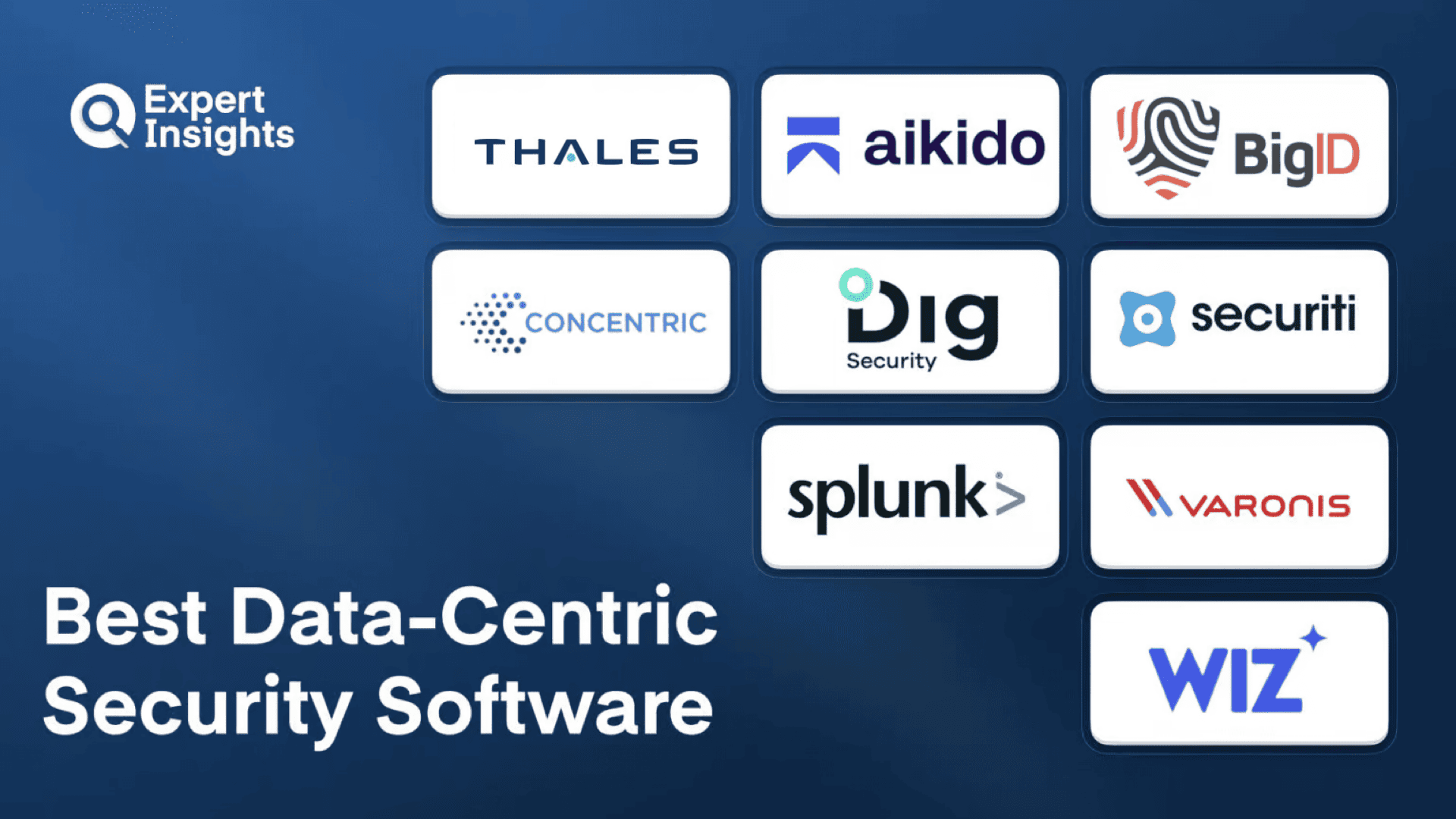
We reviewed 9 data-centric security platforms on classification accuracy, policy enforcement across storage locations, and how well each controls access to sensitive data when it leaves managed environments.
 Written by
Joel Witts
Written by
Joel Witts
 Technical Review by
Laura Iannini
Technical Review by
Laura Iannini
Data-centric security means treating sensitive data as your primary security perimeter. Most organizations have security controls at the network and application layers, but when attackers breach those boundaries, uncontrolled data access creates catastrophic exposure. Ransomware operators don’t care about your firewall quality, they care about finding your most valuable data and encrypting it before you can stop them.
Knowing that sensitive data exists is the easy part. Understanding where it lives, who can access it, whether those permissions are justified, and what attack paths could expose it. You need tools that discover sensitive data across infrastructure you probably don’t fully control, classify it without manual tagging, and show you the path an attacker could take from initial compromise to your most valuable assets.
We evaluated multiple data-centric security platforms across discovery accuracy, classification precision, access control visibility, attack path analysis, and real-world remediation capabilities. We evaluated across cloud, hybrid, and on-premises environments with varying data types, structured databases, unstructured file systems, alongside SaaS applications and legacy systems. We assessed whether platforms helped teams actually remediate exposure or just generate more alerts nobody acts on.
What is Data-Centric Security?
Data-centric security protects sensitive information at the data layer through classification, encryption, and access controls, regardless of where that data moves or is stored. Unlike perimeter-based security that protects the network boundary, data-centric approaches ensure protection travels with the data itself. These platforms discover where sensitive data lives, classify it by type and risk level, control who can access it, and monitor for threats targeting the data directly. The goal is to ensure that sensitive information remains protected even when it crosses network boundaries, moves between cloud providers, or is accessed by AI systems.
Data-centric security platforms operate across several functional layers. Discovery engines scan structured databases, unstructured file systems, cloud storage, SaaS applications, and AI training datasets to build a live inventory of sensitive data. Classification engines use pattern matching, machine learning, or natural language processing to identify PII, PHI, PCI data, intellectual property, and organization-specific sensitive information. Access control visibility maps effective permissions, group memberships, sharing links, and inherited access to show the true blast radius of any user account. Attack path analysis connects data sensitivity to identity risks, misconfigurations, and exploitable vulnerabilities to surface realistic exposure rather than theoretical risk. Remediation capabilities range from alerting to automated permission removal, data masking, and encryption enforcement at the data layer. Real-time monitoring detects exfiltration attempts, ransomware encryption patterns, and anomalous access behavior as threats unfold.
Data-Centric Security Solutions Compared
Here is a side-by-side comparison of the data-centric security platforms reviewed in this guide.
| Product | Best For | Type | Data Discovery | Real-Time Detection | Automated Remediation | AI Governance |
|---|---|---|---|---|---|---|
|
Thales DSPM
|
Legacy and hybrid database environments
|
Data Security Platform
|
Yes
|
Yes
|
Yes
|
Yes
|
|
Aikido Security
|
Developer-focused AppSec
|
AppSec Platform
|
Yes
|
Yes
|
Yes
|
No
|
|
BigID
|
ML-driven data classification
|
Data Intelligence
|
Yes
|
No
|
Yes
|
Yes
|
|
Concentric AI
|
Semantic data understanding
|
Data Security Governance
|
Yes
|
Yes
|
Yes
|
Yes
|
|
Dig Security (Palo Alto Networks)
|
Real-time data threat detection
|
DSPM + DDR
|
Yes
|
Yes
|
No
|
No
|
|
Securiti
|
Privacy and compliance integration
|
Unified Platform
|
Yes
|
No
|
Yes
|
Yes
|
|
Splunk Enterprise Security
|
SIEM and advanced analytics
|
SIEM
|
No
|
Yes
|
Yes
|
Yes
|
|
Varonis
|
Automated remediation at scale
|
Data Security Platform
|
Yes
|
Yes
|
Yes
|
Yes
|
|
Wiz
|
Agentless cloud data discovery
|
CNAPP + DSPM
|
Yes
|
No
|
No
|
Yes
|
How We Tested
We evaluated 9 data-centric security platforms across real-world deployment scenarios, assessing product capability, ease of implementation, and customer feedback. This guide was researched by Alex Zawalnyski and technically reviewed by Laura Iannini. Read our full methodology
Thales DSPM

Thales
Best for native encryption and key management across hybrid environments
Thales is a strong choice for organizations that need a data security posture management platform built for multi-cloud environments. At the center of the offering is the CipherTrust Data Security Platform, and the key differentiator is that CipherTrust doesn’t just identify where sensitive data lives and hand off to third-party tools for protection. It runs the full encryption, tokenization, and key management stack natively.
- Unifies data discovery, classification, encryption, tokenization, dynamic data masking, and centralized key management
- Format-preserving encryption, vaultless tokenization, and dynamic masking applied directly at the data layer
- Coverage spans AWS, Azure, GCP, on-premise databases, and SaaS for structured and unstructured data
- Policy-driven controls for AI and agentic AI workloads ensure sensitive data is protected before reaching AI systems
- File Activity Monitoring extends visibility into unstructured data access patterns and user behavior
- FIPS 140-3 Level 3 compliant HSM support with integrated IAM
We think Thales is a strong option for organizations that need a single platform covering discovery, classification, and native data protection without relying on multiple vendors. The case is particularly strong for regulated industries and organizations with on-premise or hybrid infrastructure, where cloud-native DSPM tools often fall short. If your security requirements include full encryption key ownership, tokenization, and data masking enforced at the data layer across cloud and on-premise environments, Thales is well worth the investment.
Strengths
Cautions

Aikido Security
Best for developer-focused application security
Aikido Security is a code, cloud, and runtime security platform that helps developers find and fix vulnerabilities in their code and applications. It helps protect against data loss by improving the security of applications from code to runtime, with auto-triage and auto-remediation features powered by AI.
- Consolidates SAST, SCA, IaC, API scanning, and CSPM into a single platform
- AI AutoTriage summarizes risks and provides recommendations; AI AutoFix generates code to fix vulnerabilities
- Runtime security via Zen monitors and controls network traffic, blocking inbound risks automatically
- Read-only access model; never edits your code directly
- Compliance detection for SOC 2, ISO 27001, and more
Aikido offers a free plan for up to two developers. Paid plans start at $350 USD per month for up to 10 users. We recommend Aikido for developers looking to shift left, moving data-centric security to the code and application level. The platform is a strong choice for both startups and large teams of developers.
Strengths
Cautions
BigID

BigID
Best for ML-driven data classification at enterprise scale
BigID is an enterprise data security platform that unifies DSPM, AI security posture management, cloud DLP, and data access governance in one solution. We think it fits organizations that need deep visibility into where sensitive data lives, who accesses it, and how it flows across multicloud, SaaS, and hybrid environments. The platform covers structured, unstructured, and semi-structured data at scale.
- Identity-aware discovery links data risk to real user identities rather than just storage locations
- Agentic remediation uses AI-guided prioritization to recommend what to fix first and how
- AI security posture management assesses model and agent vulnerabilities and flags sensitive data use
- AskBigID GPT lets users query their entire risk posture in plain language
- Covers structured, unstructured, and semi-structured data across multicloud environments
Customers praise the depth of data discovery and classification accuracy across complex environments. The platform’s flexibility in handling diverse data types gets high marks. Something to be aware of is that initial configuration and tuning require significant investment, and some users report the interface can feel dense when navigating large-scale deployments.
We think BigID hits the mark for enterprises that need a single platform covering data security, privacy, and AI governance. The identity-aware approach adds context that pure classification tools miss. If your priority is understanding not just where sensitive data is but who touches it and why, BigID is well worth considering.
Strengths
Cautions
Concentric AI

Concentric AI
Best for semantic data understanding with minimal rule-writing
Concentric AI is a data security governance platform that uses context-aware AI to discover, classify, and protect sensitive data across cloud and on-prem environments. We think it works well for organizations that need autonomous data security with minimal manual rule-writing. The platform uses natural language processing to understand the meaning of content rather than relying solely on pattern matching.
- NLP-based classification reads content contextually rather than scanning for regex patterns
- Discovers sensitive data regardless of storage location with continuous risk monitoring
- Automated remediation actions reduce manual security operations effort
- GenAI data security protects sensitive data from entering or leaking through Copilot, Gemini, and ChatGPT
- CMMC compliance workflows for defense supply chain organizations
Customers highlight the accuracy of autonomous classification and the reduction in manual policy creation. The platform’s ability to surface risks without extensive rule configuration gets positive feedback. Something to be aware of is that some users report the reporting interface could be more customizable, and integration with certain legacy systems requires additional configuration.
We think Concentric AI fits organizations that want data classification driven by content understanding rather than rigid rules. The NLP approach reduces false positives on unstructured data where pattern matching struggles. If your environment includes diverse data types and you want to minimize manual policy management, this is a good option to evaluate.
Strengths
Cautions
Dig Security (Palo Alto Networks)

Palo Alto Networks
Best for real-time data threat detection in cloud environments
Dig Security provides DSPM and data detection and response capabilities, now integrated into Palo Alto Networks’ cloud security platform following its acquisition in December 2023. We think it fits organizations already invested in the Palo Alto ecosystem that want agentless data security across their cloud estate. The DSPM module provides sensitive data mapping within 24 hours without connectors.
- Agentless architecture analyzes cloud logs, backups, and snapshots without deploying agents or proxies
- Complete sensitive data mapping achievable within 24 hours of deployment
- Data detection and response monitors for real-time threats to sensitive data
- Integration with broader cloud security platform connects DSPM to workload, identity, and network risks
- Full attack path analysis from initial compromise to sensitive data exposure
Customers praise the speed of deployment and the agentless architecture that avoids performance overhead. The data classification accuracy across diverse cloud data stores gets positive feedback. Something to be aware of is that the platform is now tightly coupled with the broader cloud security suite; organizations not using other Palo Alto products may find the standalone DSPM value harder to access. The legacy Prisma Cloud Data Security module reached end of sale in August 2024.
We think Dig Security works best for organizations already running Palo Alto’s cloud security platform. The agentless DSPM and data detection capabilities are strong, and the integration with the wider security stack adds context that standalone tools lack. If you need cloud-native data security within an existing Palo Alto environment, this is well worth considering.
Strengths
Cautions
Securiti

Securiti
Best for unified data security, privacy, and AI governance
Securiti’s Data Command Center is a unified platform for data security, privacy, governance, and AI trust across hybrid multicloud environments. Following its $1.7 billion acquisition by Veeam in December 2025, the platform now combines data resilience with DSPM and AI governance. We think it fits enterprises that need a single platform spanning data discovery, access governance, privacy automation, and compliance.
- Knowledge graph architecture connects data assets, identities, regulations, and policies in a unified model
- Automatically discovers cloud-native, shadow, and dark data assets using AI-powered contextual classification
- Breach impact analysis with automated notification workflows for incident response
- Agent Commander manages enterprise AI agent access with prompt and response firewalls
- Now part of Veeam, adding data resilience and recovery capabilities
Customers praise the breadth of capabilities and the unified approach to data security and privacy. The automated compliance workflows save significant manual effort. Something to be aware of is that the platform’s depth means onboarding takes longer than simpler point solutions, and some users report the learning curve is steep for teams new to DSPM and privacy automation.
We think Securiti fits organizations that want data security, privacy, and AI governance unified in one platform rather than stitched together from multiple tools. The knowledge graph approach provides context that siloed tools miss. The Veeam acquisition adds data resilience and recovery capabilities to the mix. If you need a platform that spans DSPM, privacy, and AI trust, Securiti is well worth evaluating.
Strengths
Cautions
Splunk Enterprise Security

Cisco
Best for analytics-driven data threat detection at scale
Splunk Enterprise Security is a threat detection, investigation, and response platform that now sits within Cisco’s security portfolio following its $28 billion acquisition in March 2024. We think it fits security operations teams that need data-aware threat detection with deep analytics across large, diverse data environments. The platform ingests and correlates security data at scale to surface threats targeting sensitive information.
- Analytics-driven detection correlates events across endpoints, network, cloud, and identity sources
- Agentic AI capabilities including Triage Agent, AI Playbook Authoring, and Personalized Detection SPL Generator
- Cisco Talos threat intelligence integrated directly for real-world threat context
- Available in Premier (UEBA, SOAR, AI Assistant) and Essentials editions
- SPL and schema-on-read enable flexible queries against unstructured data
Customers praise the depth of analytics and the flexibility to build custom detections. The correlation engine’s ability to surface complex attack patterns gets strong feedback. Something to be aware of is that licensing costs scale with data ingestion volume, which can become expensive for organizations with large data footprints. The query language has a learning curve for analysts without prior experience.
We think Splunk Enterprise Security fits organizations that need analytics-driven data threat detection at scale. The Cisco integration strengthens the threat intelligence and network visibility story. The new agentic AI capabilities should reduce analyst workload on triage and investigation. If your data security strategy needs a strong detection and response layer, this is a serious option to consider.
Strengths
Cautions
Varonis

Varonis
Best for automated remediation of overexposed data at scale
Varonis is a data security platform that combines DSPM, data access governance, data detection and response, and automated remediation in a single SaaS solution. We think it fits enterprises with large unstructured data estates across cloud and on-prem environments that need to reduce overexposed data and detect insider threats. The platform is built around an access graph that maps who can reach what data and how.
- Access graph maps entitlements, group memberships, sharing links, and inherited permissions for true blast radius visibility
- Automated remediation removes stale permissions without human intervention
- Forensic audit trail logs every data access event, permission change, and sharing action
- Managed Data Detection and Response with 30-minute SLA for ransomware detection
- AllTrue.ai acquisition adds AI trust and risk management for internal AI model access
Customers praise the granularity of access visibility and the automated remediation of overexposed data. The forensic audit trail is frequently highlighted for incident investigation. Something to be aware of is that initial deployment and data scanning across large environments takes time, and some users report the volume of findings in the early stages requires careful prioritization to avoid alert fatigue.
We think Varonis fits organizations where overexposed data and stale permissions are the primary risk. The automated remediation is a genuine differentiator; most platforms tell you what’s wrong but leave you to fix it manually. The MDDR service adds a managed layer for organizations without 24/7 security operations. If reducing your data blast radius is the priority, Varonis is a very strong option.
Strengths
Cautions
Wiz

Google Cloud
Best for agentless cloud data discovery with attack path context
Wiz provides DSPM within a unified cloud security platform that connects data risk to identity, misconfiguration, workload posture, and real attack paths. Following its $32 billion acquisition by Google, completed in March 2026, Wiz operates within Google Cloud while maintaining its multi-cloud commitment. We think it fits cloud-native organizations that want data security integrated with their broader cloud security posture rather than bolted on as a separate tool.
- Security graph connects sensitive data findings to identity risks, misconfigurations, and exploitable attack paths
- Agentless scanning discovers PCI, PII, PHI, and secrets across storage, databases, serverless, and third-party platforms
- New data stores discovered automatically as cloud environment changes without agent deployment
- DSPM for AI covers training datasets, vector databases, embedding stores, and inference pipelines
- Multi-cloud support maintained post-Google acquisition
Customers highlight the speed of deployment and the clarity of the security graph for prioritizing data risks. The agentless architecture and multi-cloud coverage get consistently strong feedback. Something to be aware of is that some users report the DSPM capabilities are still maturing compared to the core cloud security features, and granular policy customization for data classification rules has room for improvement.
We think Wiz fits cloud-native organizations that want DSPM embedded within their cloud security platform rather than operating as a standalone data security tool. The attack path context is a real advantage; knowing data is sensitive is useful, but knowing it’s sensitive and reachable through a misconfigured identity is actionable. If your data security needs are cloud-first and you want unified visibility, Wiz is well worth evaluating.
Strengths
Cautions
Data-Centric Security Pricing
Data-centric security pricing varies by platform type, data volume, and deployment model. Most platforms use quote-based enterprise pricing. Contact vendors directly for accurate pricing based on your requirements.
| Product | Starting Price | Billing | Link |
|---|---|---|---|
|
Thales DSPM
|
Contact for quote
|
Annual
|
|
|
Aikido Security
|
Free for up to 2 developers; from $350/mo
|
Monthly/Annual
|
|
|
BigID
|
Contact for quote
|
Annual
|
|
|
Concentric AI
|
Contact for quote
|
Annual
|
|
|
Dig Security (Palo Alto Networks)
|
Contact for quote
|
Annual
|
|
|
Securiti
|
Contact for quote
|
Annual
|
|
|
Splunk Enterprise Security
|
Contact for quote (ingestion-based)
|
Annual
|
|
|
Varonis
|
Contact for quote
|
Annual
|
|
|
Wiz
|
Contact for quote
|
Annual
|
|
Data-Centric Security Checklist
These are the evaluation criteria we recommend when selecting a data-centric security platform.
The platform must discover sensitive data across your infrastructure without manual tagging and classify PII, PHI, and PCI accurately across structured and unstructured sources.
Understanding who has access to sensitive data, whether those permissions are appropriate, and where overexposure exists is critical for reducing blast radius.
Platforms that connect data sensitivity to identity risks, misconfigurations, and vulnerabilities surface realistic exposure rather than theoretical risk scores.
Tools that automate permission removal, data masking, and encryption enforcement reduce exposure faster than platforms that only generate alerts.
Continuous monitoring of data access and behavior detects exfiltration and ransomware activity as threats unfold rather than after damage is done.
Agentless platforms deliver faster time to value; verify how deeply the tool integrates with your SIEM, SOAR, and DLP stack before committing.
If your organization uses or plans to deploy AI, the platform should govern how models access sensitive data, monitor training datasets, and control AI agent permissions.
Ingestion-based and data-volume pricing models create different cost profiles as your environment grows; verify pricing predictability before committing.
The Bottom Line
Data-centric security succeeds when tools reduce noise and drive actual remediation.
For multi-cloud environments where you need agentless deployment and attack path context, Wiz DSPM delivers the fastest time-to-value. The Security Graph integration shows realistic exposure, not theoretical risk.
If you need threat detection alongside posture management, Dig Security adds real-time DDR to DSPM capabilities. The multi-cloud support and executive reporting reduce alert fatigue.
If your organization has unstructured data sprawl and permission debt, Varonis automates remediation at scale. The managed detection service adds analyst coverage without hiring.
For enterprises with legacy database footprints transitioning to cloud, Thales handles diverse repository types that pure-cloud tools cannot reach. BigID Data Security Platform handles petabyte-scale classification. Concentric AI cuts false positives through semantic classification. Securiti Data Security Posture Management unifies DSPM with privacy automation. Splunk Enterprise Security provides SIEM flexibility for mature security operations. Aikido Security consolidates AppSec scanning for dev teams.
Read the detailed reviews above for implementation complexity, deployment timelines, pricing, and specific capabilities that matter for your data environment and team maturity.
Everything You Need To Know About Data-Centric Security (DCS) Software (FAQs)
Data-Centric Security (DCS) is there term used to describe a specific data storage philosophy. It prioritizes securing, protecting, and managing data at a granular level, rather than focusing on the systems and networks where data is held. Where cybersecurity is often likened to a castle with a firewall or EDR solution being the outer perimeter, DCS looks to secure the people (data) within the bounds directly.
The approach makes sense. Focus on protecting the thing that you’re trying to protect: data.
One of the benefits of this approach is that a network or device breach does not directly put information at risk. Equally, if an attacker is able to decrypt a piece of data, they will only have access to that one piece. You do not have to worry about all of the information stored on that device being at risk.
Data-centric security works by securing data at the earliest point possible, at its most fundamental level. This results in effective security that is fully integrated with the data lifecycle, rather than being applied at a later point.
Data-centric security solutions incorporate multiple techniques and processes to ensure that your data is managed effectively and kept secure. Common features of a DCS solution include data encryption, access controls, data classification and auditing, data governance, and data loss prevention. Together, these solutions bring an effective and robust level of security, effectively securing your important information at its most fundamental level.
- Data Encryption – By encrypting data you can ensure that it is only readable by users with the means to decrypt it. This makes it virtually impossible for unauthorised users to make sense of your data. One of the most secure encryption standards is AES-256.
- Access Controls – You can secure data by ensuring that specific, pre-approved users are able to access the data. This is often controlled by a Privileged Access Management (PAM) solution which enforces multi-factor authentication, role-based access, and passwords.
- Data Classification and Auditing – This means that you data is accurately classified and searchable. In doing this, you can ensure that all data is treated effectively and has the appropriate level of controls applied.
- Data Governance – By setting and enforcing standards across your organization, you can ensure that data is always handled, accessed, and managed appropriately, thereby reducing the chances of a breach.
- Data Loss Prevention (DLP) – This puts measures into place to prevent data from being lost or stolen and gives you a means of recovering it this does happen (either intentionally or maliciously).
Data-Centric-Security solutions are technically advanced and complex solutions. As such, it can be difficult to understand which features to look for when selecting a solution. In this section we’ll highlight some of the key features that you should look for when choosing a data-centric security solution.
- Effective Data Discovery – As DCS solution work by focusing on securing data rather than the device, it is essential that your platform can discover and identify all data within your network. If a platform is unable to do this, there could well be large amounts of data that have no form of encryption or security protecting them.
- Accurate Data Tagging – Organizations will have different types of data that are used for different purposes and have different security requirements. To help facilitate this, your solution needs to accurately tag data to ensure it has the right security controls applied.
- Range Of Capabilities – While this isn’t exactly a single feature, it is worth looking for. Your platform should offer a range of capabilities to allow for data to be managed in an effective way. These capabilities should include data encryption, access controls, data classification, auditing, data governance, and data loss prevention.
- Encryption At Rest And Transit – Data is often particularly vulnerable to being targeted whilst in transit. For this reason, it is important that your solution automatically encrypts data at rest and when in transit, thereby reducing the opportunities for attackers to gain access.
- Consistent Monitoring – A security platform that monitors and analyses information access and user behavior can improve processes to ensure that they are as secure and effective as possible. Consistent monitoring also eases the compliance and auditing process, ensuring that you have evidence of your secure practices for relevant parties.
This is not an exhaustive list of the features that a DCS platform can deliver, rather it is a starting point, highlighting some of the most useful features. It is worth taking the time to assess your organization’s own unique use-case and needs, before selecting a solution.
Data Security And Privacy Resources
Further reading on data security and privacy from Expert Insights — buyers' guides, comparison articles, and platform-specific shortlists.


 Written By
Joel is the Director of Content and a co-founder at Expert Insights; a rapidly growing media company focused on covering cybersecurity solutions.
He’s an experienced journalist and editor with 8 years’ experience covering the cybersecurity space. He’s reviewed hundreds of cybersecurity solutions, interviewed hundreds of industry experts and produced dozens of industry reports read by thousands of CISOs and security professionals in topics like IAM, MFA, zero trust, email security, DevSecOps and more.
He also hosts the Expert Insights Podcast and co-writes the weekly newsletter, Cyber Weekly. Joel is driven to share his team’s expertise with cybersecurity leaders to help them create more secure business foundations.
 Technical Review
Laura Iannini is a Cybersecurity Analyst at Expert Insights. With deep cybersecurity knowledge and strong research skills, she leads Expert Insights’ product testing team, conducting thorough tests of product features and in-depth industry analysis to ensure that Expert Insights’ product reviews are definitive and insightful.
Laura also carries out wider analysis of vendor landscapes and industry trends to inform Expert Insights’ enterprise cybersecurity buyers’ guides, covering topics such as security awareness training, cloud backup and recovery, email security, and network monitoring. Prior to working at Expert Insights, Laura worked as a Senior Information Security Engineer at Constant Edge, where she tested cybersecurity solutions, carried out product demos, and provided high-quality ongoing technical support.
Laura holds a Bachelor’s degree in Cybersecurity from the University of West Florida.