Best 8 Cloud DDoS Mitigation Software For Business (2026)
We reviewed the leading cloud DDoS mitigation solutions on mitigation capacity, the accuracy of attack traffic identification, and how well automated response preserves availability for legitimate users during high-volume attacks.
 Written by
Joel Witts
Written by
Joel Witts
 Technical Review by
Laura Iannini
Technical Review by
Laura Iannini
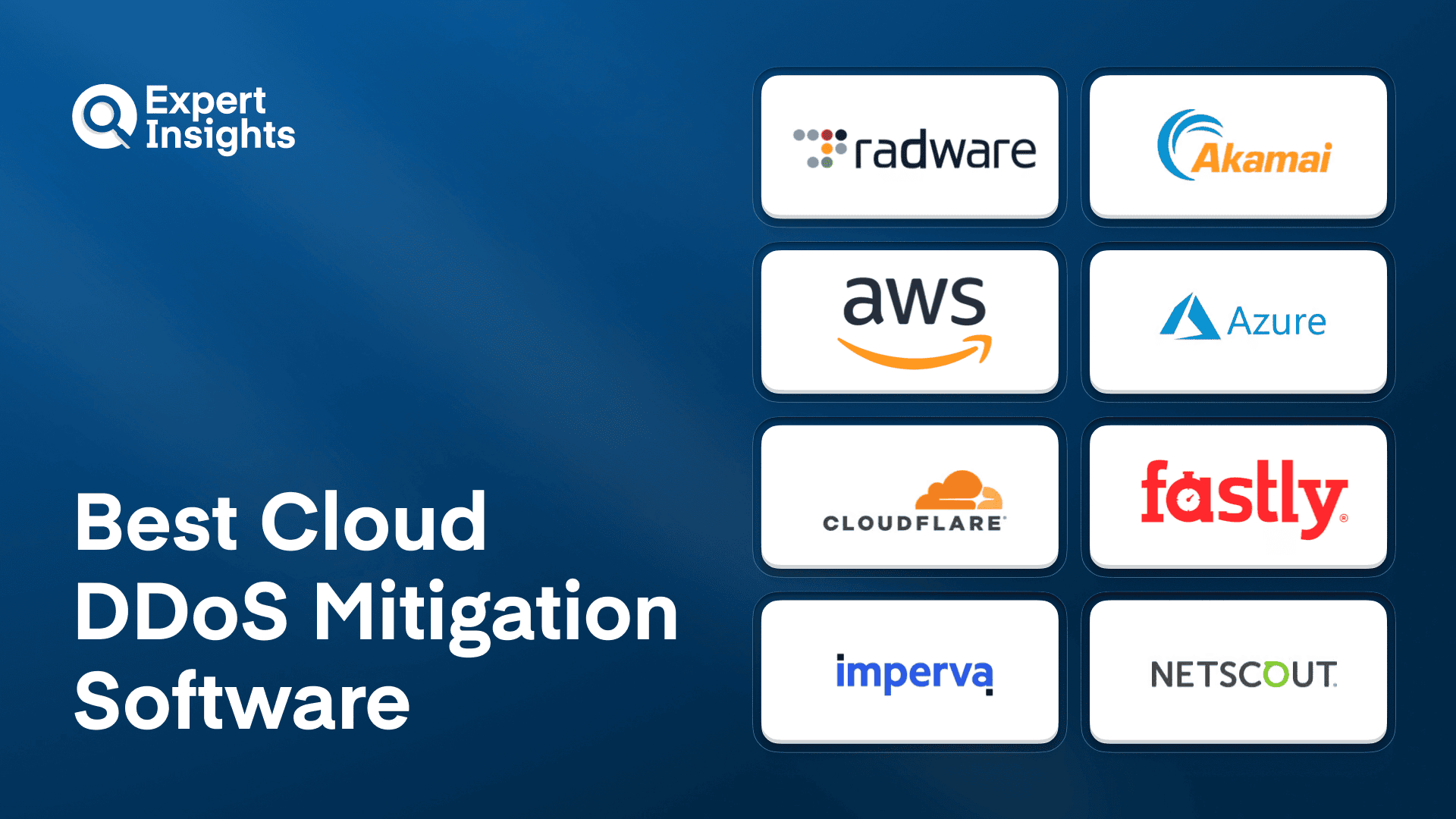
DDoS attacks hit your infrastructure in multiple ways: volumetric floods consuming bandwidth, protocol-based attacks targeting network infrastructure, and application-layer attacks exploiting HTTP/HTTPS and other protocols. The right mitigation solution stops attackers closest to their source, leaving your applications and infrastructure running clean.
You need something that detects attacks in real time, mitigates without creating latency for legitimate users, scales from single applications to enterprise infrastructure, and integrates with your existing cloud and on-premises deployments. The wrong choice means expensive bandwidth charges during attacks, service outages that cascade across your platform, or overbuilt infrastructure you’re paying for even during quiet periods.
We evaluated several cloud DDoS mitigation platforms across scrubbing capacity and distribution, detection speed and accuracy, integration with cloud providers and hybrid environments, customization flexibility, cost structure, and support quality during active attacks. We assessed trade-offs between managed services and self-service control, vendor lock-in risks, and how well each handles geographically distributed attacks. This guide gives you the decision framework to match DDoS protection to your infrastructure footprint, attack surface, and team expertise.
What is Cloud DDoS Mitigation?
Cloud DDoS mitigation protects your online services from being overwhelmed by malicious traffic. When attackers flood your websites, applications, or network with fake requests to force them offline, cloud-based mitigation platforms absorb that traffic in their global networks, filter out the attack, and deliver only legitimate user traffic to your servers. Because the mitigation runs in the cloud, it can scale to handle attacks much larger than your own infrastructure could absorb.
Cloud DDoS mitigation platforms operate distributed scrubbing networks that intercept attack traffic before it reaches origin infrastructure. At Layers 3 and 4, these platforms absorb volumetric floods (SYN floods, UDP amplification, DNS reflection) using Anycast routing to direct traffic to the nearest scrubbing center, where malicious packets are dropped and clean traffic is forwarded via GRE tunnels or direct cross-connects. At Layer 7, behavioral algorithms and machine learning distinguish legitimate application requests from HTTP floods by analyzing request patterns, session behavior, and client fingerprints. Key architectural decisions include always-on versus on-demand activation (always-on adds latency but eliminates detection delay), managed versus self-service control (managed services reduce operational burden but limit customization), and cloud-only versus hybrid models that combine cloud scrubbing with on-premises detection for sub-second local response. The critical metrics are scrubbing capacity in Tbps, time-to-mitigation SLA, false positive rates during legitimate traffic spikes, and cost protection against bandwidth charges triggered by attack volume.
Cloud DDoS Mitigation Software Compared
This table compares the 8 cloud DDoS mitigation platforms we reviewed across capacity and key capabilities.
| Product | Best For | Scrubbing Capacity | Mitigation SLA | Managed SOC | Cost Protection |
|---|---|---|---|---|---|
|
Radware Cloud DDoS
|
Flexible deployment with cloud scrubbing
|
15 Tbps (21 centers)
|
10 seconds
|
yes (ERT)
|
No
|
|
Akamai Prolexic
|
Fully managed enterprise protection
|
20+ Tbps (36 centers)
|
Zero-second
|
yes (SOCC)
|
No
|
|
AWS Shield
|
AWS-native workloads
|
AWS global network
|
Automatic
|
no
|
Yes
|
|
Azure DDoS Protection
|
Azure-native workloads
|
Azure global network
|
Automatic
|
yes (Rapid Response)
|
Yes
|
|
Cloudflare
|
Massive-scale web protection
|
500+ Tbps (330+ cities)
|
35 seconds (demonstrated)
|
no
|
No
|
|
Fastly
|
Developer-first edge mitigation
|
532 Tbps
|
Seconds (edge)
|
no
|
Yes
|
|
Imperva
|
Guaranteed mitigation speed
|
13 Tbps
|
3-second SLA
|
no
|
No
|
|
NETSCOUT Arbor Cloud
|
Hybrid on-prem and cloud scrubbing
|
15+ Tbps (16 centers)
|
Sub-minute
|
no
|
No
|
How We Tested
We evaluated eight cloud DDoS mitigation platforms across scrubbing capacity, detection speed, cloud provider integration, customization flexibility, cost structure, and support responsiveness during active attacks. This guide was researched and written by Joel Witts, with technical review by Laura Iannini. Read our full methodology

Radware
Best for Enterprises needing flexible cloud-delivered volumetric DDoS defense with global scrubbing
Radware Cloud DDoS Protection Service provides multi-layered defense against DDoS attacks using behavioral algorithms and automatic real-time signature creation. The service covers infrastructure DDoS protection against network-layer flooding, DNS infrastructure protection, and application-layer DDoS defense.
- Cloud Web DDoS Protection add-on uses advanced Layer 7 behavioral-based detection and mitigation to block Web DDoS Tsunami attacks and advanced HTTP/S floods
- Additional add-ons include application-layer DDoS attack protection, Firewall-as-a-Service (FWaaS), and Radware Network Analytics
- Worldwide network of 21 scrubbing centers with 15 Tbps of mitigation capacity, globally connected in full mesh mode using Anycast-based routing
- On-demand, always-on, and hybrid deployment models with comprehensive SLA and Emergency Response Team (ERT) access
- Cloud DDoS Management System provides attack traffic analysis for effective mitigation
Radware Cloud DDoS Protection Service is a strong option for enterprises that need flexible, cloud-delivered volumetric DDoS defense with global scrubbing capacity and multiple deployment models.
Strengths
Cautions
Akamai Prolexic

Akamai
Best for Enterprises needing fully managed cloud DDoS defense with zero-second mitigation
Akamai Prolexic is a fully managed cloud DDoS defense platform with one of the largest dedicated scrubbing networks in the industry. We think the managed model with a zero-second mitigation SLA is the defining feature; Akamai’s proactive approach stops over 98% of attacks instantly without waiting for detection thresholds to trigger. The sixth-generation platform, fully software-defined, provides over 20 Tbps of dedicated mitigation capacity across 36 scrubbing centers globally, backed by Akamai’s broader 250+ Tbps network.
- 36 scrubbing centers span North America, South America, Europe, Asia, Oceania, and the Middle East, with Anycast routing directing attack traffic to the nearest location
- Network Cloud Firewall provides network-wide ACLs and firewall rules that apply consistently regardless of where applications live
- Self-learning intelligence adapts to evolving attack patterns and provides early warnings before service disruption
- Hybrid deployment support extends protection to on-premises infrastructure alongside cloud workloads
- SOCC team manages mitigation decisions 24/7, with optional managed SOC services to reduce internal staffing
Support quality and 24/7 availability get consistently strong feedback. The platform stability under pressure and the distributed architecture hold up well during large-scale attacks. Something to be aware of is that the managed service model limits self-service customization through the client portal, which can feel restrictive for teams that want hands-on control. Reviews also note that premium pricing requires significant budget commitment to extract the full platform value.
We think Akamai Prolexic is one of the strongest fully managed cloud DDoS platforms available. The zero-second mitigation SLA and 20+ Tbps dedicated capacity set a high bar for enterprise protection. If you want deep self-service control over mitigation algorithms, the managed model may not suit your workflow; but for organizations that want enterprise-grade cloud DDoS defense without building in-house expertise, Prolexic delivers.
Strengths
Cautions
AWS Shield

Amazon Web Services
Best for Organizations running production workloads on AWS
AWS Shield is a managed DDoS protection service built into the AWS ecosystem, available in two tiers. Standard runs automatically for all AWS customers at no cost, covering Layer 3/4 attacks. Advanced adds application-layer protection, tailored detection, and 24/7 access to the Shield Response Team for $3,000 per month plus data transfer fees. We think the zero-cost Standard tier is the standout for cloud DDoS mitigation; every AWS customer gets baseline protection without configuration or additional spend.
- Shield Standard integrates natively with CloudFront and Route 53, providing always-on Layer 3/4 protection with automated anomaly detection and deterministic packet filtering
- Advanced tier adds customized detection that learns application traffic patterns across EC2, ELB, CloudFront, Global Accelerator, and Route 53 resources
- Health-based detection prioritizes protection for vulnerable applications during active incidents
- Cost protection feature credits back DDoS-related billing spikes for auto-scaling AWS environments
- Advanced subscription includes L7 DDoS protection with up to 50 billion requests per month through the AWS Managed Rule group
Customers describe Shield as a set-and-forget solution. Implementation with CloudFront or public ALBs takes minutes, and the service protects applications without ongoing tuning. The cost protection and automatic refunds during attacks get specific praise. Something to be aware of is that Advanced requires an annual commitment with no monthly billing option, and the base cost plus traffic charges adds up quickly for high-volume environments. Reviews mention that cross-account visibility requires additional logging and dashboard configuration.
We think AWS Shield is the natural choice for organizations running production workloads on AWS. Standard gives you genuine cloud DDoS protection at zero cost, which is hard to argue with. Advanced justifies the spend for organizations with high-value applications that need SRT access, cost protection guarantees, and application-layer defense. If your infrastructure isn’t on AWS, this isn’t relevant; but if it is, Shield should be active.
Strengths
Cautions
Microsoft Azure DDoS Protection
Microsoft
Best for Azure-native organizations wanting adaptive, zero-configuration DDoS defense
Azure DDoS Protection provides Layer 3 and Layer 4 defense for resources running in Azure virtual networks. We think the adaptive real-time tuning is the standout feature for cloud DDoS mitigation; the platform profiles your application traffic and adjusts protection settings automatically, which eliminates the manual baseline configuration other solutions require. A single plan covers multiple Azure subscriptions, simplifying billing and management for multi-tenant deployments.
- Adaptive AI learns traffic patterns specific to your environment and updates detection thresholds automatically, reducing false positives during legitimate traffic spikes
- Native integration with Azure Monitor and Splunk for teams already using those tools for observability
- DDoS Rapid Response team provides expert investigation during active incidents and post-attack analysis
- Cost protection provides service credits for resource costs during documented attacks
- Network Protection covers up to 100 public IP resources in the base subscription, with IP Protection for individual resource coverage
The zero-configuration deployment gets consistent praise. Customers report strong protection during attacks with minimal latency impact, and the always-on monitoring and real-time dashboards help teams maintain visibility without building custom tooling. Something to be aware of is that pricing runs into thousands monthly for enterprise deployments, creating a cost barrier for mid-market organizations. Reviews note limited customization and visibility into the mitigation process itself, which can be a concern for teams that want granular control.
We think Azure DDoS Protection is the right choice for organizations running primarily on Azure who value operational simplicity over granular mitigation control. The adaptive tuning genuinely reduces the configuration burden compared to other cloud DDoS platforms. If you need deep customization of mitigation rules or operate outside Azure, this won’t be the right fit; but for Azure-native teams, the protection is well worth enabling.
Strengths
Cautions
Cloudflare DDoS Protection

Cloudflare
Best for Organizations with significant web presence needing massive-scale cloud mitigation
Cloudflare DDoS Protection delivers cloud-based mitigation across three tiers: website, application, and network. Website DDoS protection comes included with all Cloudflare plans at no extra charge, with unmetered mitigation regardless of attack size. We think the combination of massive scale and accessibility is the defining advantage; Cloudflare’s network exceeds 500 Tbps of capacity across 330+ cities in 125+ countries, making it the largest cloud DDoS mitigation network available. The platform also consolidates CDN, WAF, and bot mitigation alongside DDoS protection.
- Website DDoS Protection handles HTTP/HTTPS attacks with unmetered mitigation at no extra charge on all plans
- Spectrum covers Layer 4 applications like gaming and VoIP through a pay-as-you-go reverse proxy model with built-in load balancing
- Network DDoS Protection (Magic Transit) extends to on-premises, cloud, and hybrid environments via BGP routing and GRE encapsulation
- Processes over 1 billion unique IPs daily, feeding real-time threat intelligence that updates protection automatically
- In 2025, Cloudflare mitigated a 31.4 Tbps DDoS attack in 35 seconds with zero human intervention
Customers praise the bot mitigation capabilities, with teams reporting that bandwidth drain from crawler traffic was solved with minimal configuration. Managing multiple sites through a single dashboard appeals to organizations with large web portfolios. Something to be aware of is that advanced features like phone support and granular controls require Enterprise plans. Reviews note an initial learning curve before the platform becomes intuitive for new users, particularly around WAF rule configuration and bot management settings.
We think Cloudflare DDoS Protection is one of the strongest cloud DDoS platforms for organizations with significant web presence. The free website protection with unmetered mitigation removes budget barriers entirely for baseline coverage, and the 500 Tbps network capacity is unmatched. If your primary concern is network-layer protection for non-HTTP workloads, evaluate whether Spectrum or Magic Transit matches your architecture. For web-heavy environments, Cloudflare is hard to beat.
Strengths
Cautions
Fastly DDoS Mitigation

Fastly
Best for Engineering-heavy teams wanting fine-grained control over cloud DDoS response
Fastly DDoS Mitigation provides cloud-based protection through an edge cloud platform with over 532 Tbps of network capacity. We think the edge-native detection model is the key differentiator for cloud DDoS mitigation; detection and mitigation happen at Fastly’s edge nodes rather than centralized scrubbing centers, which means attacks are blocked in seconds at the point closest to their source. Security policy updates propagate globally in 13 seconds, which gives teams real-time control during active incident response.
- Proprietary Adaptive Threat Engine detects and mitigates attacks using Attribute Unmasking techniques that identify attack patterns faster than traditional signature matching
- Varnish Configuration Language (VCL) gives teams granular control over traffic handling, from simple rate limiting to complex conditional logic, with API-based Terraform integration
- Real-time logging and observability tools provide immediate visibility into traffic patterns and attack signatures
- Zero-attack-fees billing means customers are charged on legitimate traffic only, not on bandwidth spikes caused by volumetric attacks
- Integration with Fastly’s Next-Gen WAF creates layered defense where WAF responses feed directly into DDoS blocking decisions
Customers consistently highlight the exceptional support quality, with dedicated security architects guiding migrations and implementations. Teams report multi-year deployments with zero downtime. The edge rate limiting scales from simple UI setup to full VCL control, appealing to organizations with varying technical skill levels. Something to be aware of is that VCL configuration requires learning Varnish syntax, which has a learning curve for teams unfamiliar with the language. Reviews also note that the separation between WAF and Next-Gen WAF functionality can make finding specific security features less intuitive.
We think Fastly DDoS Mitigation is a strong fit for engineering-heavy teams that want fine-grained control over their cloud DDoS response. The 13-second global propagation and VCL customization give technically capable teams more control than most managed cloud DDoS platforms offer. The zero-attack-fees billing is a genuinely customer-friendly policy. If your security team prefers fully managed services with minimal configuration, the VCL-based approach may feel like overhead; but for teams that value control and speed, Fastly is well worth considering.
Strengths
Cautions
Imperva DDoS Protection

Imperva
Best for Organizations needing guaranteed mitigation speed across websites, networks, and IPs
Imperva DDoS Protection provides cloud-based mitigation across websites, network infrastructure, and individual IPs through a unified platform. We think the multi-layered coverage model is the core appeal; instead of separate products for different asset types, Imperva covers web applications, networks, and individual IP addresses from a single service. The platform commits to a 3-second SLA for detection and mitigation, with network-layer protection targeting sub-one-second response for most attack patterns, backed by 13 Tbps of global scrubbing capacity.
- Website protection handles application-layer attacks automatically with behavioral algorithms that distinguish legitimate users from attack traffic
- Network protection offers always-on or on-demand options for full infrastructure or specific subnets, with deployment via GRE tunnels, cross-connects, or virtual cross-connects through Equinix Fabric
- Individual IP protection secures internet-facing services on single addresses
- 95% of the world experiences sub-50 millisecond latency through Imperva’s global network
- SDN-based automated tuning and SIEM integration, with full application security platform integration
Customers running production deployments report zero successful DDoS attacks despite being constant targets. The dashboard and reporting get strong marks for clarity, with detailed reports that simplify post-incident review. Support responsiveness gets consistent praise. Something to be aware of is that initial setup requires technical expertise and often takes longer than planned. Reviews also note that scaling protection to additional websites requires purchasing separate licenses, which can increase costs for organizations with large web portfolios.
We think Imperva DDoS Protection is best suited for organizations with hybrid environments that need cloud-based protection across websites, networks, and individual IPs from a single vendor. The 3-second mitigation SLA and behavioral learning are real differentiators, and the investigative capabilities add value for teams doing active threat analysis. If budget is a primary concern, enterprise pricing may be a barrier; but for organizations facing sophisticated attack campaigns, Imperva is well worth the investment.
Strengths
Cautions
NETSCOUT Arbor Cloud DDoS Protection Services
NETSCOUT
Best for Service providers and enterprises needing hybrid on-prem and cloud scrubbing
NETSCOUT Arbor Cloud delivers hybrid DDoS protection that combines on-premises detection with cloud-based scrubbing across 16 global centers with over 15 Tbps of capacity. We think the hybrid architecture is what sets Arbor Cloud apart in the cloud DDoS space; on-premises Arbor Edge Defense handles local threats, and when volumes exceed local capacity, traffic routes automatically to the cloud scrubbing network. The ATLAS threat intelligence network, monitoring over 800 Tbps of internet traffic representing up to 50% of global activity, feeds real-time data into detection algorithms.
- AI and ML-powered Adaptive DDoS Protection in Arbor Edge Defense adjusts to changes in attacker strategy in real time without manual reconfiguration
- Sub-minute mitigation SLAs backed by intelligent automation for fast detection and response
- ASERT security research team provides expert threat intelligence and analysis
- Traffic analysis extends beyond basic DDoS into BGP monitoring and overlay VPN management for broader network visibility
- Deploy as standalone cloud service, combined with on-premises Edge Defense, or as intelligent hybrid model with automatic cloud signaling
Customers value the real-time visibility into network flows, BGP hijack detection, and detailed traffic reporting. The monitoring and traffic analysis capabilities are frequently cited as standout features. Something to be aware of is that implementation complexity requires significant technical expertise, and the learning curve is steep. Reviews describe the pricing as difficult to justify despite strong features, and some customers note that product updates have become less frequent than expected.
We think NETSCOUT Arbor Cloud is best suited for service providers and enterprises with mature network operations teams that need hybrid cloud DDoS protection with deep traffic visibility. The ATLAS threat intelligence and ASERT team are genuine differentiators for detection accuracy. If your priority is simple cloud-based deployment over granular network control, the complexity may outweigh the benefits; but for organizations that value hybrid flexibility and detailed traffic analysis, Arbor Cloud delivers.
Strengths
Cautions
Web Security Pricing
Cloud DDoS mitigation pricing varies significantly by vendor, capacity, and deployment model. Several platforms include baseline protection at no cost with their cloud services. The prices below reflect publicly available starting points; contact vendors for enterprise quotes where noted.
| Product | Starting Price | Billing | Link |
|---|---|---|---|
|
Radware Cloud DDoS
|
Contact for quote
|
Annual
|
|
|
Akamai Prolexic
|
Contact for quote
|
Annual
|
|
|
AWS Shield
|
Free (Standard); $3,000/month (Advanced)
|
Monthly / Annual
|
|
|
Azure DDoS Protection
|
~$2,944/month (Network Protection)
|
Monthly
|
|
|
Cloudflare DDoS Protection
|
Free (website); Enterprise for advanced
|
Monthly / Annual
|
|
|
Fastly DDoS Mitigation
|
Usage-based; contact for quote
|
Monthly
|
|
|
Imperva DDoS Protection
|
Contact for quote
|
Annual
|
|
|
NETSCOUT Arbor Cloud
|
Contact for quote
|
Annual
|
|
Web Security Checklist
These are the steps we recommend when evaluating and deploying cloud DDoS mitigation for your organization.
Capacity determines the largest attack the platform can absorb; geographic distribution affects how quickly traffic is re-routed and how close mitigation happens to the attack source.
Marketing claims differ from contractual commitments; ask whether the vendor provides financial remedies if mitigation exceeds the stated response time.
Always-on adds baseline latency but eliminates detection delay; on-demand reduces cost during quiet periods but requires activation time when attacks hit.
DDoS attacks can trigger auto-scaling charges that inflate your cloud bill; platforms with cost protection credits or zero-attack-fees billing protect against financial damage.
L3/L4 volumetric protection is table stakes; sophisticated attackers target the application layer where behavioral detection quality varies significantly between vendors.
Cloud-native solutions like AWS Shield and Azure DDoS Protection integrate seamlessly with their respective platforms but offer no value outside those ecosystems.
Managed services like Akamai Prolexic remove the need for 24/7 DDoS expertise but limit customization; self-service platforms like Fastly give more control but require skilled staff.
Knowing who to contact, how to activate on-demand scrubbing, and what escalation paths exist reduces response time when it matters most.
Testing in production-like conditions confirms mitigation activates as expected and reveals configuration gaps before a real attack exposes them.
Detailed post-attack analysis helps identify patterns, strengthen defenses, and demonstrate security posture to leadership and compliance auditors.
The Bottom Line
No single DDoS mitigation solution fits every organization.
For enterprise organizations that can’t afford downtime and need hands-off management, Akamai Prolexic delivers 20 Tbps dedicated capacity with zero-second mitigation SLAs. 24/7 support justifies premium pricing.
If your infrastructure runs on AWS, AWS Shield provides automatic Layer 3/4 protection free with Standard tier.
For engineering-driven teams wanting fine-grained control and real-time customization, Fastly enables granular VCL-based traffic handling with 13-second global configuration propagation.
If you’re managing large web properties and want consolidated DDoS, WAF, and bot mitigation, Cloudflare includes website protection on all plans with unmetered mitigation.
For service providers and enterprises with hybrid infrastructure, NETSCOUT Arbor Cloud combines on-premises defense with cloud scrubbing and ATLAS threat intelligence.
Read the individual reviews above to dig into deployment specifics, pricing models, latency impact, and the trade-offs that matter for your attack scenarios and infrastructure footprint.
Everything You Need To Know About Cloud DDoS Mitigation Software (FAQs)
A distributed denial-of-service (DDoS) attack is a malicious attempt to disrupt regular traffic on a targeted server, service, or network. This can result in the server crashing, meaning that a website, computer, or online service is put offline from being overwhelmed. The target’s capacity is unable to process all the attack requests, rendering it unable to respond to legitimate requests.
Cloud DDoS mitigation software falls into a category of software solutions and services that were created to provide protection for online services, applications, and infrastructure against the increasingly prevalent threat of DDoS attacks. Cloud DDoS mitigation software supports organizations in effectively detecting and mitigating these types of attacks so that the availability and performance of their online services not disrupted.
Cloud DDoS mitigation software provides a variety of benefits, which include:
- Maintaining strong service availability for legitimate users by mitigating the risk of them losing access to applications and online services in the event of a DDoS attack
- Minimizing downtime and service disruption, thereby minimizing the potential for revenue loss and reputational damage
- Dynamically scaling resources in response to attack traffic, which helps to ensure protection is maintained even during large-scale attacks
- Rapidly respond to attacks with automated detection and response, which helps organization to counter the speed and scale of modern DDoS attacks effectively
- Using detailed reports and analysis to gain better understanding of attack trends and how to improve security measures post-attack
Overall, cloud DDoS mitigation software solutions do a good job of empowering organizations to defend against DDoS attacks proactively. This, in turn, helps them to maintain their service availability and protect their online presence, both of which are imperative to remaining competitive into today’s digital landscape.
- Traffic Monitoring. A good cloud DDoS mitigation software solution should be continually monitoring network traffic patterns. If this is not the case, it cannot detect any anomalies or suspicious behaviors that might indicate that a DDoS attack is underway.
- Traffic Filtering. These solutions should be able to filter for, and then divert, any malicious traffic, keeping it away from the target infrastructure. Filtering techniques used to achieve this typically include route diversion, rate limiting, and IP filtering.
- Real-Time Alerts. Generating real-time alerts ensures that administrators, security teams, and relevant stakeholders are able to launch mitigation efforts quickly and efficiently in response to attacks.
- Automatic Mitigation. By automating the response to DDoS attacks, there is no need for manual intervention. This results in a streamlined process, reduces the risk of human error during actions like rerouting traffic, provisioning additional resources, and applying traffic filters.
- Reporting Analysis. A good cloud DDoS mitigation solution should provide users with detailed reports containing thorough analysis of any DDoS attacks. This includes information on the nature of the attacks, their source, duration, and the impact it had on the network and services.
Web Security Resources
Further reading on web security from Expert Insights — buyers' guides, comparison articles, and platform-specific shortlists.


 Written By
Joel is the Director of Content and a co-founder at Expert Insights; a rapidly growing media company focused on covering cybersecurity solutions.
He’s an experienced journalist and editor with 8 years’ experience covering the cybersecurity space. He’s reviewed hundreds of cybersecurity solutions, interviewed hundreds of industry experts and produced dozens of industry reports read by thousands of CISOs and security professionals in topics like IAM, MFA, zero trust, email security, DevSecOps and more.
He also hosts the Expert Insights Podcast and co-writes the weekly newsletter, Cyber Weekly. Joel is driven to share his team’s expertise with cybersecurity leaders to help them create more secure business foundations.
 Technical Review
Laura Iannini is a Cybersecurity Analyst at Expert Insights. With deep cybersecurity knowledge and strong research skills, she leads Expert Insights’ product testing team, conducting thorough tests of product features and in-depth industry analysis to ensure that Expert Insights’ product reviews are definitive and insightful.
Laura also carries out wider analysis of vendor landscapes and industry trends to inform Expert Insights’ enterprise cybersecurity buyers’ guides, covering topics such as security awareness training, cloud backup and recovery, email security, and network monitoring. Prior to working at Expert Insights, Laura worked as a Senior Information Security Engineer at Constant Edge, where she tested cybersecurity solutions, carried out product demos, and provided high-quality ongoing technical support.
Laura holds a Bachelor’s degree in Cybersecurity from the University of West Florida.