Best 9 Datto RMM Alternatives For MSPs (2026)
We compared the leading Datto RMM alternatives on automation breadth, security monitoring integration, and pricing at different client volume levels. Here's what we think is worth trialing before you commit to a switch.
 Written by
Caitlin Harris
Written by
Caitlin Harris
 Technical Review by
Laura Iannini
Technical Review by
Laura Iannini
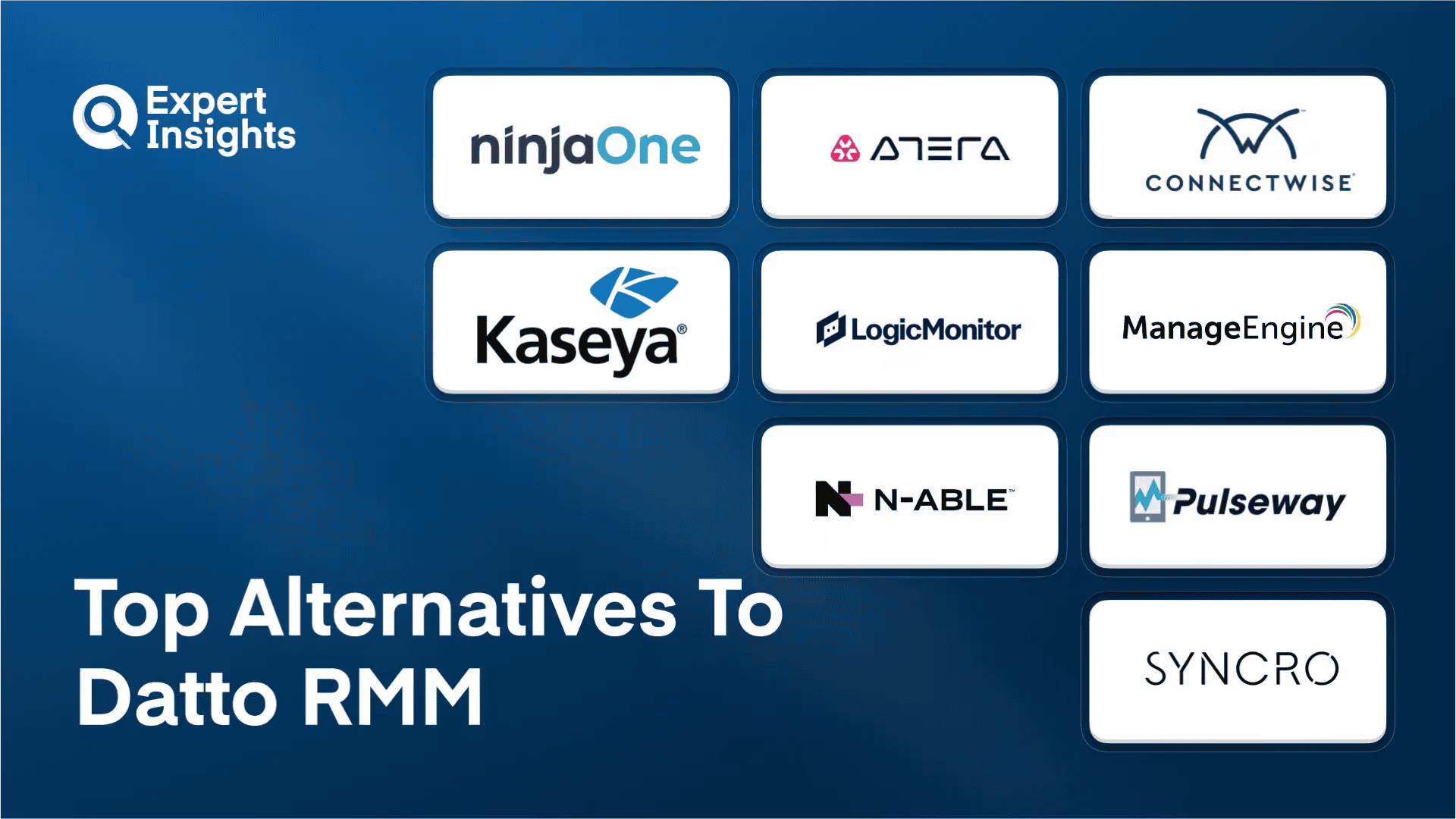
Remote monitoring and management used to be simple: push patches, monitor alerts, respond to outages. That era ended. Modern RMM requires patching hundreds of third-party applications, coordinating across multiple operating systems, managing cloud workloads, handling security monitoring, and providing the reporting that clients demand and auditors require.
Datto RMM served a specific market: MSPs and IT teams that wanted a mature, feature-rich platform with strong automation and extensive integrations. If you’re evaluating alternatives, you might be looking at cost constraints, feature gaps for your workflow, or a desire to consolidate under a different vendor ecosystem.
We have compared multiple RMM platforms including standalone tools, consolidated RMM/PSA suites, and specialized monitoring platforms. We evaluated patching capabilities, automation depth, reporting flexibility, deployment complexity, and how well each integrates with PSA and ticketing systems that MSPs and IT teams already depend on.
The right fit depends on your team size, client portfolio, and whether integration simplicity or automation depth matters more.
What is IT Management?
Remote Monitoring and Management (RMM) software lets MSPs and IT teams monitor, manage, and maintain client devices and networks from a central console. RMM platforms handle patching, alerting, scripting, remote access, and reporting across all client environments, making it possible for a small team to manage thousands of endpoints across dozens of clients without visiting each site.
RMM platforms deploy lightweight agents to managed endpoints across multiple client tenants, reporting telemetry to a multi-tenant cloud console. Monitoring covers system health, software inventory, patch compliance, and security posture with configurable alerting. Policy engines automate detection and response through conditional rules and scripting. Patch management automates OS and third-party updates with approval workflows and rollback. Remote access provides background command execution and interactive screen control. Advanced platforms add AI-assisted triage, integrated EDR, network topology mapping, NOC-as-a-service, and predictive analytics. PSA integration connects monitoring to ticketing, billing, and contract management.
Datto RMM Alternatives Compared
This table compares the 9 Datto RMM alternatives we reviewed across their core capabilities.
| Product | Best For | Pricing Model | Built-in PSA | AI Features | EDR |
|---|---|---|---|---|---|
|
NinjaOne
|
Quick deployment with reliable automation
|
Per-device
|
no
|
✓
|
no
|
|
Atera
|
Unified operations with per-technician pricing
|
Per-technician
|
✓
|
✓ (Copilot + Robin)
|
no
|
|
ConnectWise RMM
|
NOC-managed patching at scale
|
Per-endpoint
|
Via Manage
|
✓ (IntelliMon)
|
no
|
|
Kaseya VSA
|
Enterprise automation across diverse devices
|
Contact for quote
|
Via BMS
|
✓
|
✓
|
|
LogicMonitor
|
Hybrid infrastructure observability
|
Per-hybrid-unit
|
no
|
✓ (Edwin AI)
|
no
|
|
ManageEngine RMM Central
|
Deep network discovery for global MSPs
|
Contact for quote
|
no
|
✓ (ML forecasting)
|
no
|
|
N-able N-central
|
Unified RMM and EDR
|
Per-device
|
no
|
✓
|
✓ (SentinelOne)
|
|
Pulseway RMM
|
Mobile-first management
|
Per-endpoint
|
no
|
✓
|
no
|
|
Syncro
|
Per-technician pricing with M365 management
|
Per-technician
|
✓
|
✓ (AI tickets)
|
no
|
How We Tested
Expert Insights independently evaluates RMM and IT management solutions. We evaluated 9 Datto RMM alternatives through hands-on deployments across heterogeneous client environments, testing patch management, automation capabilities, reporting flexibility, integration depth, and ease of deployment. We also interviewed MSPs to understand where vendor claims diverge from operational reality. Read our full methodology
NinjaOne
NinjaOne
Best for teams looking for an RMM that's quick to deploy, with reliable automation and integrated server and SaaS backup
NinjaOne is a cloud-based RMM and unified IT operations platform for MSPs. It allows you to manage Windows, macOS, and Linux endpoints, servers, Hyper-V hosts, virtual machines, and network devices from one multi-tenant console. In our testing, we were impressed with NinjaOne’s multi-step automations, which use conditional policies and the platform’s extensive script library to take responsive actions without you having to intervene.
- Condition-based policies and multi-step automations fix stopped services, missed reboots, and open ports automatically
- Autonomous Patch Management covers Windows, macOS, Linux, and 8,800+ third-party apps, and Patch Intelligence AI pauses unstable updates
- Image, file, and folder backups are sent to cloud, NAS, or hybrid storage, and are encrypted with AES-256 at rest and in transit
- Test-boots Windows Server image backups every two weeks or monthly, with screenshot evidence
- SaaS Backup covers Microsoft 365, Google Workspace, and Entra ID with unlimited storage
- NinjaOne Remote launches attended, unattended, or Quick Connect remote control sessions in two to three seconds
- Native ticketing and PSA modules, as well as integrations with Autotask and ConnectWise PSA
We recommend NinjaOne for small to mid-market MSPs that want to bring RMM, patching, and backup for their clients onto one platform, quickly.
We like how fast it is to get running. Deployment typically takes two weeks to a month, and the intuitive console is easy for new technicians to learn. Plus, having backup, boot verification, patching, and monitoring in the same console lets you manage each of those tasks without switching tools. It’s important to note that image backup only covers Windows, so check your Linux and VMware servers against NinjaOne Backup before you move them. Also, NinjaOne has no software configuration management, just installation and uninstallation.
Strengths
Cautions
Atera

Atera
Best for MSPs wanting consolidated tooling without ecosystem lock-in
Atera combines RMM, PSA, helpdesk, and ticketing into a single platform with per-technician pricing. We think it’s a strong Datto RMM alternative for MSPs who want consolidated tooling without the ecosystem lock-in that comes with the Datto/Kaseya stack. The per-technician model is the key differentiator; you pay per technician regardless of how many endpoints you manage.
- MSP plans from $139/technician/month with unlimited devices and clients
- Patch management via Chocolatey, Homebrew, and API-based integrations
- Robin autonomous IT agent handles common support tasks 24/7
- AI Copilot add-on (~95 euros/technician/month) for ticket summarization, script generation, and diagnostics
Users highlight the polished experience and fast deployment. The per-technician pricing makes costs predictable as endpoint counts grow. Support gets consistent praise for responsiveness and helpful onboarding. Something to be aware of is that Splashtop connections occasionally fail, pushing users toward ScreenConnect instead. Hardware inventory reports are also difficult to locate and deliver too much raw data without useful summaries.
We think Atera works best for MSPs and IT teams who value simplicity and predictable costs over feature depth. If you’re leaving Datto RMM because of pricing complexity or the recent shift to Committed Minimum and Variable Consumption billing, Atera’s flat per-technician model is a straightforward alternative. Be aware that the AI Copilot is a paid add-on, not included in the base plan.
Strengths
Cautions
ConnectWise RMM

ConnectWise
Best for MSPs wanting managed NOC support for 24/7 coverage
ConnectWise RMM targets MSPs who need to monitor and manage IT environments at scale with optional 24/7 NOC services. We think it’s the right Datto RMM alternative for MSPs that want to offload routine operations to a managed team rather than building everything in-house. The NOC services are the real differentiator; they handle patching, monitoring, and remediation around the clock.
- NOC team maintains 1,200+ intelligent alerts and handles monthly Windows OS security update testing for all partners
- Third-party patching expanded to over 7,000 applications
- IntelliMon consolidates related alerts into single actionable events
- Auvik network monitoring integrated with vulnerability scanning included by default
Users already in the ConnectWise ecosystem highlight the tight integration with ConnectWise Manage, with smooth ticket-to-project workflows and synchronized data. Browser-based access works from any location without installing a local client. Something to be aware of is that the interface draws criticism for being clunky, particularly for newer users. Automation tools also require upfront tweaking for non-standard workflows.
We think ConnectWise RMM makes the most sense if you plan to use the NOC services or are already invested in the ConnectWise ecosystem. If you’re leaving Datto RMM because you want expert-managed patching without adding headcount, the NOC services offer genuine value. The 7,000+ application patching coverage is also significantly broader than most alternatives in this space.
Strengths
Cautions
Kaseya VSA

Kaseya
Best for organizations needing deeper automation and broader device coverage
Kaseya VSA is an enterprise-grade RMM platform built for midsized to large MSPs and IT departments managing complex hybrid environments. We think it’s the right Datto RMM alternative for organizations that need deeper automation and broader device coverage. It’s worth noting that Kaseya owns Datto, so if you’re leaving due to ecosystem concerns rather than capability gaps, this may not address the underlying issue.
- Auto-remediation workflows detect and resolve issues without technician involvement
- Single console manages endpoints, mobile devices, IoT, and virtual machines
- Asset and inventory tracking with full hardware, software, and license visibility
- Omni network monitoring extends visibility to LAN and cloud infrastructure
- Version 9.5.22 added Windows Server 2025 support and enhanced EDR dashboard
Users describe VSA as dependable and intuitive once you know where things are. The automation handles tasks that would otherwise require on-site visits. The platform has matured over years of development, and reliability is a consistent theme. Something to be aware of is that the interface has a steep learning curve, and remote connection workflows require multiple clicks per session, which adds friction when connecting to dozens of machines daily.
We think Kaseya VSA makes sense for organizations needing enterprise-level automation and broad device support who can invest in proper onboarding. If you’re moving from Datto RMM because you need coverage across mobile, IoT, and virtual machines alongside traditional endpoints, VSA provides that breadth. The auto-remediation capabilities are considerably deeper than what most alternatives offer.
Strengths
Cautions
LogicMonitor

LogicMonitor
Best for unified visibility across complex hybrid architectures
LogicMonitor is a cloud-based monitoring platform built for enterprises and MSPs managing hybrid infrastructure across data centers, on-premises, and cloud environments. We think it’s the right Datto RMM alternative for organizations whose primary challenge is unified visibility across complex, diverse architectures rather than traditional endpoint management. It sits in a different category from most RMM tools; this is infrastructure and application monitoring with AIOps built in.
- Topology mapping with pre-built integrations across 3,000+ technologies
- Edwin AI proactively predicts, prevents, and resolves issues with claimed 90% alert noise reduction
- AI Investigations 2.0 correlates logs, metrics, ITSM records, and communication platforms
- AI Topology Intelligence applies dependency-aware correlation to prioritize alerts
Users highlight the balance between powerful analytics and usable design. DevOps teams appreciate how AI-driven insights help them focus on improving operations rather than chasing alerts. End-to-end visibility across systems gets consistent praise for speeding up performance tuning. Something to be aware of is that initial setup feels complex, and advanced customization like complex dashboards or custom data sources requires scripting knowledge.
We think LogicMonitor fits MSPs and enterprises with diverse client portfolios or hybrid infrastructure who need scalable, proactive monitoring beyond traditional RMM. If you’re leaving Datto RMM because you need deeper infrastructure visibility across cloud and on-premises environments, LogicMonitor delivers at a different level. Edwin AI’s autonomous capabilities are a strong addition for teams looking to reduce alert fatigue. For traditional endpoint management and patching, you’ll still need a separate tool.
Strengths
Cautions
ManageEngine RMM Central

ManageEngine
Best for MSPs needing deep network discovery for distributed clients
ManageEngine RMM Central is an all-in-one RMM platform from Zoho Corporation targeting MSPs with distributed or international client bases. We think it’s a strong Datto RMM alternative for MSPs that need deeper network discovery and predictive analytics than most tools provide. The Layer 2 mapping and ML-powered forecasting are the real differentiators here.
- Layer 2 mapping and subnet scanning reveal network topology beyond basic discovery
- Cross-platform patching covers Windows, macOS, Linux, and 1,000+ third-party applications
- 8,000+ pre-defined application templates for simplified software management
- Forecast Alerts predict resource utilization issues before escalation
- Remote troubleshooting supports multi-user collaboration with video recording
Users highlight the unified asset management module for single-window visibility into hardware and software inventory. License tracking and unauthorized application detection help with compliance management. Patch deployment across multiple OS platforms gets praise for reducing downtime. Something to be aware of is that initial configuration and large network scans are time-consuming. Patch failure messages also lack sufficient detail for effective debugging.
We think ManageEngine RMM Central fits MSPs managing diverse, geographically distributed clients who value predictive analytics and deep network discovery. If you’re leaving Datto RMM because you need better visibility into undocumented client networks or multi-language support for international operations, this delivers. A Free edition offers a starting point, though it excludes browser security and network configuration management.
Strengths
Cautions
N-able N-central

N-able
Best for MSPs where security is a core part of managed services
N-able N-central is a feature-rich RMM platform that bundles endpoint detection and response directly into the core product. We think it’s the right Datto RMM alternative for MSPs where security is a core part of the managed services offering. Built for hybrid environments across Windows, macOS, Linux, and network devices, it supports both cloud and on-premises deployment.
- Integrated SentinelOne EDR eliminates separate endpoint security tools
- N-central 2026.1 brings embedded AI guidance, more reliable device filtering, and clearer security risk visibility
- Take Control lets multiple technicians troubleshoot simultaneously without disrupting end users
- Microsoft 365 and Intune integration with expanding Mac support approaching Windows parity
Users appreciate the all-in-one view of devices and networks. Proactive alerting helps catch issues before they escalate. MSPs highlight the remote management flexibility, particularly having multiple engineers collaborate on troubleshooting simultaneously. Something to be aware of is that the interface draws criticism for feeling cluttered and difficult to navigate. Configuration processes and reporting customization could also be simplified.
We think N-central works well for MSPs who want unified RMM and EDR without managing separate security tools. If you’re leaving Datto RMM because you want built-in endpoint security rather than bolting on a separate EDR product, this consolidation makes operational sense. The expanding Mac feature parity is a positive sign for MSPs managing mixed environments.
Strengths
Cautions
Pulseway RMM

Pulseway
Best for MSPs with distributed teams needing mobile-first management
Pulseway RMM is a remote IT management platform built around a mobile-first approach. We think it’s a strong Datto RMM alternative for smaller and mid-market MSPs with distributed teams who need to manage client environments from anywhere. The mobile apps are the real differentiator; they provide genuine management capabilities rather than just notifications.
- Android and iOS mobile apps provide full remote control and troubleshooting immediately after deployment
- Automated patching covers Windows OS and 200+ third-party applications manageable from mobile
- Per-endpoint pricing starts under $4/month with pay-as-you-go billing and no setup fees
- Compliance tracking with detailed reporting tools and endpoint protection via Bitdefender or Webroot add-ons
Users highlight the remote access capabilities and automation as primary value drivers. Server monitoring, device management, and service oversight are consolidated in one place. The mobile app quality gets consistent praise for providing real oversight rather than just alert notifications. Something to be aware of is that costs run higher than some comparable RMM tools, and advanced customizations require additional training beyond standard onboarding.
We think Pulseway fits MSPs who prioritize mobile-first management and speed to deployment over lowest cost. If you’re leaving Datto RMM because of configuration complexity and want to be productive immediately, the out-of-the-box approach is appealing. For teams that work remotely or manage clients across time zones, the mobile capabilities add real operational value that most competitors don’t match.
Strengths
Cautions
Syncro

Syncro
Best for midsized MSPs wanting predictable costs with native M365 management
Syncro combines RMM, PSA, and native Microsoft 365 multi-tenant management in one platform with per-technician pricing and unlimited device monitoring. We think it’s a strong Datto RMM alternative for midsized MSPs who want predictable costs without per-endpoint scaling and need M365 management built in. The unlimited device model is the key differentiator; your costs don’t increase as client endpoint counts grow.
- $129/technician/month (monthly) or $107.50 (annually) with unlimited RMM agents for Windows and Mac
- Unified interface handles ticketing, quotes, invoicing, scheduling, remote access, and monitoring
- Native Microsoft 365 multi-tenant management with AI-powered ticket classification
- 500+ script library with built-in Splashtop and 50+ third-party integrations
Users praise the speed and visibility for day-to-day technical work. Solo MSPs and hybrid break-fix shops highlight the ability to deploy agents on non-managed clients for basic monitoring without cost pressure. PowerShell scripting capabilities open automation opportunities across the client base. Something to be aware of is that policy management has a learning curve, and reporting capabilities could be improved for client-facing deliverables.
We think Syncro fits midsized MSPs who want predictable per-technician costs and need RMM, PSA, and M365 management consolidated. If you’re leaving Datto RMM because of the pricing model shift to Committed Minimum and Variable Consumption billing, Syncro’s flat per-technician approach with unlimited devices provides welcome cost predictability. The contract-free model also means no long-term commitment.
Strengths
Cautions
Other Datto RMM Alternatives Services
While evaluating over 20 remote monitoring and management (RMM) platforms, we've identified a selection of additional vendors worth considering:
Provides remote monitoring, patch management, software deployment, and endpoint management for SMBs.
Provides remote access, endpoint management, patch management, and reporting capabilities.
Provides remote monitoring, asset management, patch management, and ticketing capabilities.
Provides comprehensive RMM capabilities inc. patch management, automation, and security.
Datto RMM Alternatives Pricing
RMM pricing models directly impact MSP margins. The table below shows verified starting prices across the alternatives we reviewed.
| Product | Starting Price | Billing | Link |
|---|---|---|---|
|
NinjaOne
|
Contact for quote (per-device)
|
Monthly per device
|
|
|
Atera
|
From $139/technician/month (MSP Pro); unlimited endpoints
|
Monthly or annual
|
|
|
ConnectWise RMM
|
Contact for quote (per-endpoint)
|
Annual
|
|
|
Kaseya VSA
|
Contact for quote
|
Annual
|
|
|
LogicMonitor
|
From $16/hybrid unit/month (Essentials)
|
Annual
|
|
|
ManageEngine RMM Central
|
Free edition available; enterprise on quote
|
Annual
|
|
|
N-able N-central
|
Contact for quote (per-device)
|
Annual
|
|
|
Pulseway RMM
|
From under $4/endpoint/month
|
Monthly (pay-as-you-go)
|
|
|
Syncro
|
From $129/technician/month; $107.50 annually
|
Monthly or annual
|
|
Datto RMM Alternatives Checklist
These are the evaluation criteria we recommend when selecting a Datto RMM alternative.
Coverage ranges from 200 to 7,000+ applications; verify the tools your clients use are supported before committing.
Pre-built scripts reduce the barrier for junior techs; advanced auto-remediation workflows require onboarding investment but deliver deeper value.
Per-device pricing punishes growth; per-technician rewards it. Calculate costs at 2x and 5x your current endpoint count.
Disconnected RMM and PSA tools create sync issues; unified platforms simplify operations but may lack depth for complex project billing.
Tools that require multiple clicks per connection slow down technicians handling dozens of sessions daily.
Platforms with integrated EDR eliminate separate security tool management; standalone RMM requires bolt-on products.
Reports that require export to Excel or custom configuration before they're client-ready add overhead to every reporting cycle.
Switching RMM means deploying new agents to every managed endpoint; factor the transition effort and client communication into your timeline.
The Bottom Line
RMM platforms split across three categories: standalone tools optimized for speed and simplicity, unified suites that combine RMM and PSA, and specialized monitoring platforms for hybrid infrastructure. Your choice depends on team size, operational complexity, and whether you prioritize integration or automation depth.
For MSPs prioritizing straightforward deployment and ease of use, NinjaOne delivers reliable RMM without overwhelming complexity. For organizations wanting unified RMM and PSA without extensive setup, Atera consolidates operations with AI-powered ticket intelligence and flat per-technician pricing.
For teams managing complex, diverse environments needing deep automation, Kaseya VSA offers the workflow depth and customization that justifies the learning curve. For MSPs with unlimited device models that reward growth, Syncro combines RMM, PSA, and MS 365 management with contract-free pricing.
For hybrid and cloud infrastructure monitoring, LogicMonitor provides unified visibility across 2,000+ integrations with AIOps analytics. For global MSPs managing geographically distributed clients, ManageEngine RMM Central delivers multi-language support and asset visibility. For organizations wanting integrated RMM and security, N-able N-central bundles EDR capabilities. For ConnectWise shops, ConnectWise RMM integrates deeply with your ecosystem. For mobile-first teams, Pulseway prioritizes remote access from anywhere.
Review the individual platform sections for specific deployment models, pricing, and the operational tradeoffs that matter for your team size and client portfolio.
RMM Solutions: Everything You Need To Know (FAQs)
Remote monitoring and management is, as the name suggests, the process of monitoring and managing a network remotely. While it can be used by IT teams within large enterprises to manage a large network than spans multiple locations, it’s most commonly used by managed service providers (MSPs) to manage their clients’ networks without having to visit them in person.
RMM tools are a type of software designed specifically to help MSPs monitor and manage their clients’ IT environments remotely. To achieve this, they require the MSP to install an agent on each of the client servers, workstations, and endpoints that they want to monitor, and a central management component in their own server. With many modern RMM tools, this management component is web- or cloud-based.
Once the agents are installed, the RMM tool can gather health, performance, and security data from each client’s network, including any connected endpoints and software. It then feeds this back to the MSP in the form of detailed reports, real-time alerts, and issue tickets. The best RMM tools also offer the ability to automate routine tasks such as patching.
RMM software enables MSPs to identify and remediate health, performance, and security issues across their clients’ networks, without having to visit them on-site. This in itself offers several benefits:
- It makes it easier to manage multiple clients, and to expand your client base globally.
- It saves travel costs.
- It enables the MSP to reduce the time it takes them to respond to an incident—which in turn reduces downtime and increases security for the client, leading to higher client satisfaction.
Additionally, a strong RMM tool can automate lots of the routine tasks that technicians have to carry out on a daily basis, helping reduce workload and risk of burnout, and enabling technicians to spend more time consulting with clients on how they can improve, expand, or grow their business.
All RMM tools will offer a slightly different feature set based on the specific use case they’re designed to solve (e.g., support for different client sizes, compliance requirements, and cloud/on-prem/hybrid environments). However, there are some features that every strong RMM solution should offer:
- Remote monitoring: The tool should gather health, performance, and security information from client networks, hardware, and software, and feed that data back to you in real-time.
- Remote support/troubleshooting: The tool should offer various options to help you remotely troubleshoot issues across your clients’ networks. These may include live chat, video conferencing, screen viewing, and full remote access—and all options should support mobile devices.
- Automation: The tool should automate routine administrative or maintenance tasks such as onboarding, patch management, and ticketing.
- Reporting and analytics: The tool should provide you with clear, detailed insights into the state of each of your clients’ networks, with options to create real-time and historical reports.
- Integrations: The tool should integrate seamlessly with your user directory for easy on/offboarding. It should also integrate with any security tools you’re currently using, and client management tools such as ticketing, billing, and PSA platforms.
IT Management Resources
Further reading on it management from Expert Insights — buyers' guides, comparison articles, and platform-specific shortlists.


 Written By
Caitlin Harris is the Head of Content at Expert Insights. As an experienced content writer and editor, Caitlin helps cybersecurity leaders to cut through the noise in the cybersecurity space with expert analysis and insightful recommendations.
Prior to Expert Insights, Caitlin worked at QA Ltd, where she produced award-winning technical training materials, and she has also produced journalistic content over the course of her career.
Caitlin has 8 years of experience in the cybersecurity and technology space, helping technical teams, CISOs, and security professionals find clarity on complex, mission critical topics like security awareness training, backup and recovery, and endpoint protection.
Caitlin also hosts the Expert Insights Podcast and co-writes the weekly newsletter, Cyber Weekly.
 Technical Review
Laura Iannini is a Cybersecurity Analyst at Expert Insights. With deep cybersecurity knowledge and strong research skills, she leads Expert Insights’ product testing team, conducting thorough tests of product features and in-depth industry analysis to ensure that Expert Insights’ product reviews are definitive and insightful.
Laura also carries out wider analysis of vendor landscapes and industry trends to inform Expert Insights’ enterprise cybersecurity buyers’ guides, covering topics such as security awareness training, cloud backup and recovery, email security, and network monitoring. Prior to working at Expert Insights, Laura worked as a Senior Information Security Engineer at Constant Edge, where she tested cybersecurity solutions, carried out product demos, and provided high-quality ongoing technical support.
Laura holds a Bachelor’s degree in Cybersecurity from the University of West Florida.