Best 9 CMMC 2.0 Compliant Solutions For Defense Contractors (2026)
We reviewed 9 platforms against CMMC 2.0 requirements across Levels 1, 2, and 3. Here's what we found for defense contractors working toward certification.
 Written by
Alex Zawalnyski
Written by
Alex Zawalnyski
 Technical Review by
Laura Iannini
Technical Review by
Laura Iannini

CMMC 2.0 compliance is no longer optional for defense contractors. The framework is now a contract requirement, not a recommendation. But achieving and maintaining compliance demands infrastructure, processes, and evidence that most DIB organizations struggle to piece together.
The problem isn’t understanding the controls, it’s acting on them at scale. You need detection that catches real threats without drowning you in false positives. You need automated evidence collection that replaces the scramble before audits. You need solutions that prove compliance in real time rather than through retrospective documentation.
We evaluated multiple CMMC-compliant solutions across threat detection, compliance automation, and cloud infrastructure. We evaluated them for real-world deployment in constrained security budgets, ease of ongoing management, actual evidence generation, and the critical measure: whether they reduce compliance burden or just shift it. The gap between marketing claims and audit-ready effectiveness is enormous. Several solutions look thorough on paper but fail when auditors ask for specifics.
This guide gives you testing insights to build a CMMC-compliant technology stack that works in practice, not just on compliance scorecards.
What is CMMC 2.0 Compliance?
CMMC 2.0 (Cybersecurity Maturity Model Certification) is a DoD framework that requires defense contractors to prove their cybersecurity meets specific standards before they can bid on government contracts. It replaced the old self-attestation model with third-party assessments at higher levels. There are three maturity levels: Level 1 covers basic cyber hygiene with 15 controls, Level 2 aligns with NIST SP 800-171 and its 110 controls for handling Controlled Unclassified Information (CUI), and Level 3 adds enhanced requirements from NIST SP 800-172 for the most sensitive programs.
CMMC 2.0 maps directly to existing NIST frameworks, which means organizations already aligned with NIST 800-171 have a head start. Level 1 requires annual self-assessment against 17 FAR 52.204-21 practices. Level 2 requires either self-assessment or third-party assessment by a C3PAO (Certified Third-Party Assessment Organization) depending on the contract, covering all 110 NIST SP 800-171 Rev 2 security requirements across 14 control families. Level 3 adds 24 selected requirements from NIST SP 800-172 and requires government-led assessments by DIBCAC. The key technical challenge is continuous evidence generation: auditors expect real-time proof of control implementation, not point-in-time screenshots. Solutions that automate evidence collection across access control, audit logging, incident response, and configuration management directly reduce the assessment burden.
CMMC Compliance Solutions Compared
This table compares the nine CMMC-compliant solutions we reviewed, highlighting their primary function and key capabilities relevant to defense contractors.
| Product | Best For | Type | Threat Detection | Compliance Automation | Cloud Security | FedRAMP Authorized |
|---|---|---|---|---|---|---|
|
Huntress
|
MSPs and lean IT teams
|
Managed Security Suite
|
Yes
|
No
|
No
|
No
|
|
Check Point Infinity
|
Multi-cloud enterprises
|
Unified Security Platform
|
Yes
|
Yes
|
Yes
|
Yes
|
|
CrowdStrike Falcon Complete
|
Organizations needing turnkey MDR
|
Managed Detection & Response
|
Yes
|
No
|
No
|
Yes
|
|
Drata
|
Multi-framework compliance teams
|
Compliance Automation
|
No
|
Yes
|
No
|
No
|
|
Oracle Government Cloud
|
Classified and IL5/IL6 workloads
|
Government Cloud Infrastructure
|
No
|
No
|
Yes
|
Yes
|
|
Proofpoint Government
|
Email-centric threat defense
|
Email Security & Awareness
|
Yes
|
No
|
No
|
Yes
|
|
SentinelOne Singularity
|
Resource-constrained DIB teams
|
AI-Powered EDR/XDR
|
Yes
|
No
|
No
|
No
|
|
Vanta
|
Cloud-native compliance programs
|
Compliance Automation
|
No
|
Yes
|
No
|
No
|
|
Wiz
|
Cloud-heavy DIB contractors
|
Cloud Security Platform
|
No
|
No
|
Yes
|
Yes
|
How We Tested
Expert Insights is an independent editorial team that researches, tests, and reviews cybersecurity and IT solutions. No vendor can pay to influence our review of their products. We evaluated nine CMMC-compliant solutions across threat detection, compliance automation, and government-authorized infrastructure. Testing included control mapping verification, evidence generation quality, deployment complexity, and operational overhead. Beyond hands-on testing, we conducted vendor market mapping and analyzed customer feedback from DIB contractors and government agencies. This article was researched and written by Alex Zawalnyski and technically reviewed by Laura Iannini. For complete details on our evaluation methodology, visit expertinsights.com/how-we-test-review-products. Read our full methodology
Huntress


Huntress
Best for MSPs and IT teams supporting CMMC Level 2 compliance
Huntress is a fully managed cybersecurity suite built for MSPs and IT teams that need expert-led protection, monitoring, and response. Huntress delivers Managed EDR, SIEM, Identity Threat Protection (ITDR), and security awareness training in one integrated suite. We think Huntress is a strong option for organizations pursuing CMMC Level 2 compliance, with clear mapping documentation that simplifies the assessment process and provides auditor-ready evidence trails.
- Managed EDR provides continuous endpoint monitoring, ransomware canaries, and persistence foothold detection with 24/7 SOC triage and remediation guidance.
- Managed SIEM offers centralized log collection, correlation, and SOC analysis, helping meet CMMC logging, audit, and monitoring requirements.
- Identity Threat Protection (ITDR) monitors MFA fatigue attacks, privilege escalations, and mailbox tampering across identity sources.
- Security awareness training delivers phishing simulations and user training, with all components integrating with RMM/PSA tools for automated onboarding and ticketing.
Users consistently highlight the 24/7 SOC backing with real-world threat telemetry and the extremely easy deployment through automated onboarding and RMM integrations. Something to be aware of is that the strongest CMMC coverage comes from leveraging the entire Huntress suite across EDR, ITDR, SIEM, and SAT rather than individual modules.
We think Huntress is a strong fit for MSPs and internal IT teams that need a managed, high-efficacy security stack to support CMMC Level 2 compliance, especially Defense Industrial Base organizations without in-house SOC capabilities. The platform provides fully managed telemetry, triage, and remediation guidance, directly addressing CMMC practices around continuous monitoring, threat detection, and incident response.
Strengths
Cautions
Check Point Infinity Unified Security & Compliance

Check Point Software Technologies
Best for enterprises managing multi-cloud and hybrid compliance
Check Point Infinity brings policy management, automated governance, and continuous compliance into a single platform for multi-cloud and hybrid environments. We think the centralized compliance governance is the standout for CMMC. The platform achieved both FedRAMP and GovRAMP authorization, and its ThreatCloud AI with 50+ AI engines delivers a 99.8% block rate for malware and phishing, making it a strong fit for organizations managing security posture across distributed infrastructure.
- The unified dashboard manages security posture across cloud, on-premises, and hybrid environments from a single console.
- Real-time assessment combined with automatic remediation catches configuration drift without manual intervention.
- The platform monitors for regulatory changes and alerts you before you fall out of compliance.
- DevSecOps teams get pre-deployment security testing baked into the workflow, catching issues before they hit production.
- Continuous evidence collection simplifies audit preparation significantly.
Users consistently highlight the responsive support team with quick turnaround on deployment guidance and troubleshooting. Several report running networks 24/7 for years without service interruptions. Reviews highlight premium pricing may exceed budget for smaller organizations, and initial setup complexity often requires professional services support.
We think Check Point Infinity fits enterprises with genuine multi-cloud or hybrid complexity who need centralized governance at scale. The FedRAMP and GovRAMP authorizations make it a strong choice for government and DIB environments. If you run a single cloud or primarily on-premises setup, you may pay for capabilities you won’t fully use.
Strengths
Cautions
CrowdStrike Falcon Complete Next-Gen MDR


CrowdStrike
Best for organizations needing turnkey, expert-led threat protection
CrowdStrike Falcon Complete delivers fully managed detection and response across endpoints, cloud workloads, and identities. We were impressed by the speed: four-minute mean time to detection and 37-minute mean time to response, with the SOC team handling containment and remediation end-to-end. The service supports 71 CMMC Level 2 requirements out of the box, giving you turnkey protection without building internal capabilities.
- The AI-native Falcon platform accelerates investigations, but the human expertise behind it matters more; the MDR team acts as an extension of your security function.
- Coverage spans endpoint, identity, cloud, and third-party data sources from a single console.
- When false positives occur, the SOC team adjusts exceptions quickly rather than leaving you to tune policies yourself.
- The service resolves over 13 million detections annually, and the onboarding handoff from sales to implementation to active monitoring works smoothly.
Users consistently describe the onboarding experience as smooth and well-coordinated. Teams report high confidence that threats are actively monitored and addressed without constant internal oversight. Reviews mention dashboard complexity may challenge non-technical stakeholders, and extracting full value requires broader Falcon platform adoption beyond the MDR service alone.
We think Falcon Complete fits best when you need provable, expert-led protection and can justify the premium investment. The CMMC coverage is strong at 71 Level 2 requirements out of the box. If your budget is constrained, the premium pricing may push you toward more targeted solutions.
Strengths
Cautions
Drata


Drata
Best for organizations managing multiple compliance frameworks simultaneously
Drata automates compliance management for organizations pursuing CMMC, SOC 2, ISO 27001, and similar frameworks. We think the automated evidence collection is the standout for CMMC specifically: connect your tech stack once and Drata pulls compliance data from AWS, Google Workspace, Azure, and 120+ other integrations continuously. No more logging into multiple consoles to screenshot configurations before audits.
- The framework mapping is where Drata saves the most time for CMMC; controls you implement for SOC 2 automatically apply to overlapping CMMC or ISO 27001 requirements, eliminating duplicate evidence work.
- The centralized dashboard shows gaps, progress, and upcoming tasks in one view.
- The Trust Center feature gives you a controlled way to share audit reports with customers and prospects.
- Drata now supports 26+ frameworks and serves over 8,000 organizations.
Users consistently praise the intuitive interface and smooth onboarding. Several report achieving SOC 2 certification faster than expected. Support gets strong marks for responsiveness and practical guidance during implementation. Users report failed test diagnostics lack clarity on root causes, and asset management reporting misses key identifiers like device serial numbers.
We think Drata shines when you’re managing multiple compliance frameworks simultaneously. The control reuse across CMMC, SOC 2, and ISO 27001 pays dividends quickly for DIB contractors pursuing multiple certifications. If you only need single-framework compliance with heavy customization, the templated approach may feel constraining.
Strengths
Cautions
Oracle Government Cloud

Oracle
Best for Defense, Intelligence, and DIB organizations needing IL5/IL6 infrastructure
Oracle Government Cloud delivers high-assurance infrastructure purpose-built for Defense, Intelligence, and DIB organizations. We think the pre-authorized classification levels are the key differentiator: DISA Impact Levels 2 through 5 across three dedicated government regions, plus air-gapped National Security Regions at IL6 for classified workloads. You get the full OCI service catalog at every classification level without feature compromises.
- The dedicated government regions and air-gapped National Security Regions come with the full OCI service catalog intact, including compute, storage, databases, and AI/ML services.
- The zero egress fee structure stands out: moving data across classification boundaries or between regions won’t generate surprise bills.
- Preconfigured connectivity to NIPRNet and SIPRNet removes a common integration headache for defense contractors.
- In early 2026, Oracle added IL5 authorization for GenAI, Exadata Cloud@Customer, and Full Stack Disaster Recovery services.
Users highlight the strong security posture and reliable performance. Support earns consistent praise, particularly for database-heavy workloads where Oracle’s expertise shows. Customers note the learning curve is steeper than commercial cloud alternatives and requires ramp-up time. Air-gapped IL6 regions may also require specialized expertise to implement properly.
We think Oracle Government Cloud fits best when you need IL5 or IL6 authorization out of the box. The zero egress fees and full service catalog at every classification level are practical advantages for DIB contractors managing costs. If your requirements stop at IL2, you may find simpler and more cost-effective options elsewhere.
Strengths
Cautions
Proofpoint Government Threat Protection

Proofpoint
Best for government and DIB organizations with email as the primary attack surface
Proofpoint bundles FedRAMP-authorized email security, CASB, threat response, and security awareness training into packages built for government and DIB environments. We think the human-centric protection approach is the differentiator: it focuses on the attack vectors that actually hit government organizations, including phishing, BEC, and ransomware delivered through email. The platform is optimized specifically for Microsoft GCC and GCC High environments.
- The TAP and TRAP tools earn particular attention for catching threats before they reach users and recalling messages that slip through.
- Adaptive controls baseline normal user behavior and flag anomalies without requiring manual threshold configuration.
- Automated incident response handles containment without manual intervention, which reduces the triage burden for stretched teams.
- Native GCC High integration means you’re not fighting compatibility issues in restricted environments; Proofpoint currently holds FedRAMP Moderate authorization for email protection and TAP.
Users consistently highlight the support quality with fast response times and knowledgeable staff. Several report noticeable drops in spam and phishing reaching end users after deployment. Reviews mention dashboard navigation and the portal interface have occasional usability quirks. Some users also note that legitimate emails sometimes get filtered, requiring manual intervention to release.
We think Proofpoint fits organizations where email remains the primary attack surface and you need FedRAMP authorization baked in. The GCC High optimization is a practical advantage for DIB contractors in Microsoft environments. If your threat model centers elsewhere, you may want broader coverage beyond email.
Strengths
Cautions
SentinelOne Singularity Platform

SentinelOne
Best for resource-constrained DIB teams needing autonomous detection
SentinelOne Singularity delivers AI-powered EDR and XDR through a single lightweight agent covering endpoints, servers, containers, and cloud workloads. We think the autonomous detection is the standout for resource-constrained DIB teams: the behavioral AI engine catches threats, correlates telemetry across endpoints, cloud, and identity sources, and responds in seconds without constant analyst attention.
- The Storyline technology maps attacks visually by connecting events from various sources into a narrative, which creates auditor-ready forensic evidence without manual reconstruction.
- Ransomware rollback and fileless attack remediation happen in seconds without analyst intervention.
- The single agent covers Windows, macOS, Linux, containers, and cloud workloads from one console.
- For smaller teams, the autonomous approach means fewer late-night escalations and faster containment.
Users consistently praise the unified visibility across their environment. Onboarding gets strong marks for speed, with some teams fully configured in hours rather than days. Users note extracting full platform value requires investment in analyst training. Customers note initial setup complexity and pricing also challenge budget-constrained teams.
We think SentinelOne fits organizations that need strong detection without constant manual oversight. The Storyline visualization creates auditor-ready attack narratives automatically, which is a practical advantage for CMMC evidence requirements. If you require full Level 3 compliance with extensive logging, plan to pair this with a compliant SIEM.
Strengths
Cautions
Vanta


Vanta
Best for cloud-native organizations automating continuous compliance monitoring
Vanta automates compliance monitoring and evidence collection for organizations pursuing CMMC, SOC 2, ISO 27001, HIPAA, and 37 pre-built frameworks in total. We think the continuous monitoring is the standout for CMMC: hourly tests flag drift or missing controls the moment they happen rather than during audit prep. Vanta now serves 16,000+ customers with 300+ integrations and pre-mapped CMMC and NIST 800-171 controls.
- Connect your cloud tools, identity providers, and endpoints once, and Vanta monitors configuration drift in real time, turning compliance from a periodic fire drill into steady-state operations.
- The Trust Center feature replaces emailing ZIP files of PDFs with a clean URL showing your security posture.
- Pre-mapped CMMC and NIST 800-171 controls with AI-assisted policy drafting reduce the blank-page problem when building your compliance program.
- The Vanta AI Agent 2.0 acts as a 24/7 GRC engineer that understands your environment.
Users consistently praise the time savings; teams report shifting focus from chasing evidence to actually fixing issues. The intuitive interface and checklist-driven workflows help non-security staff understand what’s required without constant hand-holding. Users report customization is limited for organizations with non-standard control requirements. Document versioning also lacks automation for tracking policy revisions.
We think Vanta fits organizations already running modern cloud infrastructure who want compliance automation without building a GRC team. The pre-mapped CMMC and NIST controls accelerate initial setup significantly. If you need deep customization or bespoke frameworks, the standardized approach may feel constraining.
Strengths
Cautions
Wiz


Google Cloud
Best for cloud-heavy DIB contractors needing agentless posture management
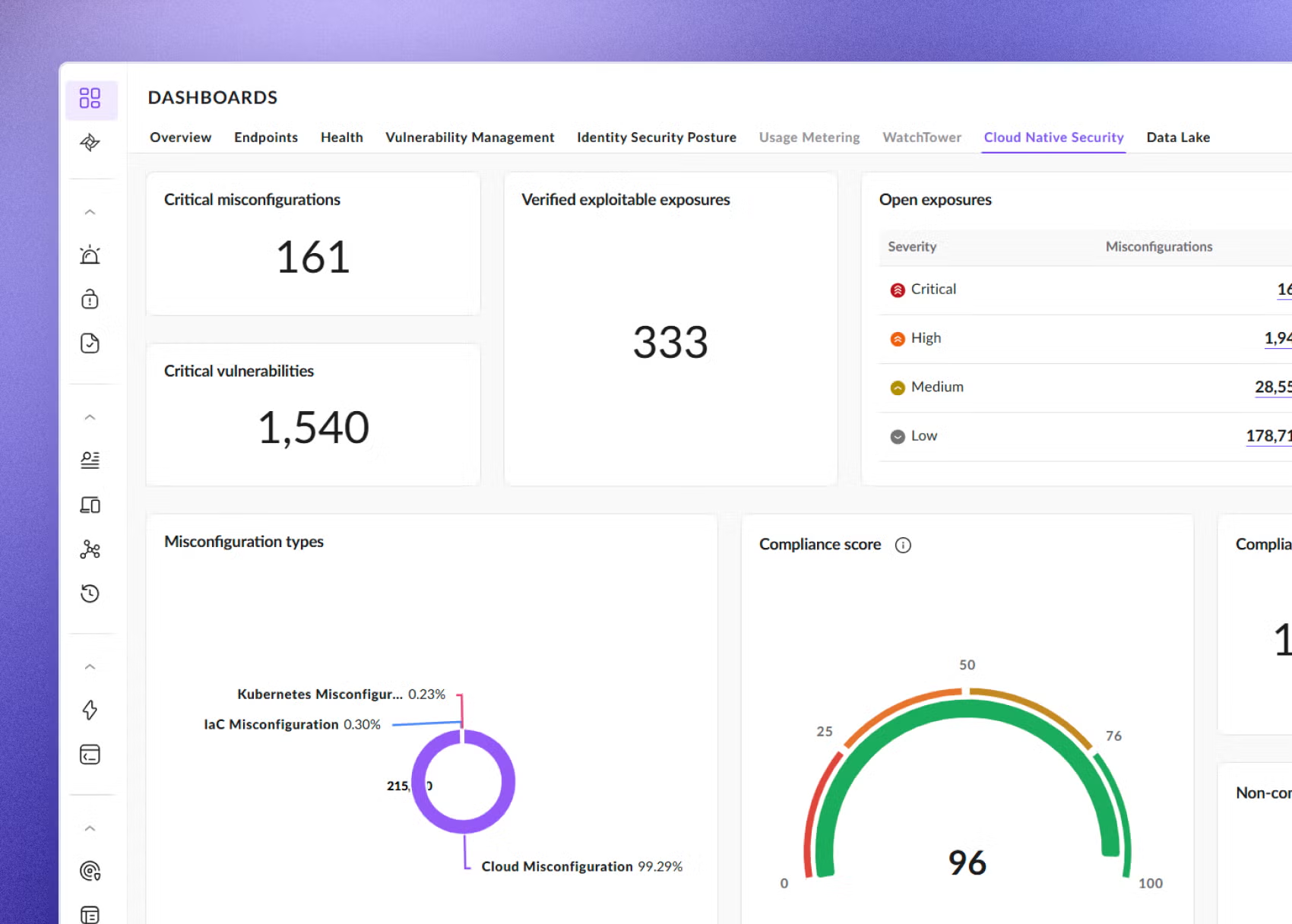
Wiz is an agentless cloud security platform that scans VMs, containers, serverless functions, and Kubernetes across AWS, Azure, GCP, and hybrid environments. We think the agentless architecture is the key advantage for DIB contractors: connect your cloud accounts and start scanning within hours rather than weeks, with no agent sprawl or complicated deployments. Wiz supports 100+ compliance frameworks and recently added a runtime sensor to its FedRAMP-authorized Wiz for Gov offering. Wiz was acquired by Google Cloud in March 2026 for $32 billion and now operates under Google Cloud while maintaining its brand.
- The Security Graph visualization maps how misconfigurations, vulnerabilities, and identity permissions combine into real breach paths.
- Instead of drowning you in thousands of unrelated findings, the toxic combination engine surfaces what’s actually exploitable.
- Pre-built CMMC and NIST 800-171 dashboards generate auditor-ready evidence packages with clear remediation guidance written in language engineers understand.
- The agentless approach means no maintenance overhead once connected.
Users consistently praise the prioritization capabilities and intuitive interface. Security teams report reaching zero critical issues within months using actionable remediation steps. Engineering teams use the platform autonomously without constant security oversight. Users report the learning curve takes time to navigate, and risk ratings update frequently, which can surface new critical findings without underlying changes.
We think Wiz fits organizations running significant cloud workloads who need continuous posture management for CMMC. The agentless deployment and pre-built CMMC dashboards deliver time to value in hours, not weeks. If your infrastructure is primarily on-premises, the platform won’t address your core risks.
Strengths
Cautions
CMMC Compliance Pricing
Pricing for CMMC-compliant solutions varies significantly by deployment size, modules selected, and contract terms. Many platforms in this category are quote-based, reflecting the enterprise and government nature of the buyer. The figures below reflect publicly available starting prices where they exist.
| Product | Starting Price | Billing | Link |
|---|---|---|---|
|
Huntress
|
$8.99/endpoint/month (direct)
|
Monthly/Annual
|
|
|
Check Point Infinity
|
Contact for quote
|
Annual
|
|
|
CrowdStrike Falcon Complete
|
Contact for quote
|
Annual
|
|
|
Drata
|
From $7,500/year
|
Annual
|
|
|
Oracle Government Cloud
|
Contact for quote
|
Usage-based
|
|
|
Proofpoint Government
|
Contact for quote
|
Annual
|
|
|
SentinelOne Singularity
|
From $69.99/endpoint/year
|
Annual
|
|
|
Vanta
|
From $10,000/year
|
Annual
|
|
|
Wiz
|
Contact for quote
|
Annual
|
|
CMMC Compliance Checklist
These are the configuration and operational steps we recommend when building a CMMC-compliant technology stack.
Knowing which of the 110 requirements you already meet prevents you from buying capabilities you don't need.
Auditors expect real-time proof of control implementation; point-in-time screenshots are no longer sufficient for Level 2 assessments.
A compliant configuration today can drift out of compliance tomorrow; real-time monitoring catches gaps before auditors do.
CMMC Level 2 requires audit logging and review across all systems; centralized SIEM or log management makes this auditable.
Solutions processing Controlled Unclassified Information should carry FedRAMP Moderate authorization or higher to meet DFARS requirements.
CMMC requires documented incident response capabilities; quarterly exercises prove your team can execute, not just document, the plan.
MFA is a baseline requirement across multiple CMMC control families and is one of the first things assessors verify.
A POA&M demonstrates awareness and intent to remediate; assessors view it as a sign of maturity, not failure.
CUI typically requires IL4 or IL5 environments; hosting it in a standard commercial cloud region creates a compliance gap.
A pre-assessment identifies gaps while there's still time to remediate, reducing the risk of a failed certification attempt.
The Bottom Line
CMMC 2.0 compliance requires architecture, not solutions. No single product will get you to Level 2 or Level 3. You need detection, compliance automation, and infrastructure working together.
For endpoint threat detection with minimal operational overhead, Huntress Managed EDR delivers human-led SOC capabilities without building one. The auto-remediation reduces false alert triage.
For compliance automation that actually reduces the audit scramble, Drata excels at multi-framework evidence collection. Vanta provides continuous monitoring that shifts compliance from periodic fire drills to steady-state operations.
For autonomous detection that works without constant analyst attention, SentinelOne Singularity delivers strong coverage. Pair it with a compliant SIEM if you pursue Level 3.
For cloud-heavy DIB contractors, Wiz provides agentless scanning with pre-mapped CMMC dashboards. Deployment and value realization happen in hours, not weeks.
For critical email defense with FedRAMP authorization, Proofpoint Government Threat Protection targets government attack patterns specifically. CrowdStrike Falcon Complete delivers expert-led MDR with 24/7 SOC when you need certainty and can justify premium pricing.
Read the individual reviews above to dig into deployment specifics, compliance mapping, and the trade-offs that matter for your DIB operations.
CMMC 2.0 Compliance FAQs: Everything You Need To Know
CMMC is a set of standards that all organizations aiming to win DoD contracts must prove compliance with. It is designed to protect sensitive data, whether from malicious attack or from being exfiltrated to invalid users.
CUI stands for Controlled Unclassified Information. This relates to government sensitive information that needs to be protected properly, even if it is not sensitive enough to be deemed “Classified.” It is this type of information that the CMMC 2.0 framework is looking to protect.
You can build your infrastructure around existing NIST CSF or ISO 27001 frameworks as CMMC 2.0 builds on the good work already established by this guidance.
It is important that you first carry out an audit of your current policies and procedures, identifying areas that you are adhering to compliance frameworks, and areas where you need to alter processes. Some of the solutions on this article will help you identify these coverage gaps.
Then, you can take steps to address these areas. You may need to improve security infrastructure or the way that you monitor your own internal processes. The specific steps that each organization will need to take will differ depending on your own circumstances.
GRC And Compliance Resources
Further reading on grc and compliance from Expert Insights — buyers' guides, comparison articles, and platform-specific shortlists.



 Written By
Alex is an experienced journalist and content editor, working alongside software experts to research, write, meticulously factcheck, and edit articles relating to B2B cybersecurity and technology solutions, focusing on topics such as DevSecOps, network security and firewalls, and cloud infrastructure security.
 Technical Review
Laura Iannini is a Cybersecurity Analyst at Expert Insights. With deep cybersecurity knowledge and strong research skills, she leads Expert Insights’ product testing team, conducting thorough tests of product features and in-depth industry analysis to ensure that Expert Insights’ product reviews are definitive and insightful.
Laura also carries out wider analysis of vendor landscapes and industry trends to inform Expert Insights’ enterprise cybersecurity buyers’ guides, covering topics such as security awareness training, cloud backup and recovery, email security, and network monitoring. Prior to working at Expert Insights, Laura worked as a Senior Information Security Engineer at Constant Edge, where she tested cybersecurity solutions, carried out product demos, and provided high-quality ongoing technical support.
Laura holds a Bachelor’s degree in Cybersecurity from the University of West Florida.