AI is no longer a side project. It is creeping into every corner of the business: employees using GenAI tools, teams building AI into products, and early experiments with AI agents doing real work.
For CISOs, this creates a simple but tough question: which AI security solution can you actually trust?
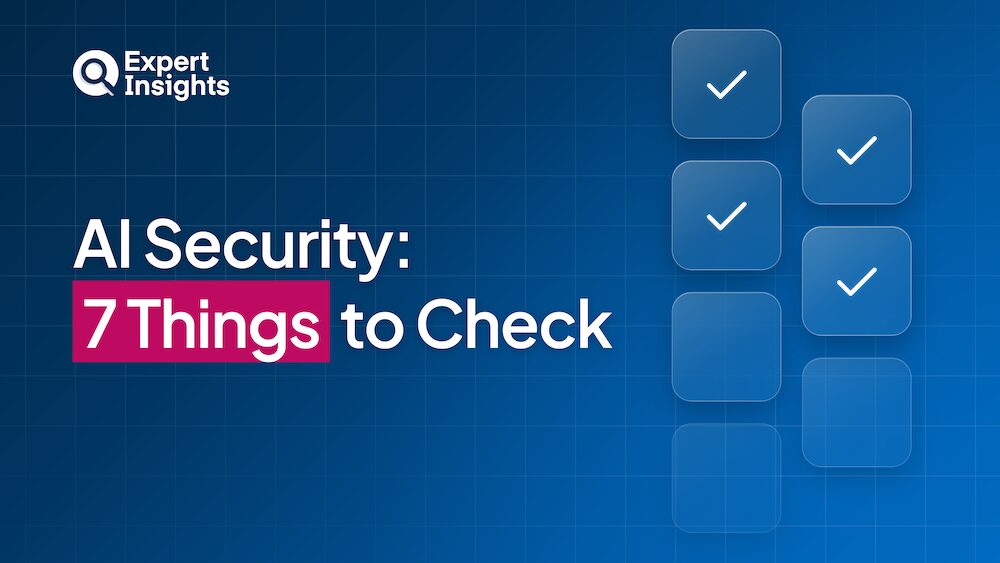
The market is crowded, and the claims are loud. To make sense of the noise, it helps to look at a short, practical checklist. Here are seven things worth checking before you sign a contract.
1. Can It See All of Your AI Use, Not Just One Slice?
The first test is visibility. A serious AI security platform should help you answer a basic question: “Where is AI actually being used in my company?”
You want coverage across:
- Employee use of public GenAI tools
- AI features inside your own apps and services
- AI agents that can talk to other systems and data
If a solution only covers one of these, you are leaving blind spots. Look for “shadow AI” discovery and clear reports that show who is using what, and how.
2. Does It Understand AI-Specific Threats?
AI brings its own set of risks. Traditional tools were not built to deal with things like:
- Prompt injection and jailbreak attempts
- Models leaking sensitive data in responses
- AI agents taking unsafe actions with real systems
A good AI security solution should name these threats clearly and show how it detects and blocks them. If the product pitch sounds like generic network or endpoint security with an “AI” sticker on top, that is a warning sign.
AI security risks go beyond prompt injection and data leaks. Understanding the broader challenges can help security teams make better decisions about protection and oversight. Read more about AI security risks CISOs need to know.
3. How Well Does It Protect Data in Prompts and Responses?
Much of the risk from AI comes from the data it processes. Employees paste sensitive information into prompts. Customer-facing AI apps process personal or business data. Agents often sit in the middle talking to back-end systems and databases and moving information around quietly in the background.
You need the platform to act like a safety net around all of that activity. In practice, that means it should be able to:
- Spot when sensitive or regulated data shows up in prompts or context
- Strip out, mask, or rewrite risky pieces before they leave your environment
- Enforce clear rules about which models and apps are allowed to see which types of data
- Keep an eye on AI responses so they do not “spill” more information than is safe
If a vendor cannot walk you through how they stop data from leaking through employee AI use, internal AI apps, and agents connected to live systems, then you probably have your answer: move on.
4. Can It Integrate Cleanly With Your Existing Stack?
Most CISOs already run a complex security stack. The last thing you need is another standalone console that does not talk to anything else.
In the integration section of your review, check how the solution fits into the tools you already use. For example, Check Point’s AI Security portfolio is built around an “AI Defense Plane” that unifies discovery, protection, and governance. For teams already using Check Point, a Check Point AI security solution can extend visibility and protection across employee AI use, applications, and agents while helping enforce consistent security policies.
Ask each vendor:
- Where does this solution live in my architecture?
- How does it integrate with my existing identity, network, and cloud tools?
- Can I reuse policies and data I already have?
The more it fits into your current workflows, the more likely your team will actually use it.
5. How Much Can You Automate, and How Safe Is That Automation?
AI is not only about detection. It is also about what happens next.
Look closely at:
- What the platform can block or limit in real time (for example, risky prompts, unsafe model outputs, and high‑risk agent actions)
- How you define policies and “guardrails”
- Whether there is a clear way to keep a human in the loop for high‑impact decisions
You want useful automation, not a black box that might shut down something critical in the middle of the workday. A good system lets you start in “monitor only” or “recommendation” mode, then move to more active controls once you are confident.
6. Does It Support Testing and Red Teaming for AI?
AI systems need to be tested in the same way you test applications and infrastructure, but with AI‑specific techniques.
A mature AI security solution should offer or integrate with:
- AI red teaming to simulate prompt injection, jailbreaks, and data leakage attempts
- Assessments of your AI models, apps, and agents against real‑world attack patterns
- Clear reporting on weaknesses and suggested fixes
Security teams can learn more about how AI systems are being attacked by studying documented attack techniques and using those findings to guide AI red-team testing.
Check Point, for example, highlights AI red teaming and assessment powered by data from a large training platform (Gandalf). Whatever vendor you choose, make sure they are not just defending today but also helping you find gaps before attackers do.
7. Is It Built for Governance, Not Just “Cool Tech”?
Finally, think about governance. You are not just protecting systems; you are also answering to the board, auditors, and regulators.
A CISO‑friendly AI security solution should help you:
- Set and enforce enterprise‑wide AI usage policies
- Show who used which AI tools, for what purpose, and with which protections
- Produce reports for audits and compliance checks
- Align AI use with your risk appetite and industry. If the platform does not provide clear, repeatable answers, it will be hard to tell executives, “Yes, we are in control of AI risk.”
The generative AI risk management guidance from NIST can also help organizations build a structured approach to identifying and managing AI-related risks
Bringing It All Together
Choosing an AI security solution is not about chasing buzzwords. It is about covering the real ways your people, systems, and customers are already using AI.
When you evaluate options, keep coming back to these seven checks: visibility, AI‑specific threat coverage, data protection, integration, safe automation, testing, and governance. If a platform can show strength in each of these, you are much closer to something you can trust.
The tools will evolve, and so will the threats. But with the right AI security foundation, your team can move from reacting in fear to guiding the business with confidence as AI becomes part of everyday work.