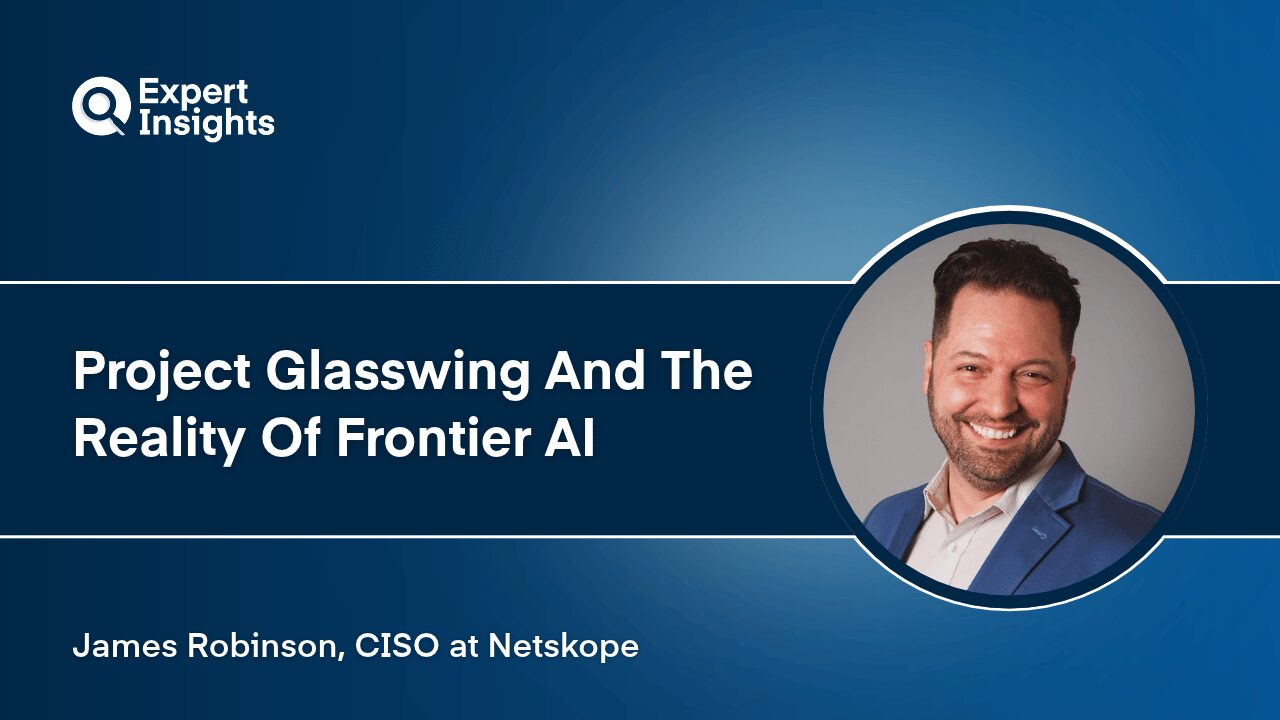
James Robinson is a cybersecurity leader whose career has spanned more than 25 years across data, application, product and cloud security.
Robinson started out in computer networking and pen testing, holding roles at State Farm and Anheuser-Busch before moving into product security at Emerson. He went on to become Security Architecture and Strategy Officer at Websense and later led Optiv’s third-party risk management business.
Today, Robinson is CISO at Netskope, having joined as Deputy CISO in 2018. Netskope is part of Anthropic’s Project Glasswing and OpenAI’s Project Daybreak, which gives a small group of organizations early access to the unreleased Claude Mythos model to find and fix vulnerabilities. Robinson’s team has been testing these models against Netskope’s own products.
He is also co-founder of The Alliance, formerly the Security Advisor Alliance, a nonprofit that aims to empower the next generation of security professionals.
Expert Insights spoke to Robinson as part of our ongoing series interviewing cybersecurity professionals to bring you their unique insights into cybersecurity today, the challenges they are facing and the realities of what it takes to defend complex global environments.
What challenges are you and your team dealing with on a daily basis, and how have those challenges evolved over the last year?
Right now, it’s the speed, and knowing where to invest. Take the move to a fully agentic SOC, which is a buzz term right now. As a team, we’re working out how to move from a pipeline approach to a SIEM, then to something else, and then into a fully agentic SOC. How do we make those moves when the market is very noisy and there are no good roadmaps for it?
At the same time, there are plenty of attacks and threats in this emerging landscape. Everyone got really excited about new AI attacks, like prompt injection. That’s a new class of attacks, a whole new set of common weaknesses, and we have to worry about those.
But I spend more time worried about an idea I’ve been sharing with the team recently: that APT no longer just means advanced persistent threat. It means agentic persistent threat, where AI agents are constantly trying to break into your organization.
When I started preparing the team to respond to these attacks, we found ourselves very underprepared. It wasn’t that we needed a tool. We didn’t have the basic procedures down. So, we built an incident response playbook specifically for an AI system getting compromised, covering the information we’d need to grab.
We’ve since had internal incidents of exactly that type, where someone said, “I just told it to do this. I didn’t realize it was going to do that.” Luckily, it was caught before it caused any damage, and because of the playbook, we knew which data sets we needed without having to think on the fly. We’re now working to open source it to help the rest of the industry, which is something you can do at a security company that wasn’t always possible in other industries.
Through Project Glasswing you got access to Claude Mythos, an unreleased model Anthropic says can outperform most humans at finding vulnerabilities. You led the effort with a cross functional team, pointing it at your own products, and it found nine kernel-level bugs plus seventeen in the open-source underneath them. That’s code your team had presumably already tested. What had your existing testing been missing, and why do you think it had been missed?
One early principle I was taught in pen testing and hacking is that everything can be broken into. You just need enough time, enough focus and attention, and some skill. Think about password cracking in the past, when you had to build hash tables to precompute everything before you could even start. That took a long time. Now, with AI, you get the skill and the speed together, so you don’t need anywhere near that much time to break into things.
We’d been building up team members to do advanced fuzz testing and security testing. When we paired those team members with a more than capable model, like Mythos or OpenAI’s cyber model, they started finding more advanced things we just hadn’t been able to get to: multi-step attacks, and RCEs we hadn’t previously discovered. That was primarily down to time, not capability. It was the speed at which the model could work through it.
But the model couldn’t do it alone. I don’t think we’d have gotten there just by saying, “Go break into my tooling.” What made it work was plugging the model into the fuzz testing frameworks and harnesses we’d spent years building, then letting it branch out into other areas from there.
The surprising part was who was finding these issues. These were people with five or seven years of experience, not 15 or 20, and they were uncovering much more advanced bugs. That was an eye-opening moment.
Netskope has access to a model most security teams never will, and a team that can build the tooling around it. What should a CISO without those resources take from the fact that a model found bugs your own testing hadn’t?
For me, it was validation that these capabilities are real. I went into it a little skeptical, thinking, “Really? Let’s test it and see.” We were fortunate to be part of Anthropic’s program, and OpenAI’s too, and we’re now testing Google’s cyber model as well. We’ve also tested open-weight models like Kimi and GLM on compute stacks we built ourselves.
For a CISO who doesn’t have access, there are a few things you can do. First, explore whether you can get access through your partnerships, even through a contractor or consultant. Second, if you can host your own models and test with open-weight models, do it. Let your team go and play. Build a GPU stack with five or 10 GPUs and test that way. Your team will see the capabilities for themselves and be able to recreate them.
Third, think about that shift from advanced persistent threat to agentic persistent threat, because that’s what’s going to shape how things happen in the future. We’re probably one or two hardware generations away from being able to run these models, or some level of them, on our own computers, so they’ll be within anyone’s reach.
Keeping them off devices will be like trying to keep pen testing tools off laptops: an ongoing battle. My son is even starting to play with models that have been jailbroken, using a GPU he had for gaming. It’s slower, but the models are out there and available.
Seventeen of those findings were in open-source code your products are built on — other people’s projects, maintained by people with no deadline and no budget. Walk me through what happens next when you find something like that.
It’s a tough decision, honestly. We’re looking at partnerships with a US government project and some of the vendors supporting it, so we can start to maintain and pay for patching. The bad news is that’s more money that has to go into this.
In the past, when we’ve found vulnerabilities in open-source projects, we’ve sometimes fixed them ourselves. We have people in the company who are part of those communities, know someone in them, or can join them and help fix things. But that’s a luxury I didn’t always have at other companies.
The industry needs to come together around some of these open-source projects. The most amazing example I’ve seen is Google’s Project Zero, which went through core internet infrastructure, libraries and systems looking for flaws. My guidance to both Anthropic and OpenAI has been that they should try to create the same kind of community and tackle these as they come up.
For our part, we took our findings directly to the open-source community through our threat labs. That’s our responsibility. We’re also working with companies like Chainguard, which are building programs that let their customers virtually patch this software or keep it up to date.
You gave a model the freedom to choose its own path to a target. What were you not willing to let it do, and who decided that?
We gave the model a target, like “break into our web UI,” inside a trusted environment we’d set up, and then let it choose how to get there. It could go through the APIs or the web UI, or, when we pointed it at one of our appliances, the CLI. In some cases, it even started trying to communicate with the appliance over other protocols, which we looked into afterward. The thinking was that if we want a model to find something new, we shouldn’t test the same areas we’ve always tested. We wanted it to take a different path based on its own analysis, rather than making it too structured.
What we didn’t want it to do was any production testing, and at first we didn’t give it access to source code. It had design documents and information like that, then later we gave it more access within the test environment. We were treating the model like a pen tester, stepping it up from black box toward white box testing and giving it more and more visibility.
Taking it in stages also gave us a comparison to the real world. One question I get asked is, “Are we secure?” That’s the worst question. It’s like asking a weather forecaster whether the weather will be nice, and they start talking about barometric pressure, when all you want to know is whether to wear a coat. I want to be able to say, “In these areas, we have it covered. In others, we could invest a bit more.”
So, if someone asks what happens if an attacker uses Mythos against us, we know they’d start with very limited, remote access, then step up, maybe getting an account on our web UI or some of the software we ship. We wanted to mimic that, and we had the time to do so.
Glasswing is invitation-only, so you have access most security teams don’t. Does that come with an obligation to the rest of the industry? And what are the ways that knowledge actually reaches the people who need it?
There is some obligation, which is why we help the open-source community fix those flaws and clearly communicate the vulnerabilities we’ve found as we patch them and roll them out. I see it as a luxury and an opportunity we were given to secure ourselves.
Then there’s how you communicate with people who didn’t have access. One surprising thing came up when I recently visited our team in Bangalore, which includes a lot of our AppSec team and pen testers. Until we really sat down and talked about it, they hadn’t internalized that they’d had access to something years ahead of everyone else. It clicked when they’d join calls with peers who’d say, “Let me tell you about Mythos,” without ever having used it. Part of our role is keeping everyone honest by sharing what we actually saw.
We also break real attacks down step by step. What were the steps of the AI-driven attack on Hugging Face, or of the Mythos breakout, where it registered a brand new account on PyPI and uploaded a malicious binary?
If you threat model those steps, you can see where you already have a good position and where you might need to invest. An employee creating an account on a third-party web service and uploading something isn’t far-fetched. We know what that attack looks like. It just happened to be AI doing it. So how good are you at detecting and responding to it?
It’s like knowing your own house in the dark. Most homes have a creaky step, maybe the second or third one on the stairs, and your front door makes a different noise than your side door. When you’re lying in bed and hear something, you immediately know someone just came in the side door and stepped on the third step. Break an attack down the same way, and you’ll know exactly where the attacker is and how far they’ve gotten.
We’ve done that internally, using the Cyber Kill Chain as a baseline. Take the Hugging Face attack. If an AI agent running inside your organization did the same thing, you’d see it carry out reconnaissance against Hugging Face, escape its sandbox through an exploit on a proxy, and then generate strange activity against a SaaS application. In total, it came to 17,000 actions in 4.5 days, one zero-day and three data sets exfiltrated. If I asked our SOC whether we’d spot one entity making 17,000 actions in 4.5 days, the answer is yes, immediately. It would stand out on any chart. As it stands today, and this could change very fast, these models are very chatty and aren’t trying to be covert. So as long as you have the visibility, you have a strategic advantage against some of these attacks.
When Hugging Face was breached in July, the AI tools they wanted to use to investigate refused to help, because the safety controls couldn’t tell their investigation apart from an actual attack. They fell back to running a model on their own systems. Have you run into that? And for a CISO who has AI somewhere in their incident response right now, what should they be checking before they find out the hard way?
I have run into it, and I was able to prompt my way past it. But that’s a big burden for anyone in the middle of an incident. That’s not the time you want to start using adversarial steps to get around a model so you can do your analysis, so that’s part of being ready and prepared.
We’ve had systems we started building where the models wouldn’t support the automation and security response we wanted, so we had to change models and move internally. Some models were even blocking our own product from doing what we wanted, so we moved to more responsive models with better prompts.
It highlights the value of prompt engineering. I’ll admit a little bias here: when it first came out, I thought, “Prompt engineering, really? That’s a job?” But having done attacks myself, and seen others run into these problems, I can see how valuable it is. It’s all about how you set up the context and the prompt to get the outcome you want. If your model is blocking you, you have to find models that will support you, but you don’t always have to go to open-weight or attack models.
Sometimes you just need to get better at your prompts. I love the little wand in Gemini Gems that improves your prompt, because it shows you what context a good prompt needs. If you just cram in a prompt without that context, it’s garbage in, garbage out. Or, in this case, garbage in, fail to execute.
Most organizations now have AI agents operating somewhere in their environment, often without anyone having formally approved them. If a CISO wanted to find out what’s actually running in their own organization this week, where would you tell them to start looking?
Think about where your biggest attack surface might be, or your biggest threat and risk surface, because those can be different. What people are running on their own devices may be completely different from what’s running in production, so you can focus your scope.
Something we did early on, which I’d strongly recommend, was draw a hard line through our AI governance committee. On one side are business-critical systems, where we have to inspect any AI going into them much more deeply.
On the other are areas where we don’t need as deep an analysis, and we have to be okay with that, because we want to adopt the technology. From there, you can do a quick check on the areas where you know there should be no AI running, then focus on the areas where risk is more likely, such as teams where more people have admin rights on their computers and are likely to download and install tools.
Our AI governance committee is amazing. It’s led by a business unit leader, not by security, legal or privacy, with security, legal and others included. That takes it away from the doom and gloom, “we can’t allow anything” conversation of the security purist or the very risk-averse, and makes it a very directional business conversation.
I started doing AI governance reviews three or four years ago, well before AI governance committees existed. Working with our teams that were building AI, I quickly realized I could slam the brakes on things, and that’s never a good place to be as a CISO. I won’t be around very long if I keep blocking things without solid reason. I reserve pulling the plug for when it’s really needed.
Otherwise, the question is: how do you get to yes? If developers want to use coding agents, the answer shouldn’t be no. It should be, “Yes, we just need a vendor review and a couple of extra solutions to keep developers safe.” Or, “Yes, but 80% of our repositories have good hygiene and no credentials in them, so we’ll start there and fix the other 20%.” And if there is an incident, you already understand what they were building, so there’s no finger-pointing.
We also created an ambassador program, because security had become a bottleneck. People were bringing so many use cases that even checking whether a vendor was approved took too long. So we put ambassadors in each business unit to handle that first request. We train them on the tooling and what’s approved, they keep their own list of use cases, and they meet regularly to share what’s happening in their areas.
They’re in marketing, sales, product and customer success, not security or privacy, and they govern themselves and escalate when needed. Too many governance committees I hear about from peers are the same people again: legal, security, privacy and HR. None of them are revenue-generating teams. It’s almost like banding together to protect ourselves.
What advice would you give to fellow CISOs and industry practitioners?
First, you have to make a decision. Making no decision is a decision, and in my opinion, it’s a bad one. You’re just gridlocked.
Second, understand that this technology is too hot and too big, and people have their own FOMO about being replaced if they don’t know it, so they’re going to figure it out anyway. You have to give them a pathway and communicate it better. “No” shouldn’t be the default answer. It should be, “Yes, but here’s how we get there.” That includes your own team. If CISOs aren’t enabling their teams to learn and understand AI, they’re setting them up to be disrupted. Nobody wants to tell their team, “Sorry, I held you back, and now I have to replace you with next-generation talent, because they know it and you don’t.”
On that note, I find that people coming straight out of college or new to cybersecurity, which I once was, are eyes wide open. They don’t come with the baggage or history, so they can go after new technology. We could all still be running on dial-up modems, but I think everyone enjoys high-speed broadband and Starlink at this point.
Recently, I was working on a car with my son, typing prompts to troubleshoot it, and he said, “Dad, why don’t you just dictate to it? Hit the microphone and tell it what to do.” He was right. I could do it much faster, and it did an excellent job of telling me the next step.
Build safe places to enable your own team and the next generation of talent you bring in, because the faster you get them going, the faster you can safely adopt these technologies.