Every week there are 1968 cyber-attacks, that’s up 18% from 2025, and 70% from 2023. IYour data has always been one of your most important assets, but these figures underline how hard it can be to protect it.
As with every cybersecurity category, there are multiple tools and solutions vying for your attention, each promising to address the issues you face, before you are aware a problem exists.
In this article we’ll explore two of the main solutions in the data protection landscape: Data Loss Prevention (DLP) and Data Security Posture Management (DSPM). We’ll highlight the main uses, before breaking down their strengths, weaknesses, similarities and differences.
To find out which DLP or DSPM solution might be best for your environment, we’ve compiled shortlists of the top products.
DSPM Overview
Data Security Posture Management is designed to continuously discover, classify, and protect sensitive data across cloud, SaaS apps, databases, and hybrid environments.
DSPM achieves this by mapping where sensitive data resides, rather than securing the network perimeter.
Key capabilities include:
- Automated data discovery / classification
- Access mapping
- Risk scoring
- Misconfiguration detection
Historically, DSPM emerged alongside the explosion in uptake of Cloud and SaaS data. These new avenues would outpace manual audits, requiring a new solution that could keep up.
DLP Overview
Data Loss Prevention is a cybersecurity strategy, as well as tool category, built around protecting your data and monitoring any instances where it might be moved without authorization.
DLP covers all data loss related risks, from accidental publication or sharing, to malicious leaking, and over privileged third-party tools.
Key capabilities include:
- Monitoring and blocking unauthorized file sharing
- Logging file access
- Managing access permissions
As security professionals have come to realize that data is the real asset of value, compliance frameworks have emerged, addressing the threats. The most prominent frameworks include PCI DSS and HIPAA, both built around preventing exfiltration.
Similarities Between The Two
Let’s consider the areas where DSPM and DLP overlap, highlighting how much shared territory there is.
- Both aim to protect sensitive data from exposure or loss – that much is self-evident.
- Both achieve this by classifying data – This data is often classified as Personally Identifiable Information (PII), Payment Card Industry (PCI) data, and Intellectual Property (IP).
- Both feed into compliance reporting frameworks – these tend to include GDPR, HIPAA, and PCI DSS.
- Both technologies are having to evolve quickly to address the burgeoning use of AI.
Areas Of Differences
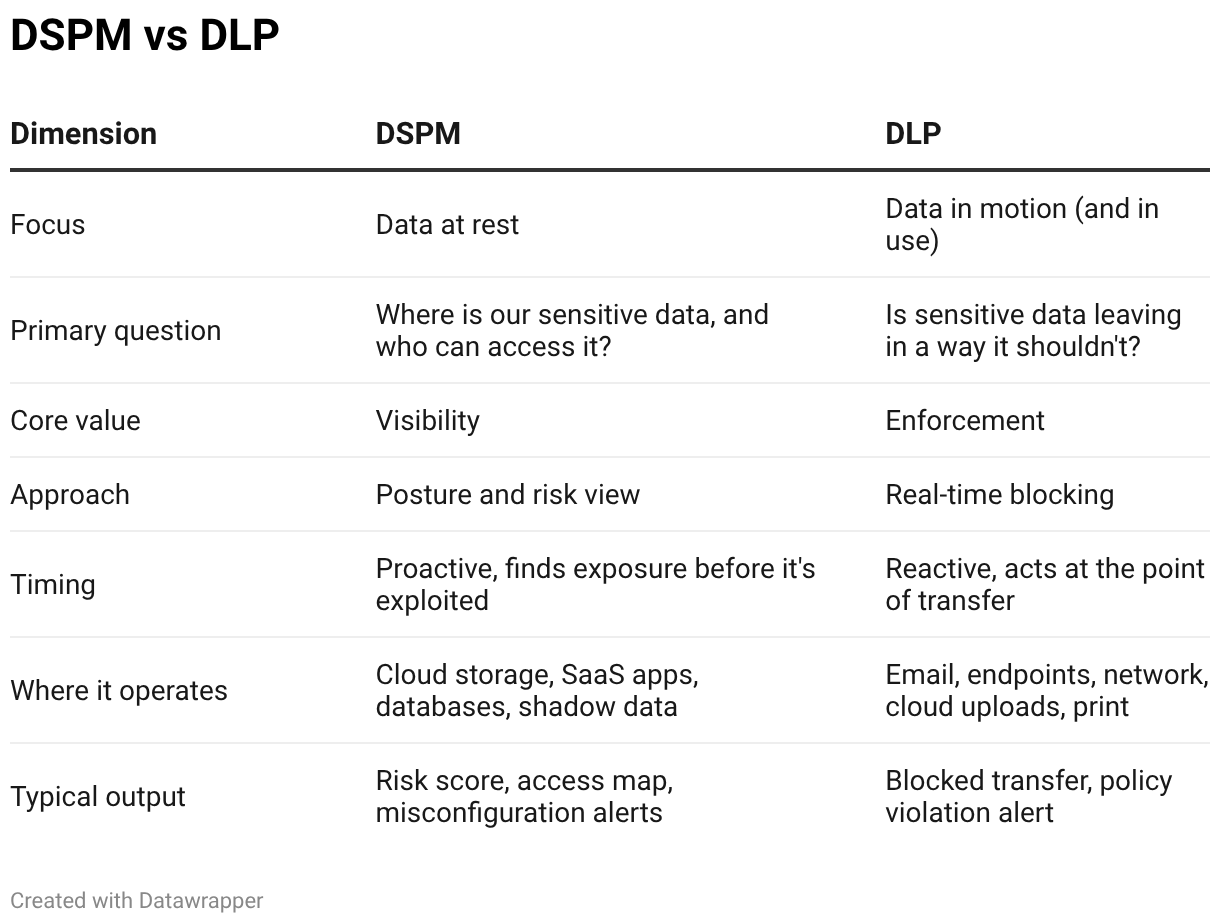
DSPM takes a proactive approach that identifies and fixes exposure before it can be exploited. By preventing there being an opportunity for data exfiltration, it’s much harder for an attacker to find the data they’re after. DLP, on the other hand, takes an enforcement based approach. It implements policies at the time of data transfer, attempting to package it in a way that makes it hard for an attacker.
DSPM is the newer of the two and consequently is better suited to cloud-native environments and risks associated with shadow data. DLP tends to be more effective on endpoints, email, and network channels.
The strengths and weaknesses of each are different. DSPM, for instance, is not able to monitor data leaving the organization, meaning you might not be able to quantify the scale of a breach. DLP, however, is unable to identify overexposed data that may be unmonitored. This would be an enticing target for attackers.
One To Replace Another, Or Using Them Together?
DSPM and DLP cannot be used interchangeably. They are set up to do different things. While they’re both set up to address risks relating to data loss, they don’t cover the same territory.
Instead, the most powerful approach is to layer one system on top of another. DSPM will tell you what to protect and identify where the exposure is, while DLP can be used to enforce the policy while data is in transit.
This is a trend we’re starting to see within the data protection space already. DLP vendors are adding DSPM-style discovery features, giving you the best of both strategies. Similarly, vendors known for their DSPM approach are adding enforcement capabilities. While these two categories are converging, we are yet to see them completely unify.
Actionable Advice
For organizations that are looking to layer the two technologies, we’ll walk through how best to put this into practice.
- Data Discovery – The first thing you need to do is audit your environment to understand how much sensitive data is exposed and where it resides. This capability can be part of a DSPM platform.
- Prioritization – Once you understand what and where your sensitive data is, you can start to address the risks and vulnerabilities. If sprawl is your biggest risk, focus on DSPM. This will help to address rapidly growing SaaS and cloud footprints. If you need to prove compliance with frameworks like PCI DSS and HIPAA, focus on DLP. This will ensure you can enforce the right controls to protect your data and ensure that it’s not being exfiltrated.
- Add Context – If you elect to use both DSPM and DLP tools, ensure they’re the findings and results can be cross referenced to inform future decisions. Use the access map and risk scores to tell DLP which repositories, file types, or user groups need the most stringent transfer rules. This informed decision making can be the single most important decision you make.
- Review Periodically – Data protection is not a set and forget activity. As data is always growing, evolving, and moving, you need to ensure that your approach to data protection is as focused and effective as it can be.
- Assign Ownership – Historically, DSPM results would sit under the data or cloud teams, while DLP enforcement would be under the SecOps team, this is an area where can infrastructure and ownership can be streamlined, resulting in reduced overlap or gaps.