
For most organizations, multi-cloud is no longer a strategic choice. It is the default.
New acquisitions bring in workloads from a different provider, developers select services based on capability, rather than corporate standard, and business units spin up accounts independently. Before long, production workloads end up spread across two or more cloud providers, each with its own security model, its own terminology, and its own tooling.
That fragmentation is the problem. Each provider handles security differently, and keeping a consistent posture across all of them is an operational challenge that most teams are still solving manually. When policies are enforced inconsistently, gaps form, and those gaps are where breaches happen.
We’ll walk through a practical framework for enforcing consistent security posture, compliance rules, and incident response across AWS, Azure, and GCP, with tool selection guidance to help your team put it into practice.
Why Multi-Cloud Creates Security Inconsistency
Each major cloud provider built its security model independently, and the differences run deeper than branding. Even fundamental concepts like identity management, default encryption behavior, and logging are implemented differently across all three:
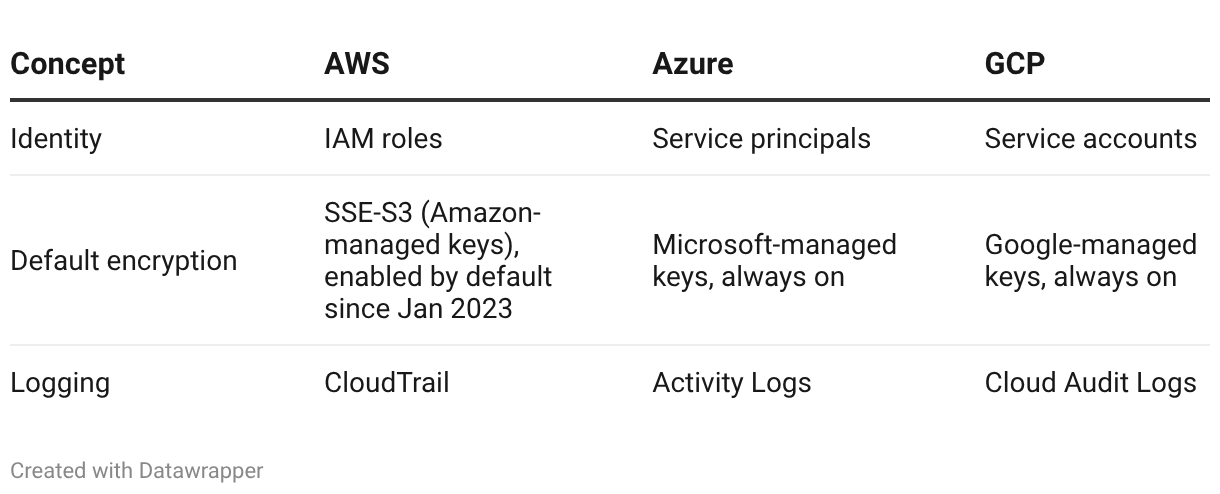
These are not just naming differences. They reflect fundamentally different default behaviors and security assumptions.
A security policy that is well-enforced in AWS can have real gaps in Azure simply because the controls are implemented differently. The human factor compounds this: teams specialize in one provider, meaning your AWS engineers and your Azure engineers enforce the same policy intent through different mechanisms, producing different outcomes. Without a unifying framework, cloud security consistency across environments is impossible to maintain.
Building a Provider-Agnostic Policy Framework
The foundation of any effective multi-cloud security strategy is a policy framework that separates intent from implementation. It is important to define your security requirements in provider-neutral terms first, then map each one to its provider-specific controls.
For example, “all object storage must be encrypted at rest with customer-managed keys” is a policy statement that applies everywhere, but the implementation looks different in each provider: AWS maps it to SSE-KMS on S3, Azure maps it to customer-managed keys in Blob Storage, and GCP maps it to CMEK on Cloud Storage. That abstraction layer, defining the requirement once and mapping it to each provider separately, is what makes cross-cloud policy enforcement possible. Without it, you end up maintaining three separate policy sets that inevitably drift apart.
CIS Benchmarks are a strong starting point for building this mapping, as they publish provider-specific versions that align to common control objectives. From there, organizations can maintain a central policy repository that serves as a single source of truth. Provider-specific runbooks branch from this repository, ensuring that every control traces back to a defined organizational requirement rather than existing in isolation.
Tool Selection: CSPM and the Abstraction Layer
A provider-agnostic policy framework needs tooling to operationalize it. Cloud Security Posture Management (CSPM) platforms serve this role by translating a single policy into automated checks across multiple providers. When evaluating CSPM solutions, look for native support across all three major providers, the ability to write custom policies beyond built-in checks, integration with your CI/CD pipeline for shift-left enforcement, and remediation guidance that maps back to provider-specific actions.
The alternative is relying on each provider’s native security tooling: AWS Security Hub, Microsoft Defender for Cloud, and Google Security Command Center. These tools are valuable as data sources, but they struggle as a unified multi-cloud security strategy. Three dashboards, three alert streams, and three compliance reports give you three partial views of posture, with no single pane of glass across the estate.
Native tools tell you what is happening within each cloud. They do not tell you whether your organization’s security posture is consistent across all of them.
Incident Response Across Cloud Boundaries
Incident response is where inconsistent multi-cloud security hits hardest. Breaches rarely stay within one provider’s boundary. Compromised credentials in AWS can be used to pivot into Azure AD within minutes, and when that happens, your IR team needs to correlate activity across CloudTrail, Azure Activity Logs, and GCP Audit Logs simultaneously. If your investigators are switching between three separate consoles mid-incident, response times suffer and critical context gets lost in the handoff.
Three elements make cross-cloud IR operational. First, centralized log aggregation, which means that all cloud telemetry flows into a single SIEM or XDR platform where investigators can correlate events across providers in one query. Second, consistent IR playbooks across providers, so that the escalation and containment process stays the same even when the technical steps differ between AWS, Azure, and GCP. Third, regular cross-cloud tabletop exercises that test your team’s ability to respond when an incident does not stay within one provider’s boundary. Most IR plans are written and tested within a single cloud. Real incidents rarely respect those boundaries.
Common Pitfalls
These pitfalls surface repeatedly across multi-cloud security programs:
- Treating each cloud as a separate security program – Separate teams, separate policies, and separate tooling produce separate postures. Consistency requires centralized governance.
- Over-relying on provider-native tooling – Security Hub, Defender for Cloud, and Security Command Center are inputs, not a strategy. Without a unifying layer, you have three partial views.
- Writing policies in provider-specific terms – Defining requirements as “enable SSE-S3” rather than “encrypt all object storage at rest” locks your policy to one provider and guarantees drift.
- Neglecting cross-cloud IR playbooks – An incident that pivots between providers will expose every gap in your response process.
- Assuming consistent configuration means consistent posture – Different default behaviors across providers mean the same Terraform intent can produce different security outcomes.
Final Thoughts
Multi-cloud is the reality, and consistent security posture across providers requires deliberate architecture rather than good intentions. The organizations that get this right build provider-agnostic policy frameworks, invest in tooling that abstracts across environments, and train their IR teams to operate across cloud boundaries.
Cross-cloud policy enforcement is not a tooling problem alone. It starts with defining what “secure” means for your organization in terms that do not depend on any single provider and then building the operational discipline to enforce that definition everywhere your workloads run.