Best 9 Enterprise IT Management Software For Business (2026)
We reviewed the leading enterprise IT management platforms on the range of infrastructure types they monitor, the quality of optimization recommendations, and how well each supports IT service management alongside technical operations.
 Written by
Joel Witts
Written by
Joel Witts
 Technical Review by
Laura Iannini
Technical Review by
Laura Iannini
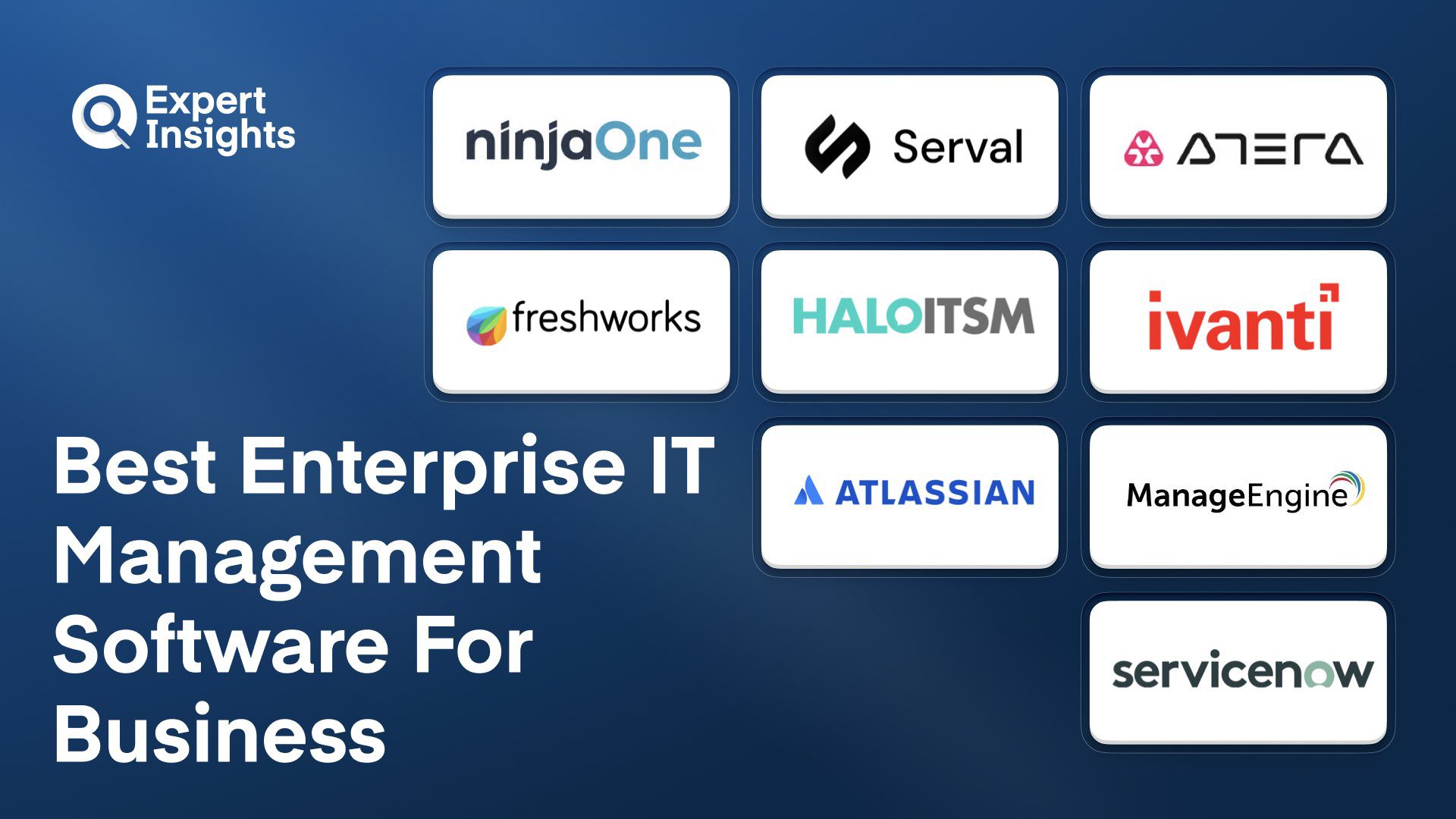
Enterprise IT operations have exploded in complexity. You’re managing hybrid infrastructure spanning on-premises, cloud, and edge. Your team handles incident response, change management, asset inventory, alongside patch management and service requests from non-technical staff. Multiple tools create silos and duplicate work, plus blind spots. The right IT management platform consolidates visibility and reduces manual overhead.
The challenge isn’t finding an IT management solution, it’s finding one that fits your organizational structure, handles your specific workflows, doesn’t create more work than it solves, and scales as you grow. Add integration requirements with your security tools, reporting needs for compliance, and support team preferences, and the field narrows quickly.
We evaluated 9 IT management platforms across MSP environments and enterprise IT departments. We assessed unified visibility across endpoints, servers, and networks, deployment simplicity and configuration overhead, admin console usability and customization options, workflow automation and integration capabilities, reporting and compliance features, and total cost of ownership at different scales.
This guide gives you the framework to match the right platform to your team structure, infrastructure complexity, and growth trajectory.
What is Enterprise IT Management?
Enterprise IT management software gives IT teams a unified view of everything happening across their organization's technology infrastructure. It combines monitoring (watching servers, networks, and endpoints for problems), service management (handling tickets, incidents, and change requests), and asset tracking (knowing what hardware and software you have) in a single platform. This replaces the collection of separate tools that most organizations accumulate over time, reducing blind spots and duplicate work.
Enterprise IT management platforms unify endpoint monitoring, IT service management, asset lifecycle tracking, and infrastructure visibility into consolidated consoles. Agent-based architectures deploy to managed endpoints (Windows, macOS, Linux) for real-time telemetry on system health, software inventory, patch status, and security posture. ITSM modules implement ITIL-aligned incident, problem, change, and request workflows with CMDB integration for configuration item tracking and dependency mapping. Automation engines handle conditional remediation, patch deployment with staged rollouts, and ticket routing with AI-assisted categorization. Enterprise platforms add multi-department service management extending ITSM into HR, facilities, and GRC functions. Integration with SIEM, EDR, vulnerability scanners, and identity platforms connects IT operations to security workflows. Multi-tenant architectures support MSP operations with per-client isolation and centralized management.
Enterprise IT Management Solutions Compared
This table compares the 9 enterprise IT management platforms we reviewed across their core capabilities.
| Product | Best For | Type | ITSM | Asset Mgmt | CMDB | Multi-Dept |
|---|---|---|---|---|---|---|
|
NinjaOne
|
MSPs and distributed IT teams
|
RMM/Endpoint Mgmt
|
No
|
Yes
|
No
|
No
|
|
Serval
|
Enterprises replacing legacy ITSM with AI agents
|
AI-Native ITSM + ESM
|
Yes
|
Yes
|
Yes
|
Yes
|
|
Atera
|
MSPs with per-technician pricing
|
RMM + Helpdesk
|
No
|
Yes
|
No
|
No
|
|
Freshworks Freshservice
|
Mid-market multi-department service
|
ITSM + ESM
|
Yes
|
Yes
|
Yes
|
Yes
|
|
HaloITSM
|
ITIL-aligned mid-market IT departments
|
ITSM
|
Yes
|
Yes
|
Yes
|
No
|
|
Ivanti ITSM Enterprise
|
Cross-functional enterprise service
|
Enterprise ITSM + ESM
|
Yes
|
Yes
|
Yes
|
Yes
|
|
Jira Service Management
|
Atlassian ecosystem teams
|
ITSM
|
Yes
|
Yes
|
Yes
|
No
|
|
ManageEngine ServiceDesk Plus
|
Deployment flexibility with AI
|
ITSM + ESM
|
Yes
|
Yes
|
Yes
|
Yes
|
|
ServiceNow ITSM
|
Large enterprises at scale
|
Enterprise ITSM
|
Yes
|
Yes
|
Yes
|
Yes
|
How We Tested
Expert Insights independently tests and reviews IT infrastructure and management solutions. We evaluated 9 enterprise IT management platforms across unified visibility, deployment flexibility, admin console usability, workflow automation, integration depth, reporting and compliance features, and total cost of ownership. We also analyzed customer feedback to validate vendor claims against operational reality. Read our full methodology
NinjaOne
Best for MSPs and internal IT teams needing centralized visibility across mixed endpoints
NinjaOne is a cloud-native unified IT management platform built for MSPs and internal IT teams who need centralized visibility across endpoints, servers, and workstations. We were impressed by the platform’s depth; from a single console, admins can monitor device health, automate patching, manage backups, and run remote support across Windows, macOS, and Linux. The platform is fully integrated, with all internal features working together and strong API integrations with third-party security and identity tools.
- Traffic light dashboard highlights critical actions with clickable device icons for hardware details and software inventories
- Activities dashboard provides detailed audit logs with granular filtering and SIEM ingestion via RESTful API
- Conditional policies with hundreds of out-of-the-box scripts for automated detection and response
- Patch Intelligence AI with CVE/CVSS-based prioritization, rollback, and forced reboot options
- Endpoint backup to cloud, local, or hybrid storage with MFA enforced for deletion
We think NinjaOne works best when you adopt it as your primary IT operations platform rather than layering it alongside competing tools. The per-device monthly pricing includes free unlimited onboarding support and training, and full deployment typically takes two weeks to a month. The interface is highly intuitive with strong visualization, making it accessible for teams of any size. NinjaOne’s strong reporting and auditing functionality supports businesses with high compliance requirements, and the remote-first architecture makes it a strong option for organizations that are geographically distributed or have a large percentage of remote workers. Something to be aware of is that NinjaOne is not an EDR tool and doesn’t protect against sophisticated threats like malware; it improves security posture through visibility, patching, hardening, and reliable backups.
Strengths
Cautions
Serval
Serval
Enterprises extending service management and automation across IT, HR, finance, and legal
Serval combines AI-native ITSM, access management, and an asset database in one platform, with an admin-facing agent that builds the automations connecting them. We were impressed by the breadth of applications for the platform; it can be run across multiple departments, including IT, HR, and legal.
- Catalyst (the platform’s admin agent) builds workflows, forms, access policies, journeys, and dashboards from natural language, ticket history, or existing Standard Operating Procedures (SOPs), generating TypeScript that admins can review before publishing
- Access management handles just-in-time provisioning and deprovisioning via SCIM, direct API, custom workflows, or infrastructure-as-code changes, as well as scheduled user access reviews
- Provides an enterprise configuration management database covering hardware, software licenses, SaaS subscriptions, and cloud costs with custom fields and asset relationships
- Handles onboarding and offboarding across multiple stakeholders, mixing automated and manual tasks
- Integrates natively with Okta, Entra ID, Google Workspace, Workday, Jamf, Kandji, ServiceNow, Jira, Zendesk, GitHub, Salesforce, and NetSuite, with a custom API framework for anything else
Customers praise Serval for its speed of deployment, and the amount of time and effort that the platform saves them through its automations. In particular, they highlight its support during user onboarding, managing just-in-time access requests, and dealing with IT help desk requests.
Although Serval is a relatively young vendor, it was launched in the age of AI and has been built with a sensible governance model and security guardrails. For example, the agent that builds automations is kept separate from the agent that runs them, and the platform stages every generated automation as a draft to keep AI-written code out of production without review.
Overall, we think Serval is a strong option for enterprises that want a single AI-native platform for service management, access governance, and asset data management. One thing to be clear about: Serval is not an RMM or endpoint management platform. It doesn’t offer patching, device monitoring, or remote control capabilities of its own; instead, it reads device state through Jamf, Kandji, and other MDM integrations. If one of your main requirements is unified endpoint monitoring, you’ll need to pair Serval with a dedicated tool.
Strengths
Cautions
Atera Enterprise IT Management

Atera
Best for MSPs managing mixed environments with AI-powered automation
Atera is an all-in-one RMM, helpdesk, and automation platform designed for MSPs and IT teams managing diverse client environments. The per-technician pricing model makes it attractive for organizations scaling across unlimited endpoints. We think it fits best for MSPs managing mixed environments, from legacy infrastructure to cloud and IoT workloads.
- Atera Copilot AI pulls real-time device diagnostics, recommends troubleshooting steps, summarizes tickets, generates scripts, and creates KB articles
- Per-technician pricing starts at $149/month billed annually with unlimited endpoints at every tier
- Extensive add-on marketplace covers security, backup, and endpoint protection
- Intuitive setup accessible for teams without deep technical expertise
Users highlight the monitoring dashboard depth and the range of available add-ons. The setup process gets consistent praise for accessibility, even for teams without deep technical expertise. With that said, some customers flag the licensing model for client portal access. The AI features may also require an adjustment period to align with your specific operational workflows.
We think Atera is a strong option for MSPs that want per-technician pricing without endpoint counting headaches. One gap to note: the platform does not handle cloud SaaS workload management or end-user licensing directly. If your practice centers on Microsoft 365 or similar SaaS administration, you will need complementary tooling. For traditional endpoint and network management, Atera covers the essentials well.
Strengths
Cautions
Freshworks Freshservice

Freshworks
Best for mid-size to enterprise organizations managing service operations across multiple departments
Freshservice is an IT service management platform that extends beyond traditional ITSM into enterprise service management. It handles IT, HR, facilities, and legal requests from a single portal. We think it works best for mid-size to enterprise organizations running service operations across multiple departments where the unified approach eliminates tool sprawl.
- Real-time visibility across hardware, software, and SaaS infrastructure through an auto-updating CMDB
- Freddy AI handles ticket categorization and prioritization, learning from historical data to route requests
- Multi-channel intake covers email, portal, mobile, phone, chatbots, and walk-ups with SLA tracking
- Built-in project management with templates for agile and waterfall workflows
Users highlight the consumer-grade portal experience. Non-technical staff can submit requests with minimal training, which drives adoption across departments. The ability to consolidate multiple tools into one platform comes up frequently as a cost and complexity reducer. With that said, customers note the initial configuration phase demands careful planning, especially for hybrid IT and facilities workflows. The feature depth creates a steeper learning curve, and teams report needing dedicated time to understand the full capability set.
We think Freshservice suits organizations wanting unified service management beyond just IT. If you need asset tracking alongside ticketing, this delivers. Freddy AI capabilities have been shown to deliver significantly faster resolution and response times compared to traditional ITSM approaches, which is impressive. The app marketplace and out-of-the-box workflows accelerate deployment.
Strengths
Cautions
HaloITSM

Halo Service Solutions
Best for mid-market IT departments valuing ITIL alignment with approachable usability
HaloITSM is an ITIL 4-aligned service management platform built for IT teams that need structured change, problem, and incident management. The focus is process standardization with enough flexibility to adapt workflows to your organization. We think it fits best for mid-market IT departments that value ITIL alignment and structured workflows without the complexity of heavier enterprise platforms.
- Change management with risk-based change control and CAB review workflows built in
- CMDB goes beyond basic asset tracking with dependency visualization between configuration items
- Built-in discovery and relational mapping strengthen the CMDB with automated asset intelligence
- AI capabilities assist with documentation creation and trend analysis from ticket data
Users consistently praise the balance between power and usability. The interface feels modern compared to legacy ITSM tools, and both technicians and end-users navigate it without extensive training. Setup and initial deployment get positive marks for simplicity. With that said, some customers flag the ticket lifecycle workflows as less customizable than expected, particularly pending-to-resolution workflows. UI customization options may not satisfy teams requiring granular interface control.
We think HaloITSM delivers strong ITIL alignment with a more approachable learning curve than heavier enterprise alternatives. The CMDB dependency visualization is a real operational advantage for teams managing complex infrastructure. If your team needs to standardize service delivery while maintaining visibility into configuration dependencies, this is well worth evaluating.
Strengths
Cautions
Ivanti ITSM Enterprise

Ivanti
Best for organizations extending service delivery across IT, HR, facilities, security, and GRC
Ivanti ITSM Enterprise is a service management platform designed for organizations extending service delivery beyond IT into HR, facilities, security, and GRC functions. The core proposition is a shared database of services and configuration items powering cross-functional workflows. We think it fits organizations with mature service management practices looking to standardize across multiple departments.
- Bundled modules cover GRC, Security Operations, HR Service Management, Facilities, and Project Portfolio Management
- All modules share a common configuration database for cross-functional workflow continuity
- AI Configuration Hub manages all AI capabilities from one place with AI-powered Ticket Classification
- GDPR-compliant data anonymization for ex-employee information
- Quarterly release cadence delivers predictable feature updates
Users value the one-stop-shop approach. Having service delivery, asset management, and strategic workflows consolidated in a single platform reduces context switching and data silos. The connector flexibility gets positive mentions for organizations with complex integration requirements. With that said, customers flag request offering configuration as lacking flexibility in certain key workflow areas. Support response times and issue communication have also drawn criticism.
We think Ivanti ITSM Enterprise makes the most sense for organizations that need GRC, security operations, and traditional ITSM under one roof. The shared configuration database eliminates silos between IT and business service functions. If your organization runs a simpler service management operation, the platform’s depth adds overhead without proportional return.
Strengths
Cautions
Jira Service Management

Atlassian
Best for organizations already running Atlassian products where dev-ops integration matters
Jira Service Management is Atlassian’s ITSM platform built to connect development, IT, and business teams on shared workflows. We think it delivers the most value when your organization already runs on Atlassian products, where the ecosystem integration creates workflow continuity that standalone ITSM tools cannot match.
- Native integration with Jira Software, Confluence, and Opsgenie eliminates handoff friction between development and operations
- Pre-configured templates with customizable request types and workflows for common service scenarios
- SLA tracking and automation rules handle routine ticket routing without manual intervention
- Opsgenie alerting capabilities consolidating into JSM for a more complete operations hub
Users highlight the daily usability factor. Teams report working in JSM without the frustration common to other ITSM tools. The centralized view of requests, incidents, and tasks keeps collaboration efficient across support and technical teams. With that said, customers flag initial setup complexity, particularly for smaller teams without dedicated Jira administrators. Native reporting also requires extensive customization or add-ons to meet advanced needs.
We think JSM is a strong choice for Atlassian-native organizations. The native integration with development tools creates a tight feedback loop between ops and engineering that competitors struggle to replicate. With Opsgenie’s alerting capabilities consolidating into JSM, the platform is becoming a more complete operations hub. For teams outside the Atlassian ecosystem, evaluate whether the integration advantages justify adoption.
Strengths
Cautions
ManageEngine ServiceDesk Plus

ManageEngine
Best for organizations wanting deployment flexibility with AI-powered service management
ManageEngine ServiceDesk Plus combines ITSM, asset management, and CMDB with enterprise service management for HR, facilities, and finance. Available as both on-premises and cloud deployments, it targets organizations wanting deployment flexibility alongside broad feature coverage. We think it fits organizations needing that flexibility, particularly those with data residency requirements or preferences for on-premises control.
- Incident, problem, change, and release management alongside project management, service catalog, and space management
- Low-code customization builds custom modules, forms, and reports without heavy development
- 20+ AI capabilities in 2025 with Zia Workflow Assist and AI-powered root cause analysis in 2026
- Native integrations with ManageEngine’s broader IT product portfolio
- Multi-instance model supports enterprise service management across departments with separation
Users praise the ITIL-aligned workflows and ticket automation capabilities. The feature set handles everyday IT operations well, and support responsiveness gets positive marks for issue resolution. With that said, customers flag performance concerns with hosted plans, noting portal slowness in larger environments. Initial setup and workflow customization also require significant time investment.
We think ServiceDesk Plus is a strong option for teams needing deployment flexibility and multi-department service management at a lower cost than enterprise alternatives. ManageEngine was recognized in the 2025 Magic Quadrant for AI Applications in IT Service Management, and ServiceDesk Plus holds PinkVERIFY certification for Knowledge Management, ServiceDesk, and AI. The ability to migrate between cloud and on-premises models provides long-term optionality.
Strengths
Cautions
ServiceNow IT Service Management

ServiceNow
Best for large enterprises with mature IT operations and complex service dependencies
ServiceNow ITSM is the enterprise standard for organizations consolidating IT operations onto a single platform. Incident, problem, change, and request management live alongside a powerful CMDB. We think it fits organizations with mature IT operations and the budget for proper implementation, where complex service dependencies demand a single source of truth across IT processes.
- CMDB provides real-time insight into how technical issues impact business services with dependency tracking
- Now Assist and Predictive Intelligence automate routing and accelerate resolution times
- ITIL-aligned modules and workflow automation reduce manual effort and improve service consistency
- Scalable platform handles enterprise complexity with strong security posture
Users value the consolidation of fragmented IT tools into a single platform. Scalability and security get consistent praise from enterprise deployments. With that said, customers flag the architectural complexity as a barrier. Initial configuration often requires specialized consultants, and heavy customization can create upgrade fragility. The licensing model positions ServiceNow at the premium end of the market, making cost justification difficult for organizations needing basic ticketing.
We think ServiceNow is the platform to beat for enterprise-scale ITSM with complex service dependencies. If your environment demands a single source of truth across IT processes and you have the implementation budget to match, the platform’s depth rewards that investment over time. For smaller teams or basic ticketing needs, the implementation overhead and licensing are harder to justify.
Strengths
Cautions
Enterprise IT Management Pricing
Enterprise IT management pricing varies by platform type and organizational scale. RMM tools charge per device or per technician, ITSM platforms charge per agent, and enterprise platforms use custom quoting.
| Product | Starting Price | Billing | Link |
|---|---|---|---|
|
NinjaOne
|
Contact for quote (per-device)
|
Monthly
|
|
|
Serval
|
Contact for quote
|
|
|
|
Atera
|
From $149/technician/month (IT dept); unlimited endpoints
|
Annual
|
|
|
Freshworks Freshservice
|
From $19/agent/month (Starter)
|
Monthly or annual
|
|
|
HaloITSM
|
From ~$49-70/agent/month; no locked modules
|
Annual
|
|
|
Ivanti ITSM Enterprise
|
Contact for quote
|
Annual
|
|
|
Jira Service Management
|
Free (up to 3 agents); from ~$20/agent/month (Standard)
|
Monthly or annual
|
|
|
ManageEngine ServiceDesk Plus
|
Contact for quote; cloud and on-prem options
|
Annual
|
|
|
ServiceNow ITSM
|
Contact for quote (enterprise pricing)
|
Annual
|
|
Enterprise IT Management Checklist
These are the evaluation criteria we recommend when selecting an enterprise IT management platform.
RMM platforms handle device monitoring and patching; ITSM platforms handle service delivery and incident workflows. Some organizations need both, but choosing the wrong type wastes budget on capabilities you don't use.
Platforms that claim full-stack visibility may have gaps for specific OS versions, cloud providers, or network devices. Test with your real environment before committing.
Cloud-only platforms may not work for regulated industries; on-premises options are increasingly rare and worth confirming early in evaluation.
Automation that works in demos may not handle the edge cases in your environment; test with real-world ticket patterns and approval workflows.
A CMDB that only tracks assets without mapping dependencies between services misses the visibility needed for safe change management in complex environments.
IT management data that doesn't connect to your security workflows creates blind spots during incident response.
Base per-agent pricing rarely reflects the full cost; AI assistants, advanced modules, and implementation services can significantly increase the actual spend.
Extending ITSM into other departments avoids the cost of separate tools later, but only if the platform handles cross-department workflows without creating administrative overhead.
The Bottom Line
The right IT management platform depends on your organization structure, infrastructure complexity, and team capacity. There’s no universal winner, only the best fit for your specific situation.
For MSPs managing diverse environments, NinjaOne delivers unified visibility with reliable agent deployment. Atera leads with AI-powered automation through Copilot. Choose based on whether unified monitoring or automation matters more to your team.
For enterprise IT departments, ServiceNow remains the gold standard for complex ITSM with proper implementation investment. Freshworks Freshservice delivers enterprise features with better usability for mid-market teams managing IT alongside other functions.
For organizations prioritizing ITIL process alignment, HaloITSM and Ivanti ITSM Enterprise both provide structured workflows. HaloITSM is more approachable; Ivanti requires larger deployments.
For teams already in the Atlassian ecosystem, Jira Service Management integrates smoothly with development tools. ManageEngine ServiceDesk Plus offers on-premises flexibility and multi-department capabilities at lower cost than enterprise alternatives.
Read the individual reviews above to understand deployment specifics, pricing models, and trade-offs that apply to your organization.
Everything You Need To Know About Enterprise IT Management Software (FAQs)
Enterprise IT management refers to the strategy undertaken my organizations to transform the management of their IT in order to gain the greatest business value. Enterprise IT management software is designed to help organizations manage and oversee their IT infrastructure and use resources more efficiently. With one of these tools in place, organizations are better positioned to streamline the management of their IT environments. This includes tasks like software, hardware, security, networks, and user support. The main goal of an enterprise IT management software solution is to enhance IT operations, while ensuring security remains strong, runtime is reduced, and the functioning of the organization’s technology systems is as smooth as possible.
Enterprise management software is a comprised of a comprehensive set of computer applications that are used to streamline and manage different business operations at the organization. These solutions are designed specifically with large-scale businesses in mind and work to meet their specific needs, which may include things like automating and integrating various business processes, including supply chain management, order management, project management, warehouse management, invoicing, and management of the organization’s financials.
The specific benefits an organization may gain from using an enterprise IT management software solution will vary depending on their unique requirements and the features offered by the solution. But some key benefits all solutions should provide include the following:
- Better Productivity and Efficiency. Since a good enterprise IT management software solution will automate various IT processes, the risk and cost associated with manual task execution and administrative overhead is significantly reduced. Taking routine maintenance tasks off their plates allows IT teams to focus their attention on strategic initiatives, resulting in a boost for productivity and efficiency in the IT department.
- Enhanced Security and Compliance. Included in enterprise IT management software are security management tools designed to support the defense against vulnerabilities, security threats, and breaches. These tools also make it easier to achieve and maintain compliance with industry standards and regulations.
- Proactive Issue Resolution with Reduced Downtime. By utilizing continuous monitoring and alerting, these solutions allow IT teams to detect any anomalies and issues more easily and swiftly. In doing this, these solutions help to minimize the impact of IT disruptions and reduce downtime. This helps to ensure that critical systems and services stay available and operational.
These benefits make enterprise IT management software highly effective in helping organizations to maintain a secure and reliable IT environment, while optimizing IT operations.
Your organization’s unique use case and needs will influence the features that you should prioritize. Any good enterprise IT management software solution should include these core capabilities:
- Manage Assets. These solutions should provide a way for organizations to track and manage any hardware and software assets they are using, including inventory, configurations, license compliance, and lifecycle management efficiently and easily. This helps to make sure the organizations is able to make well informed decisions regarding asset utilization, maintenance, and upgrades.
- Network Management. A good enterprise IT management software solution should provide the necessary tools to monitor and manage network devices, including things like routers, firewalls, switches, and access points. This should help to enhance and optimize network performance, boost security, and make it easier to trouble shoot issues and maintain security.
- Manage IT Security. Once security measure like antivirus integration, intrusion detection, firewall management, and vulnerability assessment have been implemented, a effective means of managing these services is helpful. This helps to secure sensitive data and make sure compliance with security standards is maintained.
- IT Service and Delivery Management. This helps to streamline the IT service delivery and support process. This is achieved through managing service requests, incidents, change, issues, and service-level agreements. This capability works to better align the organization’s business objectives and meet use needs.
- Monitoring and Alerts. In order for IT teams to be proactive in their response to problems it is helpful to have continuous monitoring of IT infrastructure, and to have alerts generated automatically in response to issues that arise. These solutions can provide alerts that indicate performance degradation, breaches, compliance violations, and various other potentially problematic anomalies.
IT Management Resources
Further reading on it management from Expert Insights — buyers' guides, comparison articles, and platform-specific shortlists.


 Written By

Joel is the Director of Content and a co-founder at Expert Insights; a rapidly growing media company focussed on covering cybersecurity solutions.
He’s an experienced journalist and editor with 8 years’ experience covering the cybersecurity space. He’s reviewed hundreds of cybersecurity solutions, interviewed hundreds of industry experts and produced dozens of industry reports read by thousands of CISOs and security professionals in topics like IAM, MFA, zero trust, email security, DevSecOps and more.
He also hosts the Expert Insights Podcast and co-writes the weekly newsletter, Decrypted. Joel is driven to share his team’s expertise with cybersecurity leaders to help them create more secure business foundations.
 Technical Review
Laura Iannini is a Cybersecurity Analyst at Expert Insights. With deep cybersecurity knowledge and strong research skills, she leads Expert Insights’ product testing team, conducting thorough tests of product features and in-depth industry analysis to ensure that Expert Insights’ product reviews are definitive and insightful.
Laura also carries out wider analysis of vendor landscapes and industry trends to inform Expert Insights’ enterprise cybersecurity buyers’ guides, covering topics such as security awareness training, cloud backup and recovery, email security, and network monitoring. Prior to working at Expert Insights, Laura worked as a Senior Information Security Engineer at Constant Edge, where she tested cybersecurity solutions, carried out product demos, and provided high-quality ongoing technical support.
Laura holds a Bachelor’s degree in Cybersecurity from the University of West Florida.