Best 10 MDM Solutions For Windows (2026)
We reviewed 10 Windows MDM platforms on Intune compatibility, security configuration depth, and the remote troubleshooting capabilities that reduce how often technicians need physical device access.
 Written by
Joel Witts
Written by
Joel Witts
 Technical Review by
Laura Iannini
Technical Review by
Laura Iannini
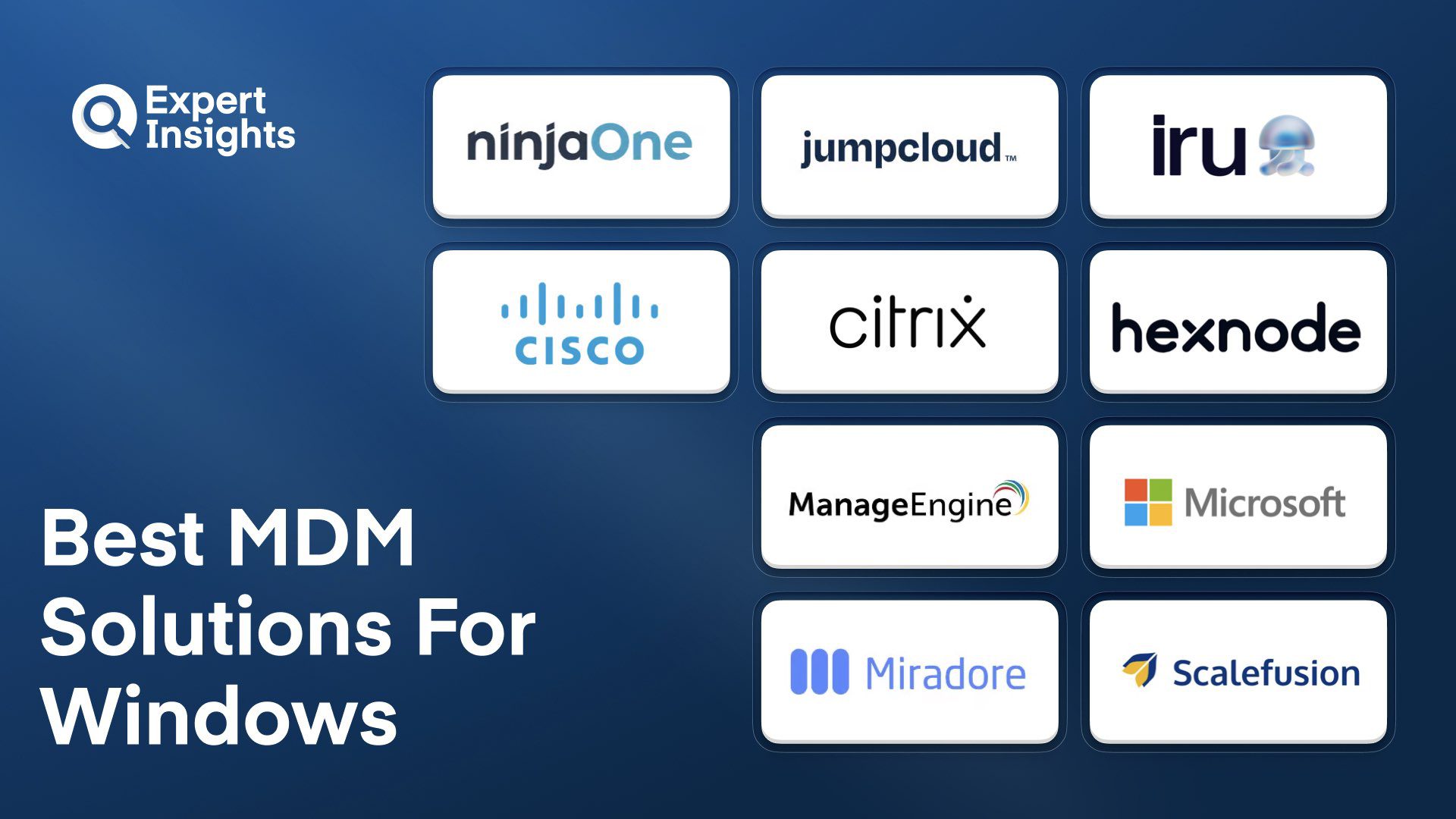
Windows MDM solutions manage the enrollment, configuration, and security of Windows devices using Microsoft’s MDM protocol and Intune-compatible frameworks, allowing policy enforcement and fleet management without Group Policy or on-premises SCCM infrastructure. We reviewed 10 solutions and found NinjaOne Mobile Device Management, JumpCloud Mobile Device Management, Iru, and Cisco Meraki Systems Manager to be the strongest on Intune compatibility and security configuration depth.
Choosing a Windows MDM solution means deciding between native Microsoft tools and independent platforms, between ease of use and feature depth, between cloud and on premises control. The wrong choice either leaves you managing endpoints through outdated tools or paying for complexity you don’t need.
The real problem isn’t finding a Windows MDM, it’s finding one that integrates with your identity infrastructure, enforces security without breaking productivity, and scales with your organization. You need reliable patching, flexible policy controls, visibility into endpoint health, and support for BYOD alongside corporate hardware. Layer in compliance requirements and Windows client diversity, and the complexity multiplies.
We evaluated multiple Windows MDM platforms across enterprise, mid market, and SMB environments, evaluating each for deployment simplicity, policy flexibility, integration depth, patch management reliability, and operational maturity. We reviewed real world deployments and identified where vendors make trade offs between control and usability. What we found: the right choice depends heavily on your existing infrastructure.
This guide gives you the testing insights and decision framework to match the right Windows MDM to your environment, user population, and team expertise.
What is MDM for Windows?
Windows Mobile Device Management (MDM) is a way for IT teams to control and secure Windows laptops and desktops from a central console, without needing to touch each machine individually. MDM lets administrators push security settings, install software, enforce encryption, and remotely lock or wipe devices. It replaces older approaches like Group Policy and SCCM with cloud-based management that works whether the device is in the office, at home, or on the road.
Windows MDM works through the OMA-DM (Open Mobile Alliance Device Management) protocol built into Windows 10 and 11. When a device enrolls, it establishes a management channel with the MDM server using configuration service providers (CSPs), which are the API layer that translates MDM commands into Windows configuration changes. Enrollment can happen through Azure AD join, bulk provisioning packages, or Windows Autopilot for zero-touch deployment. The MDM server pushes policies as SyncML documents that configure everything from BitLocker encryption and Windows Update schedules to firewall rules and application whitelisting. Compliance checks run on a schedule, and conditional access policies can block non-compliant devices from corporate resources through Entra ID integration.
Windows MDM Solutions Compared
Here is how the 10 Windows MDM solutions we reviewed compare across the capabilities that matter most for Windows device management.
| Product | Best For | Type | Zero-Touch Deploy | Patch Mgmt | BYOD Support | Remote Support |
|---|---|---|---|---|---|---|
|
NinjaOne MDM
|
IT teams with diverse device fleets
|
RMM + MDM
|
Yes
|
Yes
|
No
|
Yes
|
|
JumpCloud MDM
|
Cloud-first organizations
|
IAM + MDM
|
No
|
No
|
Yes
|
No
|
|
Iru
|
Mixed Windows and Mac fleets needing a single management console
|
MDM + EDR
|
No
|
Yes
|
No
|
Yes
|
|
Cisco Meraki SM
|
Existing Cisco environments (end-of-sale)
|
Cloud MDM
|
Yes
|
No
|
No
|
Yes
|
|
Citrix Endpoint Management
|
Regulated enterprises
|
UEM
|
No
|
No
|
Yes
|
No
|
|
Hexnode
|
Mid-market multi-platform teams
|
UEM
|
No
|
No
|
No
|
No
|
|
ManageEngine MDM Plus
|
Cost-conscious diverse fleets
|
MDM
|
No
|
No
|
Yes
|
Yes
|
|
Microsoft Intune
|
Microsoft 365 environments
|
UEM
|
Yes
|
Yes
|
No
|
Yes
|
|
Miradore
|
SMBs and nonprofits
|
MDM
|
No
|
Yes
|
No
|
Yes
|
|
Scalefusion
|
Field, retail, and kiosk devices
|
MDM
|
No
|
No
|
No
|
No
|
How We Tested
Alex Zawalnyski researched and wrote this guide, with technical review by Laura Iannini. We evaluated Windows MDM platforms across enterprise, mid-market, and SMB deployments, assessing deployment ease, policy flexibility, patch management reliability, integration depth, and operational maturity. Beyond hands-on research, we reviewed customer feedback, real-world deployments, and case studies. Read our full methodology
NinjaOne
Best for IT teams juggling diverse device fleets
NinjaOne MDM is a mobile device management module that sits inside NinjaOne’s broader endpoint management platform, covering Windows, macOS, Linux, Android, and iOS from a single console. We think it works best for organizations that want Windows device management bundled with endpoint monitoring, patching, and backup in one interface rather than running a standalone MDM tool alongside separate IT operations tooling.
- Single-console approach manages Windows endpoints and mobile devices together with consistent policies and reporting
- Zero-touch enrollment eliminates manual setup for large-scale Windows deployments; lightweight agent keeps endpoints responsive
- Conditional policies automate device management at scale, with hundreds of out-of-the-box scripts for remediation
- Automated patching covers Windows OS and third-party applications
- Integrates with Splashtop, TeamViewer, and ScreenConnect for full remote control including screen viewing
- SSO and passkey support built in; per-device monthly pricing includes free unlimited onboarding and support
We recommend NinjaOne MDM for mid-sized organizations and MSPs that want Windows device management consolidated with their broader IT operations. The unified console means your team is not switching between separate tools for endpoint management, patching, backup, and MDM. Full deployment typically takes two weeks to a month, with the agent deployed through Intune or Active Directory. If you need deep, specialized MDM features for a mobile-heavy fleet, a dedicated MDM platform may be a better fit. But for unified Windows endpoint and device management, NinjaOne delivers solid value.
Strengths
Cautions

JumpCloud
Best for organizations running mixed fleets with cloud-first infrastructure
JumpCloud MDM allows IT and security teams to centrally monitor, manage, and secure all devices in their fleet, whether personal or corporate-issued. The solution is compatible with Windows, Linux, macOS, and iOS devices, providing a unified overview of all connected devices in one location. We think JumpCloud’s identity-first approach makes it a strong Windows MDM option for cloud-first organizations that want to manage devices through user identity rather than network boundaries.
- Cloud-based architecture eliminates on-premises directory server maintenance and integrates with JumpCloud’s SSO, MFA, and conditional access
- Admins configure and push policies, commands, and software to individual devices or device groups from a single console
- Detailed device health reports cover encryption status, recovery key, device uptime, linked user accounts, and assigned policies
- Work profile separation supports BYOD deployments by keeping corporate policies off personal data
- Admins can restrict corporate-issued devices from accessing unauthorized services
We recommend JumpCloud MDM for mid-sized and larger enterprises with a diverse device fleet that want Windows MDM as part of a wider identity and device security stack. The identity-first security model works well for remote and hybrid teams managing Windows devices without relying on traditional Active Directory infrastructure. The detailed device health reporting and seamless integration with JumpCloud’s identity platform stand out. If your organization is cloud-first and looking to replace on-premises directory services while gaining device management, JumpCloud covers both from one platform.
Strengths
Cautions
Iru

Iru
Teams with a mix of Windows and Mac devices looking for a single solution to manage the whole fleet
Iru (formerly Kandji) is a security and management platform for both Apple and Windows fleets. One lightweight agent handles device management, EDR and patch management. Identity and compliance can also be managed from the same console.
Iru unifies device management, endpoint security, identity and compliance automation on one platform, with all four sharing context through the Iru Context Model, a single data layer holding users, devices, apps and policies. This means policies stay in step across workflows: device-level policies can inform sign-in decisions, identity policies can be applied to specific devices, and the same data feeds compliance reporting.
The agent continuously enforces device and application policies you set in the admin console, including pushing app updates without disrupting the user and reinstalling apps a user has removed. Iru supports 240 Windows applications, WSUS settings, OS update Library Items, trusted root deployment and custom app packaging. Endpoint detection and vulnerability management also run on the same agent.
- Windows and Mac managed from one device list, one library and one set of Blueprints
- 240 Windows applications in the Auto Apps catalog, patched automatically with severity-based enforcement deadlines
- WSUS settings, update Library Items, trusted root certificates and custom application deployment
- Windows Update policy configurable with an AI assistant that reads all 37 settings against Microsoft’s documentation and proposes a configuration with reasoning
- Windows passcode can be configured and deployed using the same Library Item as Apple and Android
- Configuration as Code with version control, pull-request changes and rollback from a repository
- Endpoint detection and response covering malware and potentially unwanted programs.
- Vulnerability detection across the whole device, with data enriched from the National Vulnerability Database and MITRE
- Remote lock, erase and forced check-in from the device record
- Integrated identity provider for user creation and authentication policy, or user sync from Okta and Entra ID
- Compliance automation covering eleven frameworks draws its evidence directly from Iru’s device and identity records
We recommend Iru to teams of any size or sector, particularly businesses with a mix of Windows and Apple devices looking for an easy-to-use platform that doesn’t sacrifice depth of control or end-user experience.
We found the console clean and easy to navigate and deploying policies to groups is straightforward. Iru is most popular with lean IT teams that operate Mac, iOS, Android and Windows devices.
The Windows Update AI assistant is another strong feature. Windows Update policy has dozens of settings that most administrators never touch because the documentation is impenetrable. Iru reads them all against Microsoft’s own guidance, proposes a configuration and explains each choice, and you can override anything you disagree with before saving.
Pricing starts at a 50-license minimum and is sold in blocks of 25, so it suits fleets of 50 devices and above. Startups with fewer than 50 employees can take advantage of discounted pricing and lower license counts in exchange for buying product bundles.
Strengths
Cautions
Cisco Meraki Systems Manager
Cisco
Best for existing Cisco environments during transition period
Cisco Meraki Systems Manager is a cloud-based MDM platform that combines device management with network and app security. However, a critical development: Cisco announced the end-of-sale for Meraki Systems Manager on December 3, 2025, with the last purchase date was June 3, 2026 and support continuing until June 3, 2029. Cisco has partnered with Ivanti to offer Ivanti Neurons for MDM as the recommended replacement.
- Centralized cloud dashboard for managing devices across distributed locations
- Zero-touch provisioning and configuration deployment
- Dynamic compliance enforcement adjusts access based on real-time device compliance status
- Real-time monitoring and remote desktop remediation for troubleshooting without on-site visits
- Native integration with Cisco Duo for authentication and Cisco Umbrella for security
Customers praise the intuitive interface and fast deployment, and managing firewalls, VPN, and network policies from one console saves significant time. With that said, the end-of-sale announcement means new customers should not invest in this platform. Existing customers have until June 3, 2029 for support, but should begin planning their migration. One-year and three-year licenses remain available until June 3, 2026, but five-year licenses are no longer offered. Reviews flag licensing costs as a consistent pain point.
We think the end-of-sale announcement changes the calculus for Meraki Systems Manager significantly. For existing Cisco environments with active licenses, the platform continues to function well during the transition period. But for any organization evaluating new Windows MDM solutions, we would not recommend investing in a product that is being discontinued. Cisco’s recommended path is Ivanti Neurons for MDM, available through Cisco’s SolutionsPlus program. Organizations currently on Meraki SM should begin evaluating alternatives now rather than waiting for the support end date.
Strengths
Cautions
Citrix Endpoint Management

Citrix
Best for enterprises in regulated industries running Citrix infrastructure
Citrix Endpoint Management is a UEM platform with deep MDM capabilities and over 300 pre-built policies for organizations running mixed device fleets. We think Citrix Endpoint Management is best suited for enterprises in regulated industries that need granular compliance controls and already run Citrix infrastructure.
- Over 300 pre-built policies for device compliance, app management, and security configuration
- Micro-VPN settings secure app-level connections without routing all traffic through traditional VPN infrastructure
- Supports Windows 10/11, Apple (including iOS 26 and macOS), and Android devices (including Android 16 as of v25.9.0)
- BYOD handling cleanly separates work profiles from personal data
- SSO integration connects with the broader Citrix Workspace ecosystem
- Exchange Online OAuth 2.0 support and Apple Intelligence restriction settings for iOS 18+ and macOS 15+
Customers in healthcare, manufacturing, and education report strong performance at scale. Integration with Microsoft Endpoint Manager and Intune gets praise for streamlining permissions management. Something to be aware of is that the setup complexity requires significant training investment before teams see full platform value. The learning curve is steep for administrators unfamiliar with Citrix ecosystem terminology and architecture. Reviews mention that the depth of configuration can be overwhelming for smaller teams.
We think Citrix Endpoint Management is a strong choice for enterprises that already run Citrix infrastructure and need tight integration with Workspace. The 300+ policy library and micro-VPN capabilities are well-suited to regulated industries with complex compliance requirements. If you want simpler setup and faster time to value, lighter platforms will serve you better. But for organizations that need the depth, the investment in setup and training pays off with granular control that most competitors can’t match.
Strengths
Cautions
Hexnode

Mitsogo
Best for mid-market teams needing broad device coverage without enterprise pricing
Hexnode is a UEM platform with MDM capabilities spanning nine operating systems: Windows, macOS, Android, iOS, Linux, ChromeOS, tvOS, Fire OS, and visionOS. We think Hexnode offers one of the best price-to-capability ratios in the Windows MDM space, making it a strong option for mid-market teams that need broad device coverage without enterprise pricing.
- Kiosk and lockdown modes with granular configuration for single and multi-app setups
- DLP controls cover encryption, remote locking, and remote data wipe
- App management includes catalog creation with blacklisting and whitelisting support
- Integrates with Active Directory, Google Workspace, and Microsoft 365 for identity management
- Supports nine operating systems from a single console: Windows, macOS, Android, iOS, Linux, ChromeOS, tvOS, Fire OS, and visionOS
Customers praise the intuitive interface and say enrollment through Apple ADE and Android Enterprise runs smoothly with solid documentation. Something to be aware of is that Windows and macOS management features feel less mature than the mobile device controls. Advanced settings can be difficult to locate, and behavior varies slightly between platforms. Reviews flag that reporting and analytics lack the customization depth of larger enterprise UEM platforms. Some customers find bulk operations frustrating due to MFA prompts on every action.
We think Hexnode is best suited for organizations that primarily need mobile device management with solid Windows and macOS coverage. The $1/device/month starting price is accessible, and the breadth of platform support is strong. If you need deep Windows policy management or advanced compliance controls for a Windows-heavy fleet, dedicated Windows endpoint platforms may serve you better. But for mixed mobile-and-desktop environments on a budget, Hexnode is well worth considering.
Strengths
Cautions
ManageEngine Mobile Device Manager Plus

ManageEngine
Best for cost-conscious teams managing diverse device fleets
ManageEngine Mobile Device Manager Plus is a multi-platform device management tool covering Windows, macOS, iOS, Android, ChromeOS, and IoT devices from a single console. We think MDM Plus offers one of the broadest device coverage ranges in this category, with a free tier and flexible deployment options that make it accessible for teams of all sizes.
- Centralized management for diverse device fleets with policy controls for peripherals, security settings, encryption, VPN, and role-based access
- Remote troubleshooting includes live chat, remote screen viewing, restart, wipe, shutdown, and full unattended remote access
- Kiosk mode separates corporate work profiles from personal data on BYOD devices
- Jailbreak and non-compliance detection flags high-risk devices automatically
- Supports both cloud and on-premises deployment
- App distribution handles both in-house and store apps across platforms
Customers say enrollment and initial configuration are straightforward with an accessible learning curve. The remote wipe and stolen device marking features get positive mentions for practical security. Something to be aware of is that Windows management is less mature than mobile platforms; some users report bugs around encryption reporting for Windows and serial number detection failures. Apple ecosystem support also draws criticism, with macOS and iOS enrollment running less smoothly than Android. Customer support quality receives mixed feedback.
We think ManageEngine MDM Plus is best suited for organizations primarily managing Windows and Android devices with some Apple coverage. The free tier for 25 devices lowers the barrier for evaluation, and the remote troubleshooting toolkit is genuinely deep. If Apple devices dominate your fleet or you need advanced Windows compliance controls, other platforms may be a better fit. But for cost-conscious teams managing diverse fleets, MDM Plus offers strong value.
Strengths
Cautions
Microsoft Intune

Microsoft
Best for organizations already running Microsoft 365 infrastructure
Microsoft Intune is Microsoft’s cloud-based UEM platform that integrates directly with Entra ID (formerly Azure AD) and Microsoft 365. We think Intune is the most natural Windows MDM choice for organizations already running Microsoft infrastructure; the native integration eliminates the federation and connector overhead that third-party tools require.
- Cross-platform endpoint management for Windows, iOS, Android, and macOS with zero-touch deployment and endpoint analytics
- Conditional access policies work natively with Entra ID; compliance policies check device health automatically with remediation triggers
- Self-service portal lets users enroll their own devices without IT intervention
- Endpoint privilege management and remote support capabilities
- Starting July 2026, Microsoft 365 E3 bundles Intune Remote Help, Advanced Analytics, Plan 2, and Defender for Office P1 for a $3/user/month increase
Customers praise the integration with Microsoft 365 and the reduced complexity compared to managing separate identity and MDM platforms. Something to be aware of is that key security features require premium licensing, which can make the total cost of ownership significantly higher than the base price suggests. Policy troubleshooting can be time-consuming when policies don’t apply as expected. Reviews note that non-Windows device support feels less polished, and large enterprise deployments report application management limitations and reporting gaps compared to SCCM.
We think Intune is the strongest option for organizations where Microsoft 365 already anchors the environment. The July 2026 E3/E5 bundling changes add significant value for existing subscribers. Smaller organizations see the most straightforward benefit. If you run a large enterprise and need features matching SCCM maturity, expect some gaps that may require additional tooling. But for cloud-native Windows device management within the Microsoft ecosystem, Intune is the natural choice.
Strengths
Cautions
Miradore

Miradore
Best for SMBs and nonprofits managing modest device fleets
Miradore, now part of the LogMeIn family, is a device management platform built for SMBs that need straightforward MDM without enterprise complexity. We think Miradore is one of the most accessible entry points to Windows MDM, with a free plan for up to 50 devices and paid plans starting at $2.75/device/month.
- Patch management covers OS updates plus over 200 third-party applications
- BitLocker encryption, passcode enforcement, and remote lock and wipe capabilities
- Lost mode with location tracking lets admins lock devices and display custom recovery messages
- Automates repetitive tasks like enrollments, configurations, and patch updates
- Integrates natively with GoTo Resolve for remote support, with optional TeamViewer integration
- Apple Business Manager integration simplifies iOS deployments
Customers consistently praise the easy setup and responsive support team. Customer success managers get positive marks for hands-on guidance during implementation. The free tier lets organizations start without financial commitment and upgrade as needs grow. Something to be aware of is that reporting and analytics feel dated and lack the depth needed for detailed compliance audits. Reviews mention that app deployment can be laggy with no automatic retry when installations fail.
We think Miradore is best suited for SMBs and nonprofits managing modest device fleets who prioritize simplicity and affordability over advanced features. The free plan for up to 50 devices makes it low-risk to evaluate, and the $2.75/device/month paid pricing is one of the most affordable in this category. If you need deep Windows policy controls, enterprise-scale reporting, or advanced compliance features, larger platforms will serve you better. But for straightforward device management at an accessible price point, Miradore is a practical choice.
Strengths
Cautions
Scalefusion

ProMobi Technologies
Best for organizations managing field devices, retail endpoints, and kiosks
Scalefusion is an MDM platform that combines device control, security, and compliance across Windows, Apple, Android, ChromeOS, and Linux from a centralized dashboard. We think Scalefusion is particularly strong for organizations managing field devices, retail endpoints, kiosks, and shared workstations alongside standard corporate hardware.
- Kiosk and app restriction capabilities lock devices to approved applications only, eliminating settings tampering and unauthorized software
- Automation handles scheduled reboots and storage clearing without manual intervention
- Apple Business Manager integration, BitLocker encryption, and password enforcement
- Shared device profiles with unique user permissions for multi-user environments
- Covers Windows, Apple, Android, ChromeOS, and Linux from a centralized dashboard
Customer feedback on support is consistently positive, with named support engineers praised for hands-on guidance through setup and troubleshooting. Chat resolution works well for most issues with quick escalation to calls when needed. Something to be aware of is that the dashboard takes time to learn; some settings feel buried, especially when updating multiple profiles simultaneously. Reviews mention that advanced configurations need more in-app guidance, and older devices sometimes require trial-and-error adjustments to work with all features.
We think Scalefusion is a strong fit for organizations managing purpose-built devices in retail, field service, or logistics environments. The kiosk controls and automation are well-suited to high-volume, distributed fleets where devices need to be locked down to specific functions. The $24/device/year pricing and dedicated support engineers add to the value proposition. If your needs center on standard corporate laptop management, simpler platforms may get you there faster. But for specialized device management, Scalefusion is well worth considering.
Strengths
Cautions
Windows MDM Pricing
Windows MDM pricing varies significantly by vendor and licensing model. Some platforms charge per device, others per user, and several offer free tiers for smaller deployments. Many enterprise-grade platforms require contacting sales for a custom quote. The table below reflects publicly available starting prices as of mid-2026.
| Product | Starting Price | Billing | Link |
|---|---|---|---|
|
NinjaOne MDM
|
Contact for quote
|
Per device/month
|
|
|
JumpCloud MDM
|
$9/user/month
|
Annual
|
|
|
Iru
|
Contact for quote
|
Annual
|
|
|
Cisco Meraki SM
|
End-of-sale (last purchase was June 3, 2026)
|
N/A
|
|
|
Citrix Endpoint Management
|
Contact for quote
|
Annual
|
|
|
Hexnode
|
$1/device/month (Express)
|
Annual
|
|
|
ManageEngine MDM Plus
|
Free (up to 25 devices); $1.28/device/month (Cloud)
|
Annual
|
|
|
Microsoft Intune
|
$8/user/month (Plan 1 standalone)
|
Annual
|
|
|
Miradore
|
Free (up to 50 devices); $2.75/device/month (Premium)
|
Annual
|
|
|
Scalefusion
|
$2.75/device/month ($24/device/year)
|
Annual
|
|
Windows MDM Checklist
These are the configuration and operational steps we recommend when deploying and managing a Windows MDM platform.
Zero-touch deployment, bulk provisioning, and self-service enrollment have different infrastructure requirements; choosing the wrong one adds weeks to rollout.
Native integration with your identity provider (Active Directory, Entra ID, Google Workspace) determines how smoothly authentication and conditional access will work.
Treating personal and corporate devices identically creates privacy friction with employees and compliance risk for your organization.
A failed Windows update pushed to every endpoint at once can take down productivity across the organization; staged rollout with maintenance windows reduces that risk.
Centralized encryption management with escrowed recovery keys is one of the highest-value security controls an MDM delivers for Windows devices.
Automated compliance checks against established frameworks reduce audit preparation time and provide continuous visibility into your security posture.
Manual remediation doesn't scale; conditional access policies that block non-compliant devices from corporate resources enforce standards without requiring IT intervention.
Some platforms include remote control capabilities natively while others require third-party integrations; knowing this upfront avoids duplicate licensing costs.
Base pricing often excludes advanced security features, premium support, and additional modules that your environment will need at scale.
Cisco Meraki Systems Manager's end-of-sale is a reminder that vendor continuity is a real risk; evaluate how easily you can export policies and re-enroll devices on a different platform.
The Bottom Line
No single Windows MDM fits every organization. Your choice depends on existing infrastructure, team expertise, and whether you need unified multi platform management or Windows focused depth. If you run a mix of Windows and Mac and want both in one console, Iru manages them through the same Library Items and Blueprints, with 240 Windows applications patched automatically.
If you run Microsoft 365, Microsoft Intune eliminates integration friction. Azure AD conditional access works out of the box. Budget for premium licensing if you need advanced security features.
If you want unified endpoint management across Windows, Mac, mobile, and servers, NinjaOne MDM delivers a clean interface and solid automation.
If you need enterprise flexibility with on premises options, Citrix Endpoint Management provides 300+ pre-built policies and micro-VPN controls for enterprise deployments. Setup and training are required investments.
If you’re replacing Active Directory with cloud infrastructure, JumpCloud unifies identity and device management without on premises systems. Works well for modern cloud first organizations.
If you need broad multi platform coverage on a budget, ManageEngine Mobile Device Manager Plus provides good value with a free tier for small deployments. Verify Windows specific features meet your needs.
Read the individual reviews above to dig into specific capabilities, patch management reliability, and the integration and policy trade offs that matter for your environment.
MDM For Windows: Everything You Need To Know (FAQs)
Mobile Device Management (MDM) tools allow you to remotely manage, monitor, and configure policies for your users’ mobile devices, including both corporate-issued and BYOD devices. They give you a unified view of all these devices, so you can easily enforce security policies, deploy apps, manage updates, control device settings, and remotely troubleshoot device issues from a single, centralized platform.
MDM solutions for Windows typically use protocols like Microsoft Intune (formerly Endpoint Manager) and Windows MDM APIs to manage devices remotely. Once you’ve enrolled your users’ devices (usually by having your users install an endpoint agent), you can push policies, configure settings, deploy apps, and enforce security measures. The Windows Notification Service (WNS) helps deliver these commands securely, ensuring devices stay updated and compliant.
When comparing MDM tools for your Windows device fleet, we recommend looking out for the following key features:
- Device enrollment and provisioning: You should be able to remotely setup and configure Windows devices.
- Policy management: You should be able to enforce security policies, including password requirements, encryption, and firewall settings.
- Application management: You should be able to deploy, update, and remove software remotely.
- Patch management: The solution should automatically deploy patches and updates to maintain system security.
- Compliance management: The solution should monitor devices to ensure they meet company compliance standards, and alert you to any deviations.
- Remote support: You should be able to remotely troubleshoot devices. Some solutions offer screen viewing capabilities; others offer full remote control.
- Reporting and analytics: You should be able to access comprehensive, real-time insights into device performance, usage, compliance, and security.
- Anti-theft features: The solution should offer geolocation tracking to help you locate devices in case of loss or theft. You should also be able to remotely lock or erase device data if compromised.
- Added security features: Though Mobile Device Security (MDS) is a different type of solution, some MDM tools do offer built-in security functionality, such as data encryption, a VPN or Zero Trust Network Access (ZTNA), Multi-Factor Authentication (MFA), and content filtering for websites and applications.
- Integration with Microsoft ecosystem: The solution should be compatible with Azure AD, Microsoft Intune, and other Windows-specific services.
IT Management Resources
Further reading on it management from Expert Insights — buyers' guides, comparison articles, and platform-specific shortlists.


 Written By

Joel is the Director of Content and a co-founder at Expert Insights; a rapidly growing media company focussed on covering cybersecurity solutions.
He’s an experienced journalist and editor with 8 years’ experience covering the cybersecurity space. He’s reviewed hundreds of cybersecurity solutions, interviewed hundreds of industry experts and produced dozens of industry reports read by thousands of CISOs and security professionals in topics like IAM, MFA, zero trust, email security, DevSecOps and more.
He also hosts the Expert Insights Podcast and co-writes the weekly newsletter, Decrypted. Joel is driven to share his team’s expertise with cybersecurity leaders to help them create more secure business foundations.
 Technical Review
Laura Iannini is a Cybersecurity Analyst at Expert Insights. With deep cybersecurity knowledge and strong research skills, she leads Expert Insights’ product testing team, conducting thorough tests of product features and in-depth industry analysis to ensure that Expert Insights’ product reviews are definitive and insightful.
Laura also carries out wider analysis of vendor landscapes and industry trends to inform Expert Insights’ enterprise cybersecurity buyers’ guides, covering topics such as security awareness training, cloud backup and recovery, email security, and network monitoring. Prior to working at Expert Insights, Laura worked as a Senior Information Security Engineer at Constant Edge, where she tested cybersecurity solutions, carried out product demos, and provided high-quality ongoing technical support.
Laura holds a Bachelor’s degree in Cybersecurity from the University of West Florida.