

Social engineering attacks now get past email filters in two ways. AI generates unique variants of each lure faster than signature and reputation filters can learn them, and attackers increasingly bypass the inbox altogether through voice calls and SMS. Stopping them takes layered defenses: security awareness training, out-of-band verification, AI-based email security, phishing-resistant MFA, and identity controls that limit damage when an attack gets through.
IBM’s Cost of a Data Breach Report puts the average cost of a breach just shy of $5 million at $4.99 M USD, that’s up 12% YoY. More than a quarter of organizations affected by a malicious attack say that AI played a role, that’s a 56% increase on the previous year.
In this article, we’ll consider what has changed in the world of social engineering attacks. We’ll explore how the attacks used to manifest, then address how this has changed with the widespread use of AI and what you should be doing to keep yourself safe.
How AI Changed Social Engineering
Traditionally, email was properly protected by erecting a big wall and having the right policies to make sure you knew what was coming through the gate. Over time, we saw this evolve from keyword identification, to DMARC, DKIM, and SPF, to shared knowledge bases flagging malicious emails. These systems were great at recognizing something once it had been flagged as a threat. AI doesn’t work like this.
AI is able to iterate attacks endlessly, meaning that your traditional defense tools will see each instance as something new. They won’t be able to assess any contextual information to recognize how the attack is structured. The AI-generated attack is permitted access because it appears to be unique.
Not only does this allow AI to find ways through the gate, but it also means that when you try to check the legitimacy of a claim, request, or link, the authentication may be AI too.
One of the biggest threats here is voice cloning (vishing). There are high-profile stories where a diligent employee has been on a video call with their seniors, who turned out to be AI-generated. There are stories of people receiving calls from CFOs asking them to make payments.
So, in a world where everything seems legitimate, how do you keep yourself safe?
The Main Types Of Social Engineering Attack
Every social engineering attack is a variation of the same core principles: impersonation, authority, and urgency. These attacks will all aim to get you to carry out a risky action, by convincing you that it’s the right thing to do.
Phishing
Phishing is a social engineering attack in which an attacker sends fraudulent messages in bulk to trick recipients into clicking a malicious link, opening an attachment, or handing over credentials. It is the original, simplest form of social engineering. It typically relies on generic content to trick users. This also means that it is the easiest form to spot. For example:
You have an unpaid parking charge. Click here to review it.
A recipient who doesn’t have a car will know that this email has not been sent directly to them. A busy employee who is pushed for time may be more inclined to click the link to avoid a fine.
SEGs are designed to catch this type of campaign because the messaging is distributed in bulk. That being said, phishing remains the most common initial attack vector for a fourth year running, according to IBM.
Spear Phishing
Spear phishing is a targeted phishing attack aimed at a specific person, using personal details or an impersonated colleague to make the request convincing. To make the content more convincing, attacks may use personal details or impersonate real colleagues, aiming to build trust and authority.
For example:
Hi Alice, I’ve lost the login details for the shared drive. Would you mind sending them over to me when you get a minute? Cheers, Chuck.
Or:
Hi Bob, we’ve got an outstanding PO for one of our temps. Could you please fill this in so I can send it back to the agency? Thanks! Mallory.
These types of emails are often sophisticated enough to evade traditional email filtering solutions and require a multi-layered security architecture to mitigate – including security at the human layer. This type of attack has become much more prevalent as it’s easier than ever for attackers to use AI to gather personal information that makes their attack more convincing.
Whaling
Whaling is spear phishing aimed at executives and other high-value targets, such as finance leads and anyone who approves payments. This attack type may be the final step in an escalating series of attacks. More junior employees may be targeted via phishing, smishing, or vishing attacks. While they are not the ultimate target, information gathered from these smaller breaches can be used to make the whaling attack more convincing.
Smishing
Smishing is phishing delivered via SMS or messaging apps. It is effective because people treat messages with less caution than they would an email. Employees know to be careful of suspicious email links, but a text message received outside of work hours (on a personal device) does not set alarm bells ringing in the same way.
Vishing
Vishing (voice phishing) is a social engineering attack carried out by phone, where the attacker impersonates a trusted person or organization to extract credentials, MFA approvals, or payments.
Vishing uses the same principles as the other attack types. The impersonated voice is often an IT helpdesk or an insurer. They will claim a position of authority, encouraging you to give up personal details or permit access. As with many attacks, they will rely on urgency and pressure to make you click on a dangerous link.
Pharming
Pharming is an attack that redirects victims to a fraudulent website even when they type the correct address, usually by compromising DNS, a domain registrar account, or a router.
When a victim arrives on this convincing landing page, they will input their genuine credentials, with the attacker harvesting these. Because the URL looks right, user training cannot always mitigate the threat that this attack type poses. DNS security, registrar account protection, and phishing-resistant MFA are important defenses.
What Does This Look Like In The Real World?


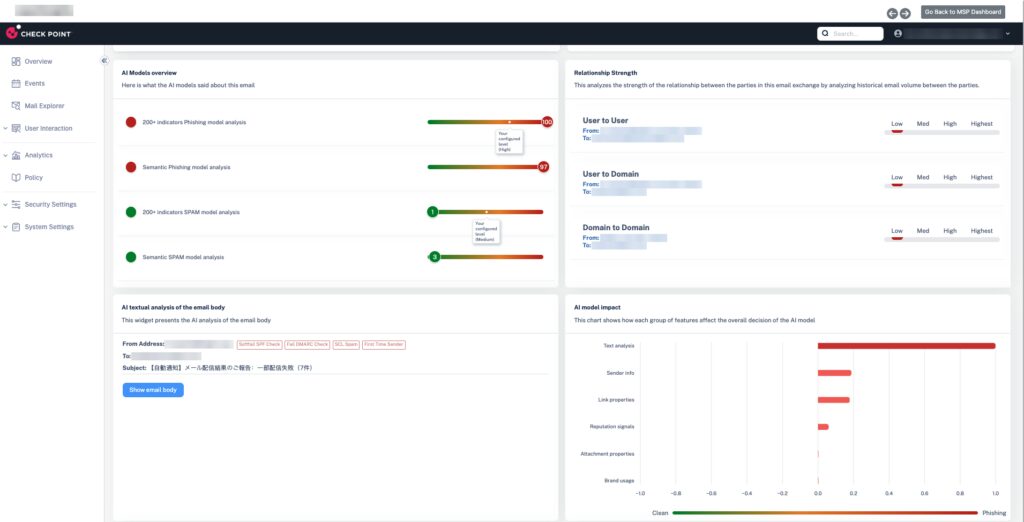
Why Email Filtering Alone Isn’t Enough
Email remains a major attack vector. However, some of the most damaging attacks are delivered by channels other than email.
IBM found that vishing and smishing were the costliest initial attack vectors in its 2026 report, at an average of $5.29 million per breach. Mandiant’s M-Trends 2026 report found that voice phishing accounted for 11% of initial access incidents in 2025, making it the second most common vector, while email phishing fell to 6%. In cloud environments, voice phishing accounted for 23% of initial access.
For threats that are still delivered by email, static filters and rules struggle to detect AI-generated variations. Any attempt to add more rules or tighten existing rules can result in a higher false-positive rate, rather than better detection. That’s because these rules weren’t designed to deal with AI content.
Instead, you need to use AI-based tools to detect and respond to AI threats. IBM found that organizations making extensive use of security AI and automation cut breach costs by $1.93 million and shortened the breach lifecycle by 65 days.
How To Stop Social Engineering Attacks
Unfortunately, there isn’t one single control that can stop all phishing attacks with 100% certainty. That’s largely due to the fact that every phishing attack is subtly different and depends on context. The best thing that defenders can do is to be prepared and make it as hard as possible for attackers to be successful.
Security Awareness Training (SAT)
Awareness is the first line of defense. Employees who know that these attacks exist, and that they are targets, are best placed to respond to them.
Modern training goes well beyond just spotting suspicious links, with training designed to reveal the extent of deepfakes, encouraging users to remain skeptical and seek additional, out-of-band authentication if something seems high risk.
Out-of-Band Communication
If someone contacts you asking you to share sensitive information or make a payment, you should double check it’s really them. The best way to do this is to reach out to that person using a different method than the one they are contacting you on. For example, if you get an email from the CFO asking you to make a payment, give them a phone call, head to their office, or send them a message.
Deepfakes complicate this step because a voice or a video is no longer proof of authenticity. There have been high-profile cases where synthetic video has been used to dupe employees and employers alike. Instead, agree verification phrases in advance for high-value requests, or ask a question that only the real person would know the answer to. Avoid any question where the answer may be in the public domain.
AI-Based Email Security
Rather than giving up entirely from your SEG, you should layer defenses on top of it. SEGs are great at handling the bulk of spam email and known threats. Adding a behavioral, contextual analysis layer on top will give you better coverage.
API-based Integrated Cloud Email Security (ICES) solutions will connect directly with your inbox, generating an understanding of who you communicate with and other communication patterns. Any content that does not fit with this baseline will be flagged as suspicious.
Your ICES solution should allow users to report suspicious messages and remove any matching messages from all email accounts. On your own domains, ensure that DMARC is in place, with p=reject policies in place. This prevents attackers from spoofing your brand.
Phishing-Resistant MFA
Stolen credentials are the aim of most phishing, vishing, and pharming attacks. Phishing-resistant MFA (such as FIDO2 passkeys and hardware security keys) ensures that authentication is linked to a physical entity.
Prioritizing phishing-resistant MFA for senior staff (such as executives, finance teams, IT admins, and anyone with privileged access) is essential. SMS codes and push notifications are vulnerable to interception and MFA fatigue attacks.
Privileged Access Management (PAM)
If a phishing attack does make its way through the inbox, one of the things they are most likely to do is to try to escalate the attack. They will do this by looking for privileges and making use of everything that a user has access to. The obvious solution here is to only permit access for a user to the areas that they need. Users should not be granted default access to areas that aren’t strictly within their work remit. Even then, they may have to request specific, time-bound access for certain tasks.
Identity Threat Detection And Response
Social engineering attacks often end in a legitimate login with stolen credentials. A traditional security tool would view this as normal activity. ITDR tools can monitor your infrastructure, identifying exactly this type of abuse.
ITDR tools can flag suspicious logins based on location, impossible travel, MFA device changes, and privilege escalation. Many platforms will automatically revoke session access or disable accounts if they detect any of these signs. ITDR tools allow you to identify and stop an attack whilst it’s in progress.
Managed Detection and Response (MDR)
Managed Detection and Response solutions enable organizations of all sizes to have access to sophisticated and comprehensive security protection. Rather than having to manage this in house, MDR solutions use third-party experts to deliver the protection and security expertise that SMBs require.
Where Cyber Insurance Fits
Cyber insurance helps your organization recover from an attack, covering costs such as incident response, legal fees, and business interruption. It does nothing to reduce your attack surface.
Insurers know this. Most now ask applicants to prove they have specific controls in place before offering cover, and MFA, email security, security awareness training, and endpoint detection and response feature heavily in their questionnaires. Insurers want clients who take the threat seriously, so the organizations with the strongest controls get the best terms. The controls above strengthen your security posture and your insurance application at the same time.
Next Steps
Attackers are continually adapting and innovating, trying to hit on the perfect attack combination that you’ve not defended against yet. Your organization’s best defense against social engineering is a layered defense, where each level works independently of another. You need training that builds skepticism, workflows that force verification, email security tools that assess context, and identity controls that limit damage for those attacks that do make it through.
You should start by mapping where your organization’s biggest exposures are. This will include the channels that your employees use most often, who approves payments, and who has privileged access. You should then look for a solution that can address those same gaps and vulnerabilities.
You should approach social engineering knowing that the work is never complete. You are able to improve your security posture and make it harder for attackers. Over time, however, the attackers will continue to probe your defenses and identify weak spots. Indeed, thinking that you’re secure can lead to complacency, which is the one thing that phishing attacks rely on.


