State of the Market
The shift to cloud-first infrastructure, remote work, and SaaS adoption has fundamentally changed enterprise traffic patterns, with a growing proportion of traffic now heading directly to cloud applications rather than through a central data center.
Traditional hub-and-spoke networks, built around routing all traffic through a central data center, were not designed for this environment. They incur additional latency and create bottlenecks for cloud-bound traffic.
SD-WAN emerged as the first practical solution. It created a software-defined overlay across multiple transport links to enable application-aware routing, without the cost and rigidity of hardware-WAN setups. In 2025, the global SD-WAN market was valued at $7.9 billion, with this projected to grow at 22% CAGR to 2030.
SASE, coined by Gartner in 2019, converges SD-WAN with a cloud-delivered security stack. In 2024, the SASE market sat at $3.8 billion and is forecast to grow at 27% CAGR to 2030, driven predominantly by zero trust adoption, remote work, and cloud-first strategies.
Our Recommendations
Before diving into the details, here are our top tips for making the choice decision for your organization:
- For consistent policy enforcement: make sure any solution gives you unified visibility and control across all locations, users, and devices. Any gaps in coverage are gaps in security.
- For deployment planning: audit your current WAN infrastructure, MPLS contracts, and on-prem security stack first. The details of your plan will depend on the shape of your current infrastructure and processes.
- For vendor consolidation: if you’re managing separate networking and security vendors, a SASE platform can reduce complexity and lower long-term TCO significantly. Take the time to calculate the costs before assuming one option is more expensive than the other.
- For hybrid environments: many organizations deploy SD-WAN at the branch for WAN optimization and layer SASE security on top, adopting the full converged architecture gradually rather than all at once.
How SD-WAN and SASE Work
SD-WAN
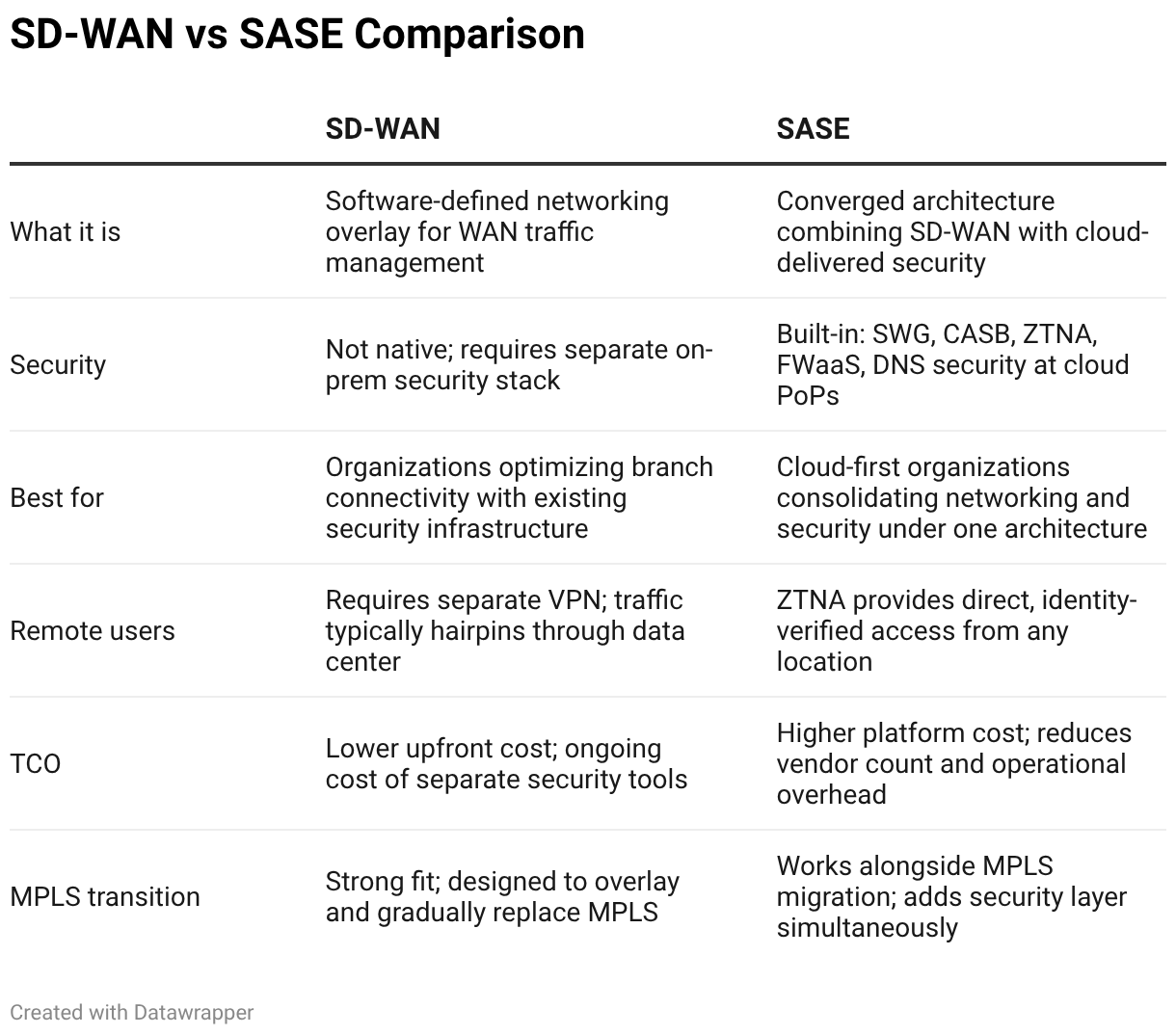
SD-WAN moves away from hardware requirements for a Wide Area Network (WAN), making it more agile and better suited to the modern work environment.
A centralized software controller dynamically routes traffic across multiple transport links, including MPLS, broadband, and LTE or 5G, based on real-time network conditions and application requirements.
SD-WAN capabilities route latency-sensitive traffic through the best-performing link, ensuring efficiency is maintained. SaaS traffic can travel directly to the internet, rather than having to travel via a data center. This flexibility also allows new sites to be onboarded without the need for complex or costly infrastructure.
What SD-WAN does not do natively, however, is security. Most platforms include basic firewall and encryption, but granular policy enforcement, encrypted traffic inspection, and cloud application control require a separate security stack.
SASE
SASE unites SD-WAN capabilities with a cloud-delivered security stack. These typically include a Secure Web Gateway (SWG), Cloud Access Security Broker (CASB), Zero Trust Network Access (ZTNA) infrastructure, and Firewall-as-a-Service (FWaaS).
Security enforcement happens at Points of Presence (PoPs), which are distributed globally. It’s worth checking the location of these before committing to a SASE solution. Policies can then be applied consistently across your organization, whether users are in a branch office, at home, or traveling.
SSE
While not the focus of this article, it’s worth understanding how Security Service Edge (SSE) relates to SD-WAN and SASE. SSE takes the security components delivered with SASE but does not include the SD-WAN component. It’s a security-only layer.
SSE can be a good entry point for organizations that already have a functioning SD-WAN but need to add additional cloud-delivered security, without replacing the entire networking architecture.
Benefits of SD-WAN
Improved Application Performance
SD-WAN’s application-aware routing finds the best pathway for different types of traffic, ensuring transmission is as efficient and fast as possible, without impacting security. Users get better performance for cloud applications, while the networking team can centralize traffic management and ensure it runs efficiently across all locations.
Simplify Branch Networking Operations
Rather than managing multiple disparate systems, SD-WAN provides a centralized platform that is easier to operate at scale. WAN policies across multiple locations are quick to update and roll out. Admins also receive real-time visibility into link performance and traffic across the whole network.
Reduce WAN Costs
SD-WAN allows organizations to move away from expensive legacy infrastructure, particularly MPLS circuits, and replace or supplement them with lower-cost broadband or LTE links. For organizations with multiple branch locations, the cost savings from transitioning away from full MPLS can be significant and is often the primary business case for SD-WAN adoption.
Benefits of SASE
Reduce Attack Surface and Enforce Zero Trust Principles
Traditional VPNs grant network access once a user is authenticated. ZTNA replaces that model with continuous verification, granting users only the minimum access they need to carry out their role. As users and devices are continuously verified, lateral movement and privilege escalation become significantly harder for attackers, regardless of where they connect from.
Consolidate Networking and Security
At its heart, SASE is a unification tool. By bringing together separate tools like SD-WAN, VPN, SWG, and CASB under one platform, SASE reduces the time spent on routine management. Fewer vendors mean fewer integration points, fewer coverage gaps, and clearer accountability when something goes wrong.
Support Compliance
When it comes to compliance, being able to efficiently enforce security policies across your network is essential. It is not only best practice, but also important for reassuring customers, clients, and insurers. The CASB component addresses data governance directly, helping organizations demonstrate compliance with frameworks like ISO 27001, NIST CSF, and SOC 2.
Common SASE and SD-WAN Challenges
Legacy Infrastructure Integration
Most organizations have existing technologies that will be displaced by SASE, including firewalls and legacy routers. Stepping away from these tools is rarely straightforward. Plan implementation carefully to ensure the process does not become overly lengthy or introduce unnecessary downtime.
Single-Vendor vs Multiple
Some vendors offer a fully integrated architecture, simplifying management but creating a dependency on that provider across every component. The single-vendor approach is a strong starting point for organizations looking to introduce SASE to their environment, provided the platform meets requirements across the board.
The alternative is to select best-of-breed tools for each component. This requires more work in deployment and ongoing management, but gives you more flexibility in how the solution is implemented and allows you to optimize individual components where it matters most.
Networking and Security Team Alignment
SD-WAN has traditionally sat within the networking team’s remit. SASE, however, requires networking and security teams to work from a shared platform. There are real benefits to this, including shared context and tighter alignment. Any decisions about platform selection should involve both teams, rather than being made top-down.
Features Checklist
When looking for the right SD-WAN or SASE platform for your organization, Expert Insights recommends looking for the following features:
- Application-aware routing: dynamic traffic steering based on real-time link quality and policy control, with direct internet breakout for SaaS traffic.
- Zero Trust Network Access: identity-based, least-privilege access that continuously verifies users and devices, rather than granting broad network access to any authenticated user.
- Cloud-delivered security stack: SWG, CASB, FWaaS, and DNS security enforced in the cloud, rather than via on-premises appliances.
- Centralized management console: a single interface to manage policy, visibility, and reporting across all locations, users, and devices.
- Integration: native connectors with SIEM, identity providers, and endpoint security platforms to reduce additional workload and ensure context is shared where relevant.
- Scalability: ability to onboard new sites and remote users without additional hardware deployment.
- Reporting and analytics: visibility into traffic, security events, policy violations, and application performance across the whole environment.
Future Trends
With the widespread adoption of AI in modern technologies, SD-WAN and SASE are likely to evolve quickly over the coming years. SD-WAN platforms are already using machine learning to predict link degradation, automate traffic steering at a granularity that manual policies cannot match, and identify anomalous traffic patterns that may indicate a security incident. We expect this to accelerate.
We would also expect to see deeper integration between SASE and XDR, adding network telemetry and correlation to improve threat detection and investigation. While some vendors already offer this today, we expect these capabilities to become standard across the market.
SSE will remain a steppingstone for organizations carrying out a phased adoption of these technologies. Many organizations need cloud-delivered security without replacing their SD-WAN deployment. SSE gives them a defined path to add ZTNA, SWG, and CASB now, with further integration possible down the line.
The Bottom Line
SD-WAN and SASE solve related but distinct problems. If your primary challenge is WAN performance and cost, particularly if you are running expensive MPLS contracts and want to improve branch-to-cloud application delivery, SD-WAN is the right starting point. If you are also rethinking your security architecture, managing a large remote workforce, or looking to consolidate a fragmented stack of networking and security tools, SASE gives you a framework to do all of that under one architecture.
For most organizations, the decision is less about choosing one over the other and more about where you are on the journey. SD-WAN is often the first step. SASE is where that journey leads. The question is how quickly you need to get there, and how much of your existing infrastructure you are ready to leave behind.
When evaluating solutions, prioritize vendors that are transparent about how their networking and security components integrate, what their global PoP coverage looks like, and how they support migration from legacy infrastructure. The technology is mature enough that the differentiators now are operational: how easy is it to manage, how well does it integrate with what you already have, and how much of the heavy lifting does the vendor take on.