Best 11 Human Risk Management (HRM) Solutions for Business (2026)
We reviewed 11 human risk management platforms on the sophistication of individual risk scoring, how well training is adapted based on measured behavior, and the reporting that gives security teams evidence of real risk reduction over time.
 Written by
Joel Witts
Written by
Joel Witts
 Technical Review by
Laura Iannini
Technical Review by
Laura Iannini
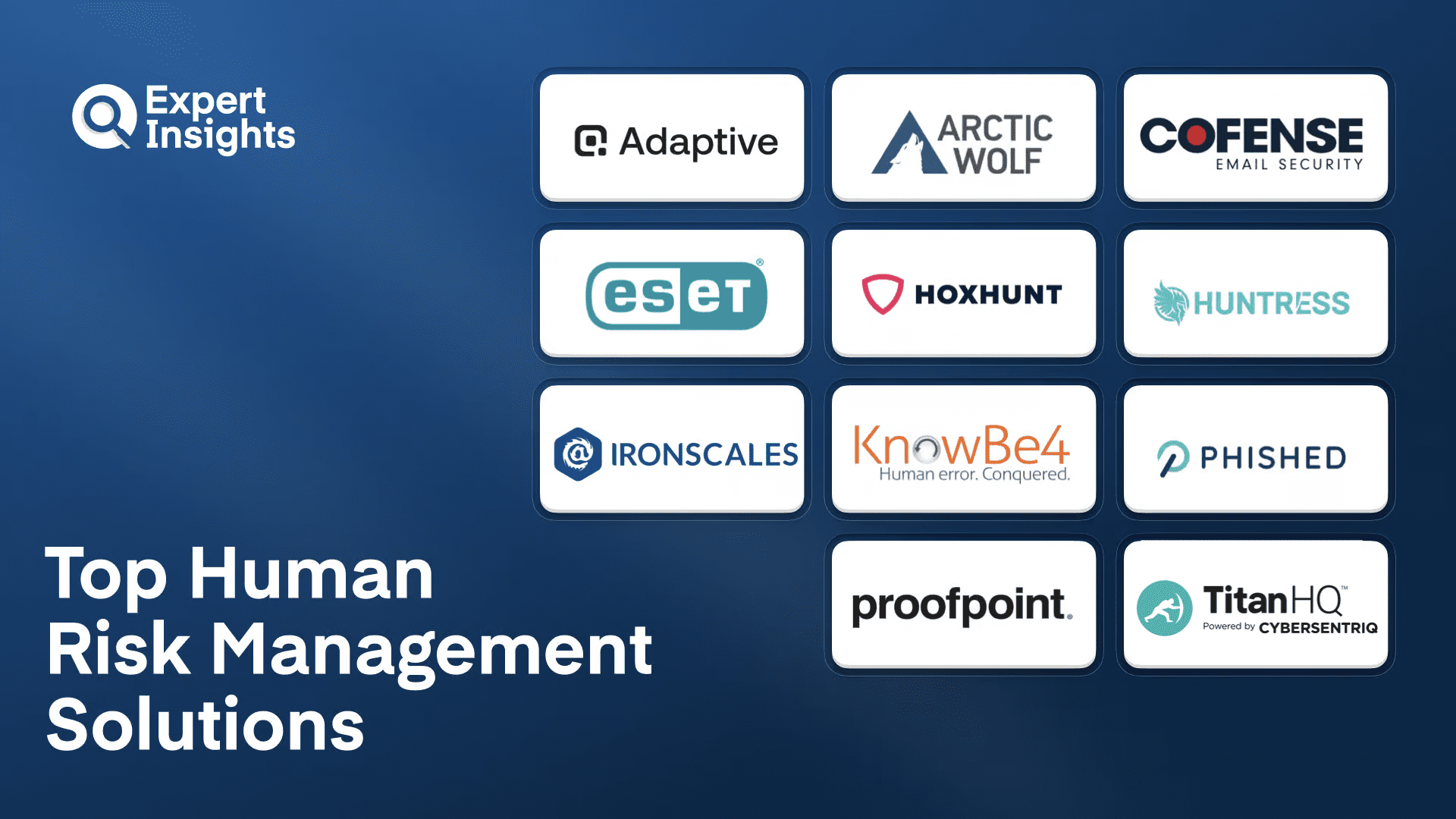
Human Risk Management (HRM) solutions take a data-driven approach to reducing employee-created security risk, combining security awareness training, phishing simulation, and individual risk scoring to target interventions at the employees who pose the greatest measured risk. Unlike compliance-oriented awareness programs, HRM focuses on measurable behavior change. We reviewed 11 platforms and found Adaptive Security, Arctic Wolf Managed Security Awareness, and Cofense PhishMe to be the strongest on individual risk scoring sophistication and training adaptation quality.
Human Risk Management (HRM) solutions are designed to help organizations understand, measure, and reduce cybersecurity risks introduced by employee behavior. With many organizations implementing robust and sophisticated cybersecurity systems, attacks are targeting the human user as a vulnerability. We’ve seen this time and time again in MFA spamming attacks, for instance. HRM platforms focus on the human element of security, recognizing that people are both a critical line of defense and a potential vulnerability.
Rather than relying solely on education or technical controls, HRM solutions take a more holistic approach. They combine risk assessment, behavioral analysis, tailored training, continuous monitoring, and adaptive policies to address the root causes of human-driven security incidents such as phishing, social engineering, and insider threats. This allows organizations to move beyond periodic awareness initiatives and adopt a more strategic, people-centric approach to cybersecurity.
While there is considerable overlap between HRM and the more traditional Security Awareness Training (SAT), the two differ in their methodology and scope. SAT is all about raising awareness and knowledge for employees, which is also a foundational component for HRM. However, the latter puts additional focus on measurable risk reduction via behavioral change done in a strategic, data driven way.
Human risk management platforms analyze employee behavior to identify areas of elevated risk and provide visibility into an organization’s overall human risk profile. Based on these insights, security teams can apply targeted training, preventative controls, and policy adjustments that reduce the likelihood of human error, while balancing security with productivity.
In this shortlist, we’ll highlight the top human risk management solutions designed to help organizations build a stronger security culture and reduce exposure to human-related cyber risks.
What is Human Risk Management (HRM)?
Human risk management is a data-driven approach to reducing the cybersecurity risks created by employee behavior. Instead of treating all employees the same with generic awareness training, HRM platforms measure individual risk levels based on how employees interact with phishing simulations, real threats, and training content. Security teams can then target their highest-risk employees with specific interventions, track whether those interventions are working, and demonstrate measurable risk reduction to leadership.
HRM platforms operate across five core layers: behavioral analytics, risk scoring, adaptive training, simulation engines, and reporting. Behavioral analytics track employee interactions with simulated and real threats, capturing click rates, credential submissions, reporting behavior, and time-to-report. Risk scoring engines aggregate this data into individual, departmental, and organizational risk scores, identifying which employees and behaviors pose the greatest threat. Adaptive training engines use these risk scores to personalize content delivery, adjusting difficulty, frequency, and topic focus based on each user's measured performance. Simulation engines generate phishing, BEC, smishing, vishing, and deepfake scenarios that test employees against realistic attack patterns. Reporting dashboards surface risk trends over time, correlate training completion with behavioral change, and generate compliance-ready outputs. Advanced platforms integrate with email security gateways, SIEM platforms, and identity providers to create closed-loop workflows where employee-reported threats feed directly into detection and remediation pipelines.
Human Risk Management (HRM) Solutions Compared
This table compares the key capabilities across all 11 human risk management platforms we reviewed.
| Product | Best For | Type | Individual Risk Scoring | AI-Driven Personalization | Closed-Loop Remediation | Managed Service |
|---|---|---|---|---|---|---|
|
Adaptive Security
|
AI-powered risk interventions
|
AI-Native
|
Yes
|
Yes
|
No
|
No
|
|
Arctic Wolf Managed Security Awareness
|
Managed HRM with minimal overhead
|
Managed
|
No
|
No
|
Yes
|
Yes
|
|
Cofense PhishMe
|
Threat intelligence-driven HRM
|
Standalone
|
Yes
|
No
|
Yes
|
No
|
|
ESET Cybersecurity Awareness Training
|
Gamified behavior change
|
Standalone
|
Yes
|
No
|
Yes
|
No
|
|
Hoxhunt
|
Adaptive training at enterprise scale
|
Standalone
|
Yes
|
Yes
|
No
|
No
|
|
Huntress
|
Fully managed HRM for MSPs
|
Managed
|
No
|
No
|
Yes
|
Yes
|
|
IRONSCALES
|
Detection-linked risk reduction
|
Integrated
|
Yes
|
Yes
|
Yes
|
No
|
|
KnowBe4
|
Enterprise-scale risk visibility
|
Standalone
|
Yes
|
Yes
|
Yes
|
No
|
|
Phished
|
Behavioral risk scoring
|
Standalone
|
Yes
|
Yes
|
Yes
|
No
|
|
Proofpoint ZenGuide
|
Proofpoint ecosystem HRM
|
Standalone
|
Yes
|
Yes
|
Yes
|
No
|
|
TitanHQ, powered by CyberSentriq
|
MSP behavioral reinforcement
|
Standalone
|
No
|
No
|
Yes
|
No
|
How We Tested
We evaluated 11 human risk management platforms, assessing behavioral analytics depth, risk scoring sophistication, training personalization, simulation quality, and the practical usability of each platform. This article was researched and written by Mirren McDade and technically reviewed by Laura Iannini, Cybersecurity Analyst at Expert Insights. Our editorial and commercial teams operate independently; no vendor can pay to influence our reviews. Read our full methodology
Adaptive Security
Adaptive Security
Best for AI-powered human risk interventions
Adaptive Security is an AI-native human risk management platform built around the social engineering threats that static training platforms miss: deepfake audio, video, voice, and text-based phishing. Backed by $136 million in total funding from the OpenAI Startup Fund, Andreessen Horowitz, and Bain Capital Ventures, it’s one of the most customizable HRM platforms in the market. We think it fits best for mid-sized to enterprise organizations whose threat model includes AI-powered social engineering.
- GenAI delivers fully modular, customizable training and simulations, including audio deepfakes of employee voices, setting it apart from static template libraries.
- Training and simulation modules can be built using real-world attack examples and personalized to employees with high risk profiles.
- Real-time analytics dashboard tracks user responses across every simulation type.
- Automated enrollment and reminders run through Slack and email.
- Content tailored by role and access level using the GenAI content builder.
Customers praise the realistic, AI-driven simulations for keeping content current as threats evolve. The Outlook and Teams integrations work smoothly, and most teams report operational deployment within days. Support is responsive and hands-on during onboarding. Something to be aware of is that some customer reviews mention reporting could be improved, and the library of phishing simulations is not as extensive as some more mature platforms.
We were impressed by the depth of the GenAI content builder and how it enables hyper-personalized risk interventions rather than generic training. If your organization needs to simulate AI-powered attacks and target high-risk employees with tailored content, Adaptive addresses those requirements more directly than any other HRM platform we reviewed.
Strengths
Cautions
Arctic Wolf Managed Security Awareness

Arctic Wolf
Best for managed HRM with minimal admin overhead
Arctic Wolf Managed Security Awareness delivers a fully managed human risk management program designed to reduce risky employee behaviors through continuous microlearning and phishing simulations. We think it fits organizations that want measurable behavior change without adding administrative burden. The Concierge Security Team and Hollywood-quality content from the 2021 Habitu8 acquisition set it apart from self-serve platforms.
- Microlearning sessions of roughly three minutes delivered directly via email with no passwords or portal logins required, removing the biggest barrier to training completion.
- Content updates continuously based on emerging threats; phishing simulations come pre-packaged with automatic post-click remediation.
- Reported emails get automated threat-level scoring, speeding up incident triage.
- Fully managed content schedule handles creation, scheduling, and delivery via the Concierge Security Team.
- Compliance modules for HIPAA, FERPA, and PCI ship alongside core security content.
Customers highlight the Concierge Security Team as a standout, with regular check-ins that help identify behavioral risk gaps and optimize configuration. The onboarding process gets consistently positive marks. Training content sparks actual conversations about security topics, which is a strong signal that behavior change is taking hold. Something to be aware of is that some customer reviews mention the interface could be less busy and more consolidated.
We were impressed by the managed service model combined with continuous, threat-driven content updates. For organizations that want to reduce human risk without building or managing the program internally, Arctic Wolf is well worth considering. Teams needing heavy customization for company-specific risk scenarios will find the standardized approach limiting.
Strengths
Cautions
Cofense PhishMe
Cofense
Best for threat intelligence-driven HRM
Cofense PhishMe is an HRM platform that connects phishing awareness directly to active threat response, reducing human risk by turning employees into frontline sensors for your SOC. We think it fits best for organizations with dedicated security staff who want human risk reduction grounded in real-time threat intelligence rather than generic training scenarios.
- Simulations built from Cofense’s own Phishing Defense Center, Cofense Labs, and Cofense Intelligence using threats actively circulating in the wild.
- SmartSuggest recommends scenarios based on your organization’s risk profile; ResponsiveDelivery optimizes send timing for maximum impact.
- One-click Report Phishing button feeds flagged emails directly into Cofense Triage for analysis and Cofense Vision for inbox-level quarantine.
- Multi-lingual content covers phishing, ransomware, BEC, malware, and social engineering.
- RecipientSync automates user management and enrollment.
Customers praise the highly realistic simulations and the Report Phishing button as the feature that gets used most consistently. The gamified, interactive learning experience keeps engagement high. Something to be aware of is that some customer reviews mention the platform could be more intuitive, and some users flag the rate of false positives as a concern.
We were impressed by how the real-time threat intelligence drives both risk assessment and simulation content. The closed-loop connection between employee reporting and active remediation creates genuine human risk reduction beyond awareness metrics alone. SmartSuggest is a practical tool for prioritizing where to focus risk reduction efforts.
Strengths
Cautions
ESET Cybersecurity Awareness Training
ESET
Best for gamified behavior change
ESET Cybersecurity Awareness Training is an HRM platform that uses gamification to drive lasting security habits. We were impressed by how the interactive approach drives higher engagement and retention than most platforms we reviewed, particularly for organizations where passive video-based training hasn’t produced results.
- Role-playing, interactive quizzes, and scenario-based sessions explain the consequences of poor security decisions in context.
- Reputation scoring assigns each user a score based on quiz performance; individual and departmental leaderboards encourage improvement.
- Users who fail phishing simulations are automatically enrolled in refresher courses.
- Admin dashboard tracks progress and individual learner status in real time.
- Supports HIPAA, PCI DSS, SOX, NIST, ISO/IEC 27001, GDPR, and CCPA compliance; some insurers recognize ECAT completion for premium reductions.
We were impressed by how the gamification drives genuinely higher engagement than passive training formats. The content works across skill levels; even technically experienced employees report learning something new. Modules are short and focused, which prevents the training fatigue that kills completion rates on longer courses. Setup is straightforward, and ESET’s licensing model lets you reassign accounts when employees are offboarded. Pricing starts at $250 for 10 users on the premium plan, with a free plan available. With that said, the platform does not support multiple languages, which is a limitation for multinational organizations. If your team is struggling with low training engagement and you need compliance coverage alongside behavior change, ESET is well worth considering.
Strengths
Cautions
Hoxhunt
Hoxhunt
Best for adaptive training at enterprise scale
Hoxhunt is an HRM platform that uses AI-driven personalization and gamification to reduce risky employee behavior through targeted behavioral change. We think it’s a strong fit for larger organizations in regulated industries where email-based threats are common and reducing human risk through advanced, individualized training is a priority. The platform supports over 30 languages and adapts automatically to each user’s skill level.
- AI personalizes training based on individual skill levels, departments, geolocation, and language for targeted risk reduction.
- Phishing simulations escalate in difficulty as users improve, keeping experienced users challenged.
- Leaderboards and rewards create genuine motivation rather than checkbox compliance.
- Detailed reporting tracks individual and organizational performance, showing which topics users struggle with most.
- Integrations include email security providers and Microsoft Teams.
Customers highlight the personalized learning paths and gamification for making security awareness feel engaging. Teams report measurable improvements in phishing detection rates after the first quarter of deployment. The Outlook reporting button is consistently praised for simplicity. Something to be aware of is that some customer reviews note the simulation volume can feel overwhelming during busy periods, and the platform could offer more customization options.
We were impressed by how the AI-driven difficulty adjustment creates targeted risk reduction at the individual level. The detailed reporting on individual and organizational performance gives security teams actionable visibility into where human risk is highest. For enterprise teams that need human risk management at scale across distributed workforces, Hoxhunt is well worth considering.
Strengths
Cautions
Huntress

Huntress
Best for fully managed HRM for MSPs and lean IT teams
Huntress is a managed HRM platform that combines fully managed security awareness training with 24/7 SOC monitoring, EDR, identity threat detection, and SIEM. We think it’s the right fit for MSPs and lean IT teams that want human risk reduction delivered as part of a broader managed security stack rather than a standalone tool. The fully managed model eliminates the admin overhead that other platforms demand.
- Handles learning plans and phishing campaigns entirely on the customer’s behalf, delivering HRM as a fully managed service.
- Episodes run 7 to 10 minutes, built by Emmy-winning animators, with story-based content that drives engagement and retention.
- Content informed by threat telemetry from millions of endpoints and identities monitored through Huntress’s SOC.
- Granular reporting tracks trends over time based on compliance requirements.
- Pre-built integrations simplify multi-tenant deployment for MSPs; integration with Huntress EDR and ITDR through Behavior-Based Assignments.
Customers highlight the easy deployment, clean UI, and the confidence that comes from 24/7 SOC backing. The fully managed model is consistently praised for reducing administrative effort. Granular reporting aligned to compliance requirements gets positive feedback. Something to be aware of is that some customer reviews mention modules can feel repetitive over time, and the initial configuration could be more intuitive.
We were impressed by the managed service model combined with SOC-informed content quality. Huntress is the only platform on this list delivering HRM as a fully managed service, which is a meaningful differentiator for teams without dedicated security awareness staff. The integration with Huntress EDR and ITDR through Behavior-Based Assignments adds depth to the human risk picture.
Strengths
Cautions
IRONSCALES
IRONSCALES
Best for detection-linked risk reduction
IRONSCALES is a cloud-based HRM platform that combines AI-driven email threat detection with integrated security awareness training and phishing simulations. We think it fits best for organizations wanting human risk reduction directly linked to real-world attack data. The tight integration between detection and training means risk interventions are personalized based on the threats actually hitting your inbox.
- Themis AI engine auto-classifies suspicious emails and improves continuously as you tune it.
- Training ties directly to actual attack data; phishing simulations and awareness campaigns are personalized based on real threats.
- Detects BEC, account takeover, and VIP impersonation attacks.
- One-click report phishing button feeds real threat data back into the system for immediate analysis.
- Customizable landing pages educate users at the point of interaction; setup takes under an hour through native API integration with no mail flow disruption.
Customers with multi-year deployments praise the time savings from having threat detection and training in one portal. The rapid deployment and personalized training driven by real threats draw consistent positive feedback. Something to be aware of is that some customer reviews mention the interface could be more user-friendly, particularly during initial setup.
We were impressed by how directly IRONSCALES links human risk measurement to real attack data. The feedback loop where employee reporting strengthens AI detection over time creates genuine, measurable risk reduction. If you want HRM that ties behavior change to the actual threats hitting your organization, IRONSCALES is well worth considering.
Strengths
Cautions
KnowBe4
KnowBe4
Best for enterprise-scale risk visibility
KnowBe4 is the largest dedicated security awareness and human risk management platform on the market, with over 1,300 training resources available in 35 languages. We think it’s the default choice for large enterprises that need content depth, multi-language support, and organizational risk visibility at scale. The platform’s behavioral risk measurement capabilities make it a strong fit for strategic human risk programs.
- Organizational risk score aggregates individual phishing simulation results into a single metric showing where human risk is highest.
- Personalization engine assigns training and simulations based on individual employee behaviors and risk profiles rather than blanket campaigns.
- AIDA (Artificial Intelligence Defense Agents) system within the Diamond tier automates training assignments based on individual user risk scores.
- Content library spans videos, interactive modules, games, quizzes, posters, and newsletters; over 60 built-in reports support tracking and industry benchmarking.
- Mobile Learner App extends reach beyond desktop; reduces phish-prone percentage from 30% to under 5% after 12 months on average.
Customers praise the content quality and multi-language support for global organizations. Many new features including deepfake defense training ship at no additional cost. Dedicated success managers who stay engaged beyond onboarding draw consistent praise. Something to be aware of is that some customer reviews note training content could be modernized with more gamification, customization, and AI capabilities. Pricing can also be complex for larger deployments.
We were impressed by the organizational risk scoring and the measurable outcome data: reducing phish-prone percentages from 30% to under 5% is a strong proof point for human risk reduction. The reporting suite with over 60 built-in reports supports both compliance and board-level risk visibility. For enterprises needing strategic HRM at scale, KnowBe4 earns its market position.
Strengths
Cautions
Phished
Phished
Best for behavioral risk scoring and continuous visibility
Phished is an HRM platform that transforms employees into active defenders by combining automated phishing simulations with behavioral risk scoring. The platform uses machine learning to tailor simulations to each individual user’s click patterns, meaning every user receives a unique phishing test based on their own behavior. We think the Behavioral Risk Score is the key differentiator for human risk management; it gives security teams continuous, measurable visibility into individual vulnerability levels.
- Behavioral Risk Score tracks each employee’s interactions with simulated threats over time, pinpointing who is improving and who remains at risk.
- Auto-generates simulation content covering BEC, insider threats, and spear-phishing; schedules campaigns autonomously on a recommended 15-day cadence.
- Users report suspected phishing via a button in their Microsoft 365 client; correct reports are congratulated, failures trigger training at the point of failure.
- Phished Academy delivers bite-sized micro-learning modules with articles and limited video content.
- Reporting includes Hall of Fame and Wall of Shame views by user and department, tracking training completion, email reporting, simulation clicks, and credential submissions.
We were impressed by how the Behavioral Risk Score gives security teams continuous visibility into individual human risk levels. The personalization is the real strength; because every user receives simulations tailored to their own click history, risk assessment is more accurate than platforms using a one-size-fits-all approach. Configuring a campaign takes minutes and once set up, simulations run on schedule without extra work. Something to be aware of is that the training content library is limited and doesn’t provide enough material for comprehensive awareness training across a range of topics. Templates and training are available in nine languages, though Spanish content is limited and the most material is in Dutch and English.
Strengths
Cautions
Proofpoint ZenGuide

Proofpoint
Best for Proofpoint ecosystem HRM
Proofpoint ZenGuide (formerly PSAT) is an HRM platform backed by Proofpoint’s threat intelligence and email security ecosystem. We think it makes the most sense for larger enterprises already invested in Proofpoint email security, where the integration depth and risk-scoring tools create human risk visibility that standalone platforms can’t replicate.
- Very Attacked People identifies which employees face the most exposure; Nexus People Risk Explorer quantifies human risk across the organization.
- Adaptive Groups for automatic enrollment based on behaviors and risk levels.
- Over 700 phishing templates across email, SMS, and other vectors, all customizable.
- Training content spans interactive videos, posters, images, and articles in 35 languages.
- PhishAlarm button integrates with Proofpoint’s scanning pipeline.
Customers highlight the seamless integration with Proofpoint’s email security and the extensive library of customizable training materials. The multi-language support and risk-scoring features draw positive feedback for global organizations. Something to be aware of is that some customer reviews mention the platform lacks customization depth in certain areas, and reporting could be more intuitive.
We were impressed by the Very Attacked People and Nexus People Risk Explorer tools, which give security teams genuine human risk quantification rather than just training completion metrics. The ability to turn real neutralized threats into simulation content keeps risk interventions aligned with actual attack patterns. For enterprises in the Proofpoint ecosystem, ZenGuide extends that investment into strategic human risk management effectively.
Strengths
Cautions
TitanHQ, powered by CyberSentriq
CyberSentriq
Best for MSP behavioral reinforcement
CyberSentriq Security Awareness Training takes a behavior-driven approach to human risk management, combining gamified training with immediate post-training phishing tests to reinforce secure behaviors. We think it fits MSPs and mid-market organizations that want to manage and reduce human risk through engaging, automated training at an affordable price point.
- Short 8 to 10 minute training sessions prevent information overload; immediate post-training phishing tests create a direct behavioral reinforcement loop.
- Phishing simulation library runs into the thousands with strong customization options.
- Integrations cover Microsoft Outlook 365, Teams, Azure AD, and G Suite.
- Comprehensive reporting provides visibility into user behavior and performance over time.
- Meets ISO, HIPAA, and GDPR compliance standards; SCORM compliance allows LMS integration.
MSPs highlight the automatic campaign features and reasonable pricing as key differentiators for managing human risk across multiple client environments. The low-maintenance model and content quality draw positive feedback. Something to be aware of is that some customer reviews cite inconsistent customer support, and some users note a lack of interactivity in the training materials compared to more gamified platforms.
We were impressed by the immediate post-training phishing test model, which creates a direct reinforcement loop for behavioral change. The comprehensive reporting gives visibility into human risk trends over time, and the affordable pricing makes it practical for MSPs managing multiple client environments. Teams needing advanced interactivity or customization may find other platforms better suited.
Strengths
Cautions
Security Awareness Training Pricing
Pricing for human risk management platforms varies by vendor, organization size, and contract terms. Many platforms are quote-based, particularly at enterprise scale. The table below reflects publicly available starting prices where we could verify them; contact vendors directly for tailored quotes.
| Product | Starting Price | Billing | Link |
|---|---|---|---|
|
Adaptive Security
|
Contact for quote
|
Annual
|
|
|
Arctic Wolf Managed Security Awareness
|
Contact for quote
|
Annual
|
|
|
Cofense PhishMe
|
From $10/user/year
|
Annual
|
|
|
ESET Cybersecurity Awareness Training
|
$250/10 users (Premium); free plan available
|
Annual
|
|
|
Hoxhunt
|
Contact for quote
|
Annual
|
|
|
Huntress
|
Contact for quote
|
Annual
|
|
|
IRONSCALES
|
From $3.89/user/month (Protect tier)
|
Annual
|
|
|
KnowBe4
|
From $1.30/user/month (Silver tier)
|
Annual
|
|
|
Phished
|
Contact for quote
|
Annual
|
|
|
Proofpoint ZenGuide
|
Contact for quote
|
Annual
|
|
|
TitanHQ, powered by CyberSentriq
|
Contact for quote
|
Annual
|
|
Security Awareness Training Checklist
These are the configuration and operational steps we recommend when deploying a human risk management platform.
Run initial phishing simulations and risk assessments to establish click rates, reporting rates, and credential submission rates as your starting benchmark.
Aggregate metrics hide the high-risk individuals who cause the majority of incidents; individual risk scores let you target interventions where they matter most.
Platforms that personalize content to each user's risk profile and performance history drive faster behavioral change than one-size-fits-all modules.
Employees learn more effectively when corrective training is delivered immediately after a mistake, while the context is still fresh.
Connecting employee-reported threats to your detection pipeline creates a closed-loop workflow where human risk data strengthens technical controls.
Making it easy to report suspicious emails builds a reporting culture and provides continuous behavioral data for risk scoring.
Research shows a small percentage of users create the majority of security risk; HRM platforms that surface these individuals let you allocate resources effectively.
Click rate trends, reporting rate improvements, and risk score changes demonstrate actual risk reduction to leadership.
Infrequent testing creates gaps in behavioral data; regular simulations keep risk scores current and employees alert.
Board-level visibility into human risk trends builds organizational support for the program and justifies ongoing investment.
The Bottom Line
Human risk management is becoming an essential consideration for organizations looking to reduce cybersecurity risks linked to employee behavior. As threat actors increasingly target individuals rather than infrastructure, understanding and managing human-driven risk is key to maintaining a strong security posture.
The right HRM solution can help organizations move beyond basic awareness training by providing greater visibility into behavioral risk and supporting more targeted, data-driven security initiatives. While there are many capable platforms available, not every solution will be the right fit. It’s important to assess your organization’s specific needs and risk profile to ensure you choose an approach that delivers meaningful, long-term risk reduction rather than a compromise.
Human Risk Management: Everything You Need To Know (FAQs)
Human Risk Management (HRM) is a comprehensive approach to cybersecurity that focuses on understanding, measuring, and mitigating risks associated with human behavior within an organization. As a relatively new concept, HRM goes beyond traditional Security Awareness Training (SAT) by emphasizing the human element of security and recognizing that people are both the first line of defense and a potential vulnerability.
Rather than relying solely on education or technical controls, HRM adopts a holistic strategy that combines risk assessment, behavioral analysis, tailored training, continuous monitoring, and adaptive security policies. The goal is to establish a security-conscious culture where employees are empowered to make informed decisions that protect organizational data and assets. By addressing the root causes of human-related security incidents—such as phishing, social engineering, and insider threats—HRM represents a strategic shift from purely technical cybersecurity approaches to people-centric risk management.
As cyber criminals increasingly target individuals rather than systems, managing human risk has become critical to maintaining a strong security posture. Human risk refers to the potential for employees to inadvertently or intentionally compromise security through their actions, decisions, or behaviors—a risk inherent in every organization.
HRM acknowledges that while technology is essential, the success or failure of security measures often depends on human action. By placing people at the center of cybersecurity strategy, organizations can better prevent phishing attacks, social engineering attempts, and insider threats that might bypass technical controls.
While Security Awareness Training (SAT) focuses primarily on educating users, human risk management represents a broader and more strategic approach. HRM incorporates training as one component of a larger framework that includes behavioral analysis, continuous monitoring, adaptive policies, and risk-based prioritization.
Rather than treating training as a periodic compliance exercise, HRM positions it as an ongoing, data-informed process that evolves alongside employee behavior and emerging threats.
Some key capabilities to prioritize when selection a human risk management solution for your organizations include the following:
- Risk Assessment And Behavioral Analysis
HRM platforms should provide the ability to identify and evaluate human-related security risks specific to your organization. Behavioral analysis is central to this process, helping security teams understand employee motivations, habits, and decision-making patterns that may impact security outcomes.
- Continuous Visibility Into Organizational Risk
One of the most significant benefits of HRM is the visibility it provides into an organization’s overall human risk profile. By continuously monitoring behavior, HRM enables security teams to identify high-risk individuals and focus mitigation efforts where they are most needed.
- Tailored Training And Preventative Controls
HRM solutions support preventative controls designed to reduce the likelihood of human error, such as clicking malicious links, opening harmful attachments, or visiting compromised websites. Tailored training reinforces secure behaviors by addressing the specific risks associated with individual users, rather than applying generic guidance across the workforce.
- Reporting And Decision Support
To optimize security investments, HRM platforms should provide reporting that helps organizations understand where resources will have the greatest impact. By linking human behavior to risk outcomes, HRM allows CISOs and security leaders to make informed decisions that align security spending with real-world risk.
Human Risk Management offers several key benefits, including:
- Reduced risk of human-driven security incidents by proactively addressing behaviors that lead to breaches
- Improved organizational resilience through faster threat recognition and response
- Stronger security culture that positions employees as security advocates rather than vulnerabilities
- Better alignment with compliance and regulatory requirements by reinforcing secure behaviors and policy adherence
- Optimized security investments by focusing resources on the riskiest users and behaviors
HRM provides unprecedented visibility into an organization’s risk profile, enabling security teams to protect their most vulnerable users and reduce overall exposure.
Security Awareness Training Resources
Further reading on security awareness training from Expert Insights — buyers' guides, comparison articles, and platform-specific shortlists.


 Written By

Joel is the Director of Content and a co-founder at Expert Insights; a rapidly growing media company focussed on covering cybersecurity solutions.
He’s an experienced journalist and editor with 8 years’ experience covering the cybersecurity space. He’s reviewed hundreds of cybersecurity solutions, interviewed hundreds of industry experts and produced dozens of industry reports read by thousands of CISOs and security professionals in topics like IAM, MFA, zero trust, email security, DevSecOps and more.
He also hosts the Expert Insights Podcast and co-writes the weekly newsletter, Decrypted. Joel is driven to share his team’s expertise with cybersecurity leaders to help them create more secure business foundations.
 Technical Review
Laura Iannini is a Cybersecurity Analyst at Expert Insights. With deep cybersecurity knowledge and strong research skills, she leads Expert Insights’ product testing team, conducting thorough tests of product features and in-depth industry analysis to ensure that Expert Insights’ product reviews are definitive and insightful.
Laura also carries out wider analysis of vendor landscapes and industry trends to inform Expert Insights’ enterprise cybersecurity buyers’ guides, covering topics such as security awareness training, cloud backup and recovery, email security, and network monitoring. Prior to working at Expert Insights, Laura worked as a Senior Information Security Engineer at Constant Edge, where she tested cybersecurity solutions, carried out product demos, and provided high-quality ongoing technical support.
Laura holds a Bachelor’s degree in Cybersecurity from the University of West Florida.